Blankets, Dazzlement, Slander

This was published at Ceasefire Magazine.

The anti-imperialist left, in the West at least, is painfully divided over the NATO-led intervention in Libya. On the one hand, such commentators as Paul Woodward, Gilbert Achcar, Phil Weiss, and me, believe the intervention is the least worst option, that there was no better alternative. On the other hand, John Pilger, Mahmoud Mamdani and many others, are wary of a new Iraq and oppose Western intervention on blanket principle.

Both positions are legitimate. Although I disagree in this case, I’m very pleased that the general gut response – if we must work by gut responses – is against intervention. But unfortunately a number of lesser figures, emotional oppositionists of the sort who qualmlessly rearrange reality to fit their personal agendas, have wilfully ignored facts on the Libyan ground, and even stooped so low as to slander the revolutionary Libyan people.

Some say NATO is interfering in a civil war, that Libya is split between east and west, that Tripoli stands firm with Qaddafi. These people fail to understand the overwhelming unpopularity of Qaddafi’s capricious regime. In the first days of the revolution, the regime lost control of most areas in the west as well as the east, including suburbs of Tripoli. Protestors marching on Green Square (or Martyrs Square) were driven back by machine gun and artillery fire. Qaddafi is currently keeping the capital quiet by mass arrests, rooftop snipers, and roving jeeps of weapon-wielding thugs.

Some people describe the free Libyans are mere ‘so-called’ rebels. If they were real freedom-fighters, these people argue, they’d be able to take over the country without foreign help. Their acceptance of intervention proves them to be CIA stooges, agents of imperialism, traitors.

Continue reading “Blankets, Dazzlement, Slander”

Kuperman does Libya

You must have seen this article by Alan Kuperman doing the rounds over the past 24 hours. Nevermind the fact that Kuperman is a ‘bomb-Iran’ neocon hardliner, many are referencing it to dismiss the enormity of the situation in Libya. Kuperman begins with some strong declarative statements which he says are based on Human Rights Watch findings.

EVIDENCE IS now in that President Barack Obama grossly exaggerated the humanitarian threat to justify military action in Libya. The president claimed that intervention was necessary to prevent a “bloodbath’’ in Benghazi, Libya’s second-largest city and last rebel stronghold.

But Human Rights Watch has released data on Misurata, the next-biggest city in Libya and scene of protracted fighting, revealing that Moammar Khadafy is not deliberately massacring civilians but rather narrowly targeting the armed rebels who fight against his government.

Misurata’s population is roughly 400,000. In nearly two months of war, only 257 people — including combatants — have died there. Of the 949 wounded, only 22 — less than 3 percent — are women. If Khadafy were indiscriminately targeting civilians, women would comprise about half the casualties.

Revealing figures — which seem to leave absolutely no room for doubt. Except Kuperman’s analysis bears little relation to the report he is referencing. First he performs some deductive reasoning based on the estimates of one interviewee and tries to pass it off as the conclusions of HRW. He then inverts the actual conclusions of HRW to claim that ‘Moammar Khadafy [sic] is not deliberately massacring civilians.’ He then proceeds with an impressive kamikaze act declaring in no uncertain terms that Qaddafi is ‘narrowly targeting the armed rebels who fight against his government.’

Continue reading “Kuperman does Libya”

Libyan revolution and more infantile leftism

The asinine commentary issuing from some leftist quarters, the wild-conspiratorial ramblings, the incapacity to handle dilemmas — all of this would be amusing if it weren’t for the slanders and falsehoods which have so quickly ossified into conventional wisdom. Over half a century after Richard Hofstadter wrote his famous essay it appears the paranoid style still thrives in the politics of both the left and right. The western leftists’ answer to liberation struggles elsewhere is to project their own impotence and assume that there must be a grand conspiracy at play. How else could ordinary people take charge of their own lives and refuse to be silenced and repressed? No, they must be Al Qaeda, or CIA agents, or both — as figures such as Alexander Cockburn, Edward Herman and John Pilger have imperiously declared (relying on a report by West Point’s Counter Terrorism Center no less–never mind that it is a dubious outfit run by neoconservative terrorologists). What better way to divest yourself of moral dilemmas? Blame the victims!

There is a good reason why radicals of the left often find it so easy to turn into radicals of the right. Both are possessed of a Manichean worldview governed by absolutes, free of moral dilemmas, disdainful of ambiguity. This kind of simple-mindedness is the prerogative of those who are either completely powerless and thus free of responsibility, since their actions are of no consequence, or of the absolutely powerful, whose actions are beyond accountability. The rest of us, alas, are doomed to a world where the choices are rarely as simple as between ‘good’ and ‘bad.’

Jeffrey Blankfort has some apt comments:

Also, check out Stephen Shalom’s commentary on Sheikh Hassan Nasrallah’s speech on Libya.

Continue reading “Libyan revolution and more infantile leftism”

Who Will Survive in the End

By Nafissa Assed

free Benghazi

As the 17th February commemorates the memory of the fallen victims of the Abu Salim prison massacre, when over 1200 prisoners were brutally executed, the 7th April is also known as one of those days that witnessed some of the worst abuses of human rights in Libyan history. On 7th April 1976, Qaddafi ordered the persecution and public execution of Libyan university students who were suspected of opposing the regime. The same month of the same year also commemorates Qaddafi’s physical liquidation campaign against Libyan dissidents inside and outside Libya.

Today I called a family member in Libya and she told me that the living conditions and the level of terror in Tripoli are indescribable. People go to the gas stations, wait for hours, and when their turn comes, they may be unlucky and find none left. There is no money in banks anymore. Every time she goes to the bank, they keep telling her the same thing: that there is no money. People barely go out, and what’s worse is that there are many elderly and babies who must receive weekly treatment in clinics. The critical living conditions of Tripoli are disrupting its economic life gravely, as Malta stopped a fuel ship on its way to west Libya, preventing it from making its delivery in accordance with the UN blockade.

Continue reading “Who Will Survive in the End”

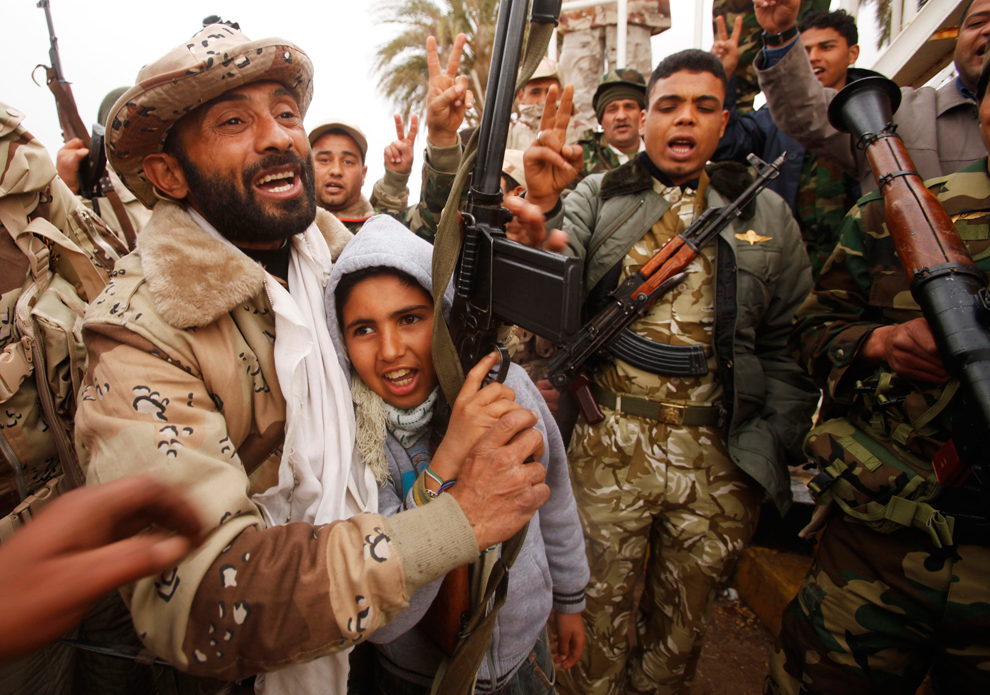
Who are the Libyan revolutionaries?

Jihan Hafiz of the Real News on the Libyan revolutionaries. (Also see Part 2)

Recently returned from Bengazi, Hafiz reports on rebel fighters, supporters and early stages of the Libyan uprising.

James Bays of Al Jazeera reports from the frontline:

Jon Lee Anderson of the New Yorker, who wrote the acclaimed biography of Che Guevara, also spent some time with the rebels. Here’s an excerpt:

During weeks of reporting in Benghazi and along the chaotic, shifting front line, I’ve spent a great deal of time with these volunteers. The hard core of the fighters has been the shabab—the young people whose protests in mid-February sparked the uprising. They range from street toughs to university students (many in computer science, engineering, or medicine), and have been joined by unemployed hipsters and middle-aged mechanics, merchants, and storekeepers. There is a contingent of workers for foreign companies: oil and maritime engineers, construction supervisors, translators. There are former soldiers, their gunstocks painted red, green, and black—the suddenly ubiquitous colors of the pre-Qaddafi Libyan flag.

Continue reading “Who are the Libyan revolutionaries?”

Bad Luck, Worse Luck, Concrete Steps

by Nafissa Assed

We all know that the western intervention in Libya is problematic, but it also remains the right decision that saved a countless number of innocent Libyans from Qaddafi’s brutal bombing and mercenaries. As the American writer Cormac MacCarthy says: “You never know what worse luck your bad luck has saved you from.”

Unfortunately, it took the UN Security Council over a month to finally authorize the necessary measures and impose a no-fly zone over Libya to protect civilians. At that time Qaddafi’s viciousness had grown, with bombings, tanks, high-caliber guns, helicopter shootings and callous mercenaries. Human rights monitors found that Qaddafi’s forces are using dozens of landmines on the outskirts of Ajdabiya.

Now air power is useful up to the point that it can dislocate Qaddafi’s logistics and stop the movement of his forces across the huge desert spaces between Libya’s cities, but it cannot take and hold ground, and that also is something that Libyans do not wish to happen. They do not want foreign ground troops.

Continue reading “Bad Luck, Worse Luck, Concrete Steps”

Battle for Benghazi: the first shots

New footage has emerged from the first moments of the uprising in Libya, showing gunmen – who appear to be Gaddafi loyalists – shooting unarmed protesters dead.

With armed men dragging people from Benghazi’s mosque, others were left to die on the streets.

Al Jazeera’s Sue Turton reports from the city.