(Neo)Orientalism with an Attitude: In the Footsteps (and Beyond) of Richard Burton

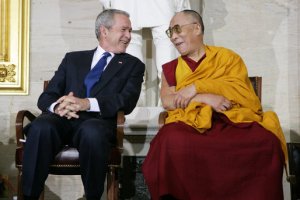
Getting one’s picture taken with the Dalai Lama or the Pope will guarantee neither Buddhist enlightenment nor beatification: my apologies for shattering the hopes of some New Agers. Similarly, entering the Ka’aba in Burtonesque disguise — specially minus his arguably relevant though shifty linguistic skills and textual knowledge — will not and cannot necessarily guarantee much “learning” about Islam.

by Huma Dar

The March 10, 2010, page A27 of the New York edition of New York Times carries an Op-Ed piece by Maureen Dowd titled, “Pilgrim Non Grata in Mecca.” Dowd writes about her desire to “learn about the religion that smashed into the American consciousness on 9/11” via “sneaking” into Mecca in “a black masquerade cloak.”  Her self-proclaimed inspiration is Richard Burton’s “illicit pilgrim[age] to the sacred black granite cube…in Arab garb” thereby “infiltrat[ing] the holiest place in Islam, the Kaaba [sic].”

Dowd, however, decides to “learn about Islam” in a way “less sneaky,” “disrespectful,” or “dangerous” and yet more entitled and privileged than Richard Burton could ever have dreamed of.   She herself describes Burton as “the 19th-century British adventurer, translator of “The Arabian Nights” and the “Kama Sutra” and self-described ‘amateur barbarian.'”  The words “illicit,” “Kama Sutra,” and “infiltration” and Dowd’s voyeuristic desires resonate with the Orientalism of yore.  Moreover Dowd’s valuable US passport and USA’s special relationship with Saudi Arabia (read: enabling of the oppressive monarchy) entitle her to meet Prince Saud al-Faisal, the Saudi foreign minister — of the “sometimes sly demeanor” — on her “odyssey” to that country.  “Infiltration” in disguise is no longer required, and yet this ease of access also disguises and makes more difficult the complexity of any real learning.

Dowd “presses” al-Faisal for the privilege to watch in Mecca, the “deeply private rituals” and “gawk at the parade of religious costumes fashioned from loose white sheets” although she knows in advance that “Saudis understandably have zero interest in outraging the rest of the Muslim world.”  While talking to this high-ranking minister, Dowd bristles at al-Faisal’s reassuring suggestion that if she desired to see any mosque in a place other than in Mecca or Medina, and was prevented from doing so, all she had to do was to contact the “emir of the region” who would comply and enable the fulfillment of her desires.  (Anyone else reminded of Aladdin’s djinn/genie?)  Without conceding the irony of the situation that she, after all, is speaking to Prince al-Faisal, the Saudi foreign minister, Dowd quips, “Sure. Just call the emir. I bet he’s listed.”   Imagine what Richard Burton would have done with the special privileges of this particular magic lamp provided by the New World Order!

Finally Dowd does indeed witness the Hajj — in an IMAX theatre watching Journey to Mecca: In the Footsteps of Ibn Battuta. Dowd, much to her surprise, makes the belated discovery that “the Kaaba [sic] was built by “Abraham, the father of the Jews” [why Jews only?]— a reminder that the faiths have a lot to learn from each other.”  It is also a reminder that journalists like Ms. Maureen Dowd have a lot of homework to do before they set out on their surely expensive travels — and I am not even including the much recommended language lessons.  Any commonly available text on Islam, for example by Karen Armstrong, Jamal Elias, Michael Sells, or Ziauddin Sardar, might have served the purpose.  Dowd could thus have avoided relying solely on the “amateur barbarian” Richard Burton or Newsweek’s own Fareed Zakaria.  The former’s scholarly credentials are hardly beyond doubt — see his problematic remarks on “Jewish human sacrifice” in The Jew, the Gipsy and el Islam (1898).  The latter’s forte is not his knowledge of Islam — or at least no more than Zakaria’s mentor, Samuel Huntington’s forte is Christianity.  Dowd might thus have disabused herself of the notion of “the sacred black granite cube.”  The “sacred black” stone is not a “cube” and neither is the “sacred cube” — the Ka’aba — all granite!

Getting one’s picture taken with the Dalai Lama or the Pope will guarantee neither Buddhist enlightenment nor beatification: my apologies for shattering the hopes of some New Agers.  Similarly, entering the Ka’aba in Burtonesque disguise — specially minus his arguably relevant though shifty linguistic skills and textual knowledge (See Parama Roy’s excellent essay for more on Burton) — will not and cannot necessarily guarantee much “learning” about Islam.  On the other hand, a trip to any local library with a willingness to read and learn, and engagement with an open mind in meaningful conversations with the (gasp!) American Muslims, might be better starting points for undertaking this particular journey.

Did the Editor of The New York Times not know the price difference between the ticket to the IMAX theatre plus membership to a local library and the cost of Dowd’s lavish travels to the Kingdom of Saudi Arabia?  The Neo-Orientalist fantasy to tread in the footsteps of Sir Richard Burton is accelerated with privilege and precisely because of this privilege skips and misses its target even more widely.

It is in the spirit of a gift that I offer Ms. Dowd this image:
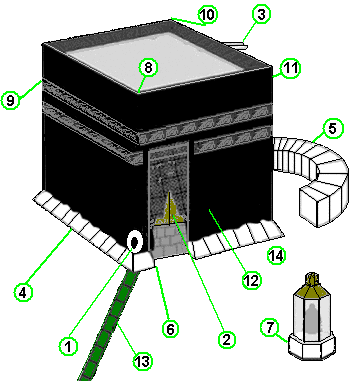
Labeled elements are as follows: 1 – The Black Stone; 2 – Door of the Kaaba; 3. Gutter to remove rainwater; 4 – Base of the Kaaba; 5 – Al-Hatim; 6 – Al-Multazam (the wall between the door of the Kaaba and black stone); 7 – The Station of Ibrahim; 8 – Angle of the Black Stone; 9 – Angle of Yemen; 10 – Angle of Syria; 11 – Angle of Iraq; 12 – Kiswa (veil covering the Kaaba); 13 – Band of marble marking the beginning and end of rounds; 14 – The Station of Gabriel.

Israeli kidnapped on Lebanese border

Ok, so relax. It’s not true. I mean, if that had really happened, we would know about it, right? It would be all over the 24hr news, analysts would be wondering what it meant for the region, and whoever was responsible for snatching the civilian would be condemned as carrying out a gross provocation. In the event that the Israeli citizen was quickly released, we would all breathe a sigh of relief.

So let’s be glad that nothing like this has happened.

Israel allegedly snatched Rabih Zahra from an area along the Lebanese border with Israel on Sunday.

According to the source, Zahra’s arrest represents a violation of UN Security Council Resolution 1701, which ended Israel’s 2006 war on Lebanon…

A joint Lebanese army and UN team inspected the area from which Zahra was taken and announced he was arrested on Lebanese territory.

Zahra claimed that Israeli soldiers had beaten him and asked him about the activities of the Lebanese Shiite Movement, Hezbollah, in southern Lebanon.

Is One Iraqi’s Self-Hatred Newsworthy?

Crusaders in Iraq?

M. Shahid Alam

An Arab-American of Lebanese descent, fluent in Arabic, Anthony Shadid was one of a handful of unembedded Western journalists reporting from Iraq during the US invasion in 2003. At the time, he was The Washington Post’s correspondent for Islamic Affairs in the Middle East.

His dispatches from Iraq were about Iraqis, about the destruction visited upon them by a war whose architects claimed that they were bringing democracy to that country. He reported the destruction and mayhem caused by this war by letting the Iraqis speak for themselves: and they spoke of their pain, their anguish, their perplexity and their anger.

For his honest reporting, for a job well done, Anthony Shadid received some of the highest accolades of his profession. In 2004 he received the Michael Kelly Award and the Pulitzer Prize for international reporting. Other honors followed, all well-deserved. He had won his spurs for reporting, not cheerleading, neither praising nor denouncing the United States. He was reporting for The Washington Post, a neoconservative newspaper.

On Jan 29, I noticed for the first time a report in The New York Times that carried Anthony Shadid’s byline. Was this a promotion? It was written from Halaichiya, a remote village in the southern tip of Iraq, untouched by the war. The village has never seen Americans before, neither troops nor diplomats.

Continue reading “Is One Iraqi’s Self-Hatred Newsworthy?”

President of Cant

By Tariq Ali

A year since the White House changed hands, how has the American empire altered? Under the Bush Administration it was widely believed, in both mainstream opinion and much of the amnesiac section of the left, that the United States had fallen under an aberrant regime, the product of a virtual coup d’état by a coterie of right-wing fanatics—alternatively, ultra-reactionary corporations—who had hijacked American democracy for policies of unprecedented aggression in the Middle East. In reaction, the election to the Presidency of a mixed-race Democrat, vowing to heal America’s wounds at home and restore its reputation abroad, was greeted with a wave of ideological euphoria not seen since the days of Kennedy. Once again, America could show its true face—purposeful but peaceful, firm but generous; humane, respectful, multi-cultural—to the world. Naturally, with the makings of a Lincoln or a Roosevelt for our time in him, the country’s new young ruler would have to make compromises, as any statesman must. But at least the shameful interlude of Republican swagger and criminality was over. Bush and Cheney had broken the continuity of a multilateral American leadership that had served the country well throughout the Cold War and after. Obama would now restore it.

Rarely has self-interested mythology—or well-meaning gullibility—been more quickly exposed. There was no fundamental break in foreign policy, as opposed to diplomatic mood music, between the Bush 1, Clinton and Bush 2 Administrations; there has been none between the Bush and Obama regimes. The strategic goals and imperatives of the us imperium remain the same, as do its principal theatres and means of operation. Since the collapse of the USSR, the Carter Doctrine—the construction of another democratic pillar of human rights—has defined the greater Middle East as the central battlefield for the imposition of American power around the world. It is enough to look at each of its sectors to see that Obama is the offspring of Bush, as Bush was of Clinton and Clinton of Bush the father, as so many appropriately biblical begettings.

Continue reading “President of Cant”

The Lost Art of Reportage

Robert Fisk and Martin Bell in conversation with Ann Leslie at The Independent Woodstock literary festival.

Event description:

Was there a golden age for international correspondents? Are current affairs now largely brought to us in dumbed down soundbites? Who now sets the framework for coverage of world events?

In this podcast recorded at The Independent Woodstock literary festival Dame Ann Leslie, recognised as one of the 40 most influential journalists of our time (‘Killing my own Snakes’), talks with The Independent’s award-winning correspondent Robert Fisk (The Age of the Warrior’) and BBC’s renowned foreign reporter Martin Bell (‘The Truth that sticks – New Labour’s Breach of Trust’). They discuss whether reportage is indeed a ‘lost art’.

How Eurocentric Is Your Day?

M. Shahid Alam

Muslim AstronomersAt the outset of the classes I teach, I always address the question of bias in the social sciences. In one course – on the history of the global economy – this is the central theme. It critiques Eurocentric biases in several leading Western accounts of the rise of the global economy.
This fall, I began my first lecture on Eurocentrism by asking my students, How Eurocentric is your day? I explained what I wanted to hear from them. Can they get through a typical day without running into ideas, institutions, values, technologies and products that originated outside the West – in China, India, the Islamicate or Africa?

The question befuddled my students. I proceeded to pepper them with questions about the things they do during a typical day, from the time they wake up.

Unbeknownst, my students discover that they wake up in ‘pajamas,’ trousers of Indian origin with an Urdu-Persian name. Out of bed, they shower with soap and shampoo, whose origins go back to the Middle East and India. Their tooth brush with bristles was invented in China in the fifteenth century. At some point after waking up, my students use toilet paper and tissue, also Chinese inventions of great antiquity.

Continue reading “How Eurocentric Is Your Day?”

The Absurdity of the Dalai Lama

Dalai Lama: "I love President George W. Bush"

He has been quoted as saying “Sleep is the best meditation.” May I suggest his holiness wake up to the fact that the two wars started by his friend George W. Bush are the clearest violations of his own espoused principles of peace and non-violence. Really, does no one else find it absurd that the Dalai Lama has on multiple occasions since 2001 stood unopposed to the brutal, barbaric and illegal wars first in Afghanistan and later Iraq? This sought-after personality loved by celebrities, the CIA, political leaders and civilians alike restated today in Calgary that “It’s hard to tell which category the current military interventions in Afghanistan and Iraq will eventually fall into.”

Continue reading “The Absurdity of the Dalai Lama”

Shoe Jihad: A Satire

The time has come, the Walrus said,
To talk of many things:
Of shoes—and ships—and sealing wax—
Of cabbages—and kings…

Lewis Carroll

M. Shahid Alam

These kleptocrats throw themselves at the feet
of Western plutocracies: they spurn

the real source of power – their own people –
seeking clientage under Western boots.

Lesser rogues gravitate to bigger ones:
this is the law of global hegemony.

This tendency emerges again and again
as long as its victims stay hidebound.

These lesser rogues – Zardari, Karzai,
Abdullah, Mubarak, Abbas –

will get their marching orders from DC,
hold down their own people for a fee,

unless the people, every one of them,
pick up their shoes, sandals, chappals

(any old footwear will do),
and point them at these scoundrels,

a shot across the bow of their kleptocracies.
If this does not work (and it might not),

ask the shoe-throwing Iraqi.
He knew better what to do with a shoe.

Phyllis Bennis on Obama’s Cairo speech

phyllisbennisThis week from CounterSpin – “Barack Obama has either been currying favor with Muslims or extending an olive branch in the Middle East depending on which media you consume. We’ll talk with Phyllis Bennis of the Institute for Policy Studies about Obama’s major speech in Cairo, and the size of the gap between words and actions.”

Phyllis Bennis on CounterSpin (9:46): MP3

Obama’s Cairo speech

In March US President Barack Obama made a direct address to the Iranian people to coincide with the festival of Nowruz, a sensitive and respectful message unheard of in the previous 30 years of non-existent diplomatic relations between the two countries. Now this week sees President Obama begin a tour of the Middle East and Europe in which he will “reach out to the Muslim world” in a speech in Cairo on Thursday. But with the political landscape changing, particularly the frosty relationship between the US President  and new Israeli Prime Minister Benyamin Netanyahu, can we expect a similarly progressive message to the wider Muslim world this time around?

In The Nation Robert Dreyfuss argues that for Obama, merely being “a repudiation of George W. Bush’s wrecking-ball approach to the Middle East” will not be enough. In order to make progress, Obama must pick apart the ““Islamofascist” ball of wax” that the ‘war on terror’ falsely suggested. To do so, says Dreyfuss, he must recognize the diverse political spectrum that currently exists across the region and approach future relations accordingly. Continue reading “Obama’s Cairo speech”