Israeli Settlers Terrorise Palestinian Villagers

Continuing his series of excellent reports from the OPT, here is Mel Frykberg’s latest article, this time exposing the daily plight of Palestinian villagers facing the brutality visited upon them by Israeli settlers.

“I couldn’t run. My pregnancy was too far advanced and there was nowhere to hide,” said Amna Salman Rabaye, 31, as she recalled the terrifying incident several months ago.

Rabaye from the Palestinian Bedouin village of At Tuwani in the southern West Bank was grazing her sheep when she was assaulted by a security guard from the adjacent illegal Israeli settlement of Ma’on.

“We saw a group of masked Israeli settlers armed with sticks and chains heading towards us. The younger shepherds ran and managed to escape, leaving me with the flock of sheep,” Rabaye told IPS.

“It was physically impossible for me to run and I also didn’t want the settlers to kill or steal my sheep. The security guard pushed me over but I was not injured,” recalled Rabaye who was then seven months pregnant.

Continue reading “Israeli Settlers Terrorise Palestinian Villagers”
The Zionist Story

The Zionist Story, an independent film by Ronen Berelovich, is the story of ethnic cleansing, colonialism and apartheid to produce a demographically Jewish State.

Ronen successfully combines archival footage with commentary from himself and others such as Ilan Pappe, Terry Boullata, Alan Hart and Jeff Halper.

An excellent film, my one criticism is that there is little mention of the Zionist lobby; an additional interview with Walt or Meirsheimer would have been of value.

I have recently finished an independent documentary, The Zionist Story, in which I aim to present not just the history of the Israeli/Palestinian conflict, but also the core reason for it: the Zionist ideology, its goals (past and present) and its firm grip not only on Israeli society, but also, increasingly, on the perception of Middle East issues in Western democracies. Continue reading “The Zionist Story”

Pro-Justice Activists Continue the Fight

Nora Barrows-Friedman, Senior Producer and co-host of the excellent Flashpoints Radio, on direct action across the international spectrum (I am one of the people mentioned in this article). This article first published in Arabic in al-Haq al-Awda.

Linking arms through metal tubes and jamming the doorways with steel bicycle locks, dozens of pro-justice activists blocked the entrance to the Israeli consulate in downtown San Francisco on January 15th — Martin Luther King Jr.’s birthday — at the height of Israel’s siege on Gaza, on a day when its military killed at least forty Palestinian men, women and children in a series of attacks that also decimated several mosques, schools and an UNRWA building. 24 hours before, in Los Angeles, protesters chained themselves to their local Israeli consulate and unfurled a banner reading “The Israeli consulate has been closed for war crimes.”

As Israel’s destruction of Gaza raged on, carried out by the Middle East’s only nuclear superpower against an entrapped, occupied and virtually defenseless population, so did countless actions across the world. Protests, marches and demonstrations were called by the usual peace and justice organizations — hundreds of thousands came to express their dissent in major international cities — but smaller, more direct actions were being taken with little to no media fanfare. And some of these quieter operations, activists say, have begun to make an impact.

Continue reading “Pro-Justice Activists Continue the Fight”

Suing for War Crimes

‘Any recourse to international law in seeking to bring Israeli officials to book must be carefully considered,’ writes Azmi Bishara.

It is not my intention to discuss the definitions of resistance, the legitimacy of resistance or the laws of war in general. Nor will I delve into the definition of war crimes, the relevant articles in international conventions, the jurisdiction of the International Criminal Court, the duties and obligations of its member states, the powers of its prosecutor and the difference between this court and those that were established for the prosecution of war crimes and crimes against humanity in specific countries, such as the International Criminal Tribunal for former Yugoslavia. All these subjects have been treated extensively in numerous other publications. My purpose here is to shed light on some possibly unfamiliar aspects of the notion of appealing to this form of international arbitration.

All such tribunals and conventions have derived their impetus from the will on the part of powerful nations to bring war criminals to account and from the ability of these powerful sovereign nations not only to draw up the law but to put it into effect when they want. Given this, it is fundamentally erroneous to liken international law to the rule of law in sovereign countries. International law does not prevail internationally, is not applied around the globe as though the world was a single sovereign country, and has no executive authority to put it into effect apart from powerful nations. It is thus subject to political aims and interests. Above all, the principle of equality before the law that applies in democratic countries does not exist in international law, either practically or theoretically.

Continue reading “Suing for War Crimes”

Robert Fisk on Flashpoints

Note: The interview begins at 3:40.

Today on Flashpoints: Internationally-renowned Middle East reporter Robert Fisk talks to Dennis Bernstein about Afghanistan, Iraq and the recent attacks in Gaza and the way in which the Western press continues to fail in covering these stories

Israel’s Death Squads

A former member of an Israeli assassination squad has broken his silence for the first time, and speaks to The Independent’s Donald Macintyre:

The Israeli military’s policy of targeted killings has been described from the inside for the first time. In an interview with The Independent on Sunday, and in his testimony to an ex-soldiers’ organisation, Breaking the Silence, a former member of an assassination squad has told of his role in a botched ambush that killed two Palestinian bystanders, as well as the two militants targeted.

Continue reading “Israel’s Death Squads”

Return to Gaza

Amira Hass has a brilliant piece in the latest issue of the London Review of Books. I consider LRB and Le Monde Diplomatique easily the world’s best publications. They are also eminently affordable; I’d encourage everyone to subscribe.

On Friday, 16 January, Mohammed Shurrab and his two sons, Kassab and Ibrahim, took advantage of the daily lull in the Israeli assault – the ‘three hours’ promised by the IDF – to travel from their plot of land in the eastern part of the Gaza Strip back to their home in Khan Younis. They were driving a red Land Rover. On the road, soldiers in a tank waved them on. Later, in the village of Al Fukhari, in a street lined with small houses and gardens, their vehicle was shot at by soldiers stationed on the roof of a local home. Kassab was killed instantly. Ibrahim lay bleeding beside his father; he died at midnight. Mohammed Shurrab had called for help on his cellphone, but the army prevented ambulances from entering the area until 23 hours after the shooting. The closest hospital was two minutes’ drive away.
Continue reading “Return to Gaza”

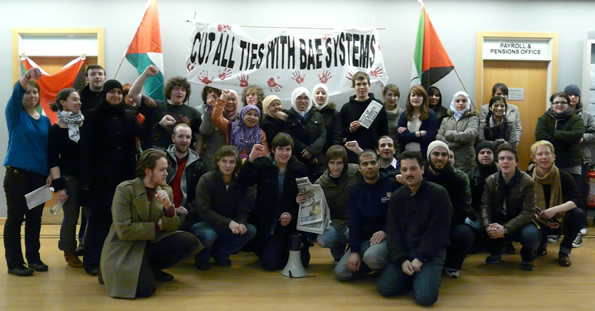
Victory for student movement: Strathclyde University to end complicity with Gaza conflict

Photo by Zuraeda Ibrahim

A vibrant and wonderful student movement has flowered a the Strathclyde University which has scored two major victories for peace and justice within this month. We at PULSE salute all the students, in particular Strathclyde Stop the War, Action Palestine, and the Strathclyde University Muslim Students Association (SUMSA) for their indispensable work. In today’s excellent guest editorial, Kim Bizzarri, who has himself lead from the front, reports on these successes and the prospects for future.

GLASGOW, February 21 – Students at Strathclyde University won the vote on Thursday to cut the university’s ties with arms manufacturer BAe Systems which supplied components used by the Israeli military in the recent massacre of Palestinian civilians in Gaza.

Students win majority support in historic AGM

The vote, which took place in relation to a motion submitted by a group of students to their Union’s General Meeting (AGM) – the student’s highest decision-making body – won with an overwhelming majority of the over 200 students who queued in the union’s corridors and stairs to participate in the event. Such a high student attendance had been unprecedented in any previous AGM, most of which failed in the past 10 years to even reach quorum.

Despite attempts by the Union’s administration to dilute the substance of the motion and have it voted upon by the conservative Student Representative Council (SRC) – who had already rejected a similar popular motion two years earlier given the uncomfortable position it placed the University vis-à-vis its corporate funders – the fervent group of passionate students were successful in galvanising sufficient support amongst their fellows to turn the motion into student policy.

Within weeks of occupying the McCance Building – heart of the University’s administration – the original 60 students involved in the occupation have already gained the support of a sizable number of their fellow students.

Continue reading “Victory for student movement: Strathclyde University to end complicity with Gaza conflict”

EU Paying for Gaza Blockade

David Cronin of IPS describes the EU’s complicity in Israel’s illegal blockade of Gaza.

European Union aid has been given to an Israeli oil company which has reduced the supply of fuel to Gaza as part of an economic blockade internationally recognised as illegal, Brussels officials have admitted.

Almost 97 million euros (124 million dollars) in funds managed by the European Commission, the executive arm of the EU, were handed over directly to the firm Dor Alon between February 2008 and January this year. Under orders from the Israeli authorities, Dor Alon has been rationing the amount of industrial diesel brought into Gaza in order to deprive its 1.5 million inhabitants of electricity. Power cuts have been a regular occurrence in Gaza because of Israeli actions undertaken since the militant party Hamas won an unexpected victory in Palestinian legislative elections during 2006.

Continue reading “EU Paying for Gaza Blockade”

Two States: A Meaningless Slogan

Israel’s targeting of civilian resistance to the separation wall, writes Ben White, proves the two-state solution is now just a meaningless slogan.

It is quite likely that you have not heard of the most important developments this week in the Israeli-Palestinian conflict. In the West Bank, while it has been “occupation as normal”, there have been some events that together should be overshadowing Gaza, Gilad Shalit and Avigdor Lieberman.

Continue reading “Two States: A Meaningless Slogan”