A Prism; Wet With Wars

by Sinan Antoon

this is the chapter of
devastation
this is our oasis
an angle where wars intersect
tyrants accumulate around our eyes
in the shackle’s verandah
there is enough space for applause
let us applaud

another evening climbs
the city’s candles
technological hoofs crush the night
a people is being slaughtered across short waves
but the radio vomits raw statements
and urges us to
applaud

with a skeleton of a burning umbrella
we receive this rain
a god sleeps on our flag
but the horizon is prophetless
maybe they will come if we
applaud
let us applaud

we will baptize our infants with smoke
plough their tongues
with flagrant war songs
or UN resolutions
teach them the bray of slogans
and leave them beside burning nipples
in an imminent wreckage
and applaud

before we weave an autumn for tyrants
we must cross this galaxy of barbed wires
and keep on repeating
HAPPY NEW WAR!

Baghdad, March 1991

Sinan Antoon is a poet, novelist and translator.

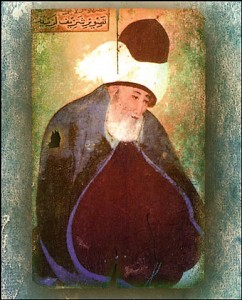
“O, God! Have mercy on me! Distracted, I whirl” — Rumi’s Gift

Not frivolously, around the alleys and bazaars, I whirl.
Lover’s temperament, I have — to have one glimpse of my Beloved, I whirl.

After Maulana Rumi (actual poet unknown)

Singing: Nusrat Fateh Ali Khan and Qawwaals

Translated by Huma Dar

Raqs al-Ruhani, al-Qahirah (Huma Dar 2005)
Naa Man Behooda Gird-e Koocha-o-Baazaar Mi Gardam (Huma Dar 2005)

نه من  بيهوده  گرد کوچه  و  بازار  می  گردم
مذاق عاشقی  دارم  پئ  ديدار  ميگردم

خدايا  رحم  کن  بر  من  پريشان وار  می  گردم
خطا کارم  گناھگارم  به  حال زار  می  گردم

شراب شوق  می نوشم  به  گرد يار  می  گردم
سخن مستانه  می گويم  ولے  هوشيار  می  گردم

گھےخندم  گھے گريم گھے افتم  گھے خيزم
مسيحا  در دلم  پيدا  و  من  بيمار  می گردم

بیا جانا  عنایت  کن  تو  مولانای رومی  را
غلام  شمس  تبریزم  قلندروار  می گردم

Continue reading ““O, God! Have mercy on me! Distracted, I whirl” — Rumi’s Gift”

Rumi On Reason

(adapted from his Fihi Ma Fihi )

M. Shahid Alam

Man seeks to know God, not because he is knowable;
not reasonably, but by reasoning he knows him.

When man accepted the trust, it was reason
he acquired, to say yes to his Creator.

Man is a moth, God a candle. When his wings
wrap around the candle’s flame,
why should they not burn –
and he perish in its fire?

A moth that shuns the candle’s flame
is not a moth. A candle that does not
draw the moth, that will not
burn it to ashes – is not a candle.

Man is not man if he denies God,
if he eviscerates his urge to know him.

A god that man can know is not
God, he is man’s alter ago.

— M. Shahid Alam is professor of economics at Northeastern University, Boston, and author of Israeli Exceptionalism (Palgrave: 2000). Visit his website – http://qreason.com – and write to him at alqalam02760@yahoo.com.

“Truth Alone Triumphs”: of David, Goliath, Stones, and Speech

“Azadi” is also the chant whose echoes swirl in the Kashmir Valley with greater resonance each day, from the minarets and playgrounds, boulevards and alleys, schools and courts, despite the crushing screeches of teargas and bullets of the Indian (in)security forces. It is “scriptured” into utterance by each breath of Kashmiri women, children, and men; calligraphed by their blood on their emerald valley; embroidered by their bones in Kashmiri Arabesque on worn cobblestones of the downtown; and papier-mâchéd in paisley tears on the blue of their beloved lakes.

by Huma Dar

“A Defiant Kashmiri woman being frisked by Indian Security Forces.” 2007. Uncredited photograph from a Kashmiri blogger


And the night’s sun there in Srinagar?  Guns shoot stars into the sky, the storm of constellations night after night, the infinite that rages on.  It was Id-uz-Zuha: a record of God’s inability, for even He must melt sometimes, to let Ishmael be executed by the hand of his father.  Srinagar was under curfew.  The identity pass may or may not have helped in the crackdown.  Son after son–never to return from the night of torture–was taken away.

… But the reports are true, and without song: mass rapes in the villages, towns left in cinders, neighborhoods torched.  “Power is hideous / like a barber’s hands.”  The rubble of downtown Srinagar stares at me from the Times.

… And that blesséd word with no meaning–who will utter it?  What is it?  Will the women pronounce it, as if scripturing the air, for the first time?  Or the last?

… What is the blesséd word?  Mandelstam gives no clue.  One day the Kashmiris will pronounce that word truly for the first time.  (Excerpt from Agha Shahid Ali’s “The Blesséd Word: A Prologue,” in The Country Without A Post Office,  1997: 16-17)

Continue reading ““Truth Alone Triumphs”: of David, Goliath, Stones, and Speech”

Peaches

by Arif Ayaz Parrey

Can I tell how much I love peaches?
Not ordinary ones
But those plucked from
The orchards along Jhelum

The ones in the basket before me
Are nebrim for sure
But they blush like a home-grown innocence
And hold as many juicy promises

I wonder what tree bore them
I wonder if it’s wise to ignore them

The tree of life
Has many buried roots

It is said that my only son
Was killed under the canopy
Of the branches of one such tree
By the army
Also known as the security forces
An old joke
What do they secure
These so-called security forces?
Not the people, not our lives, not our liberty
Not our sentiments, nor our emotions, not our sanity
Not our sons who are shot
Nor our daughters who are raped
Not the truth, not the facts, not humanity

Continue reading “Peaches”

What Kind of Wine?

by Wassim al-Adel

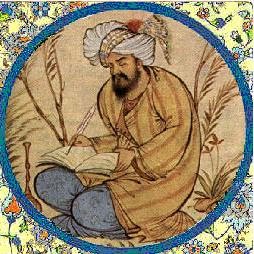
Sadeq Saba’s recent documentary “The Genius of Omar Khayyam” was awkward to watch at times but was saved by a subject matter that is interesting because of its own virtues. Saba seemed more like an inexperienced rider unable to rein in a vigorous and lively stallion but thinking that its virtues somehow rub off on him. There is no doubting his genuine interest and enthusiasm for the subject, but one is left wondering half an hour into his documentary whether his overall aim was simply to glorify Persian cultural achievements at the expense of Iran’s Muslim identity.

In one scene, where he discusses Khayyam’s poetry with a publisher, the familiar face of Iran’s former Shah peers out seditously from the wall behind him. The parts of the documentary focusing on Omar Khayyam’s mathematical and astronomical works were absolutely fascinating, but again Saba seems bewildered and the topic simply flies past his head. Another reason he may not have found this as interesting is the murky dividing line between his clean cut “Persian” civilization and the Islamic/Persian/Arab cosmopolitanism that Khayyam actually lived within.

At another point, it is quite telling to see one of the experts he interviews lament the one dimensional view of Khayyam as he is portrayed popularly, as a lover of wine and women. Yet the irony is lost on Saba when he begins and ends his documentary sitting in a wine cellar with a tasting glass beside him. Saba’s Khayyam has been appropriated into a Green Revolution style narrative, where the big bad bogeyman of orthodox religious authority is being challenged by the plucky original thinker and his defiance through hedonism; that Khayyam is telling his readers not to worry about some afterlife but to live joyously in the present – wine glass in hand and fair maiden close by. What Saba does not comprehend, and this I suspect because he selectively reads Khayyam, is that the Rubaiyat are not just about scorning an afterlife for the present – in fact even scorn is a harsh word.

Continue reading “What Kind of Wine?”

terrorist

by Cynthia Dewi Oka

another morning burns
under growl of tanks their hunger
flattens rock and bone alike

sun’s scrutiny ruptured my body
chosen. fingers
too old for their length

pull and prod and manoeuvre
me into sweat misted palm
smaller than a grown maple leaf

invisible my mission
begins in garbled pitch
wailing flaps like dying fish

i knew my turn would come
soon the days of watching
blood crust to earth would end

in the seconds waiting i plot
another life
in the dim of olive trees

Continue reading “terrorist”

A Massacre is Not a Massacre

Earlier today, I came across a short poem-essay on Electronic Intifada by Ghassan Hage, a professor of anthropology at the University of Melbourne.  He  writes, with palpable irony, about the inverted narrative of Palestine – an inversion that manifests itself in a form of  ‘truth telling’ that is tantamount to lies.

A Massacre is Not a Massacre

I don’t write poems but, in any case, poems are not poems.

Long ago, I was made to understand that Palestine was not Palestine; I was also informed that Palestinians were not Palestinians; They also explained to me that ethnic cleansing was not ethnic cleansing. And when naive old me saw freedom fighters they patiently showed me that they were not freedom fighters, and that resistance was not resistance. And when, stupidly, I noticed arrogance, oppression and humiliation they benevolently enlightened me so I can see that arrogance was not arrogance, oppression was not oppression, and humiliation was not humiliation.

I saw misery, racism, inhumanity and a concentration camp. But they told me that they were experts in misery, racism, inhumanity and concentration camps and I have to take their word for it: this was not misery, racism, inhumanity and a concentration camp. Over the years they’ve taught me so many things: invasion was not invasion, occupation was not occupation, colonialism was not colonialism and apartheid was not apartheid.

Continue reading “A Massacre is Not a Massacre”

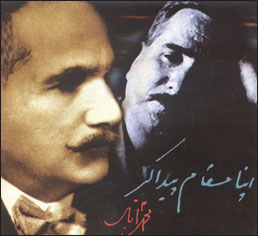
Allama Iqbal, Gabriel and Iblīs

Allama Iqbal, 1877-1938

translated by M. Shahid Alam

Note: In the Qur’anic account of man’s creation, God asks the angels to bow down to Adam; they bow down, except Iblīs. God banishes Iblīs but, granting his request, gives him the power to tempt and waylay humans except those who submit in sincerity to their Creator.

Gabriel

Old friend, how is your time spent in banishment?

Iblīs

In fire wrapped, pain-swept, surging, toiling, unbent.

Gabriel

At our heavenly summits, we often talk of you.
Should you repent, seek grace, give us the cue.

Continue reading “Allama Iqbal, Gabriel and Iblīs”

Ghazal for Iranians Who Don’t Hate Arabs

To Rom, and Parichehr

Today I met Iranians who don’t hate Arabs.
They smiled and said “hey, selam,” even knowing I was Arab.

They didn’t have green eyes, yet they seemed to bear up
pretty well without them, and they don’t fault Arabs,

not all of us, at least, for Nahavand, and the bloody flare-up
at Karbala; after all, remember, Imam Husayn was Arab.

I was a little scared at first, but soon I scraped my chair up
closer and acknowledged half our poetry and science isn’t Arab.

Half? Two thirds! Three quarters! All Persian! I went clear up
to The Arabian Nights, to Ibn Sina; who says he was Arab?

Continue reading “Ghazal for Iranians Who Don’t Hate Arabs”