Stop Starvation in Syria | End the Blockades

Call to Join the International Hunger Strike

Picture source

Syrians are slowly dying of malnutrition – but not for lack of food.  A military blockade surrounds dozens of Syrian towns.  This starvation siege prevents 1.5 million Syrians from receiving food or medicine.

Qusai Zakarya is one of them.  He is 28 years old.  Qusai declared a hunger strike on November 26, to demand food and medicine be allowed to reach civilians across military lines in Syria.  “We are all hungry here in my hometown anyway.  Let me be hungry for a purpose,” Qusai says.

We are starting the first phase of a “rolling” solidarity hunger strike onFriday, December 20, where someone will do a hunger strike every day in support of the hunger strikers in Syria through the rest of December.

Continue reading “Stop Starvation in Syria | End the Blockades”

A Trip to the Border

I’ve just returned from a brief visit to the Syrian/ Turkish border, to the Salaam School for refugee children in Reyhaniyeh on the Turkish side, where I was working with the Karam Foundation, and to Atmeh camp inside Syria, where almost 30,000 people are sheltering from the slaughter. Northern Syria is dotted with similar camps.

You can view pictures from the trip here.

Something that doesn’t come across in the pictures is how cold it is. Snow was lying on the ground in Atmeh the day before I arrived, and a child had frozen to death. I’ll be writing about my experiences and some of the stories of the people I met. In the meantime, here is the trip summed up by my Facebook status updates:

Continue reading “A Trip to the Border”

No Place Like Home

Text WARM to 70111 to donate £3 to UNICEF UK’s Syria Winter Appeal. Donate by credit card at http://www.unicef.org.uk/syria (including viewers from outside the UK).

In this short film Ewan McGregor, Michael Sheen, Tom Hiddleston, Emma Bunton, Rita Ora and Tinie Tempah join UNICEF UK in support of our Syria Winter Appeal for the children of Syria.

Thank you – your help really makes a difference to children’s lives in Syria.

Dubious Wisdom

monsterI wrote this review of Bente Scheller’s book for al-Jazeera.

Syrian poet Rasha Omran once told me that Bashaar al-Assad is “not a dictator, just a gangster boss.” But really he’s not even that. What he is, is what his father looked like in all those statues – one element in the managerial class, a (dysfunctional) functionary. Syria is a dictatorship which lacks an efficient dictator.

Hafez al-Assad – the father – was an entirely different matter. Born in a dirt-floor shack, he clawed his way to the top by brute cunning, deft flexibility, and strategic intelligence. The careful manipulation of sectarian tensions in order to divide and rule was one of his key strategies, yet he was also attentive to building alliances with rural Sunnis and the urban bourgeoisie – both constituencies now alienated by his son. Bashaar’s great innovation was supposedly economic reform. In practice this meant an unpleasant marriage of neoliberalism with crony capitalism. It succeeded in making his cousin Rami Makhlouf the richest man in the country. The poor, meanwhile, became much poorer, the social infrastructure crumbled, and unemployment continued to climb.

The thesis of former German diplomat Bente Scheller’s book “The Wisdom of the Waiting Game” is that the Syrian regime’s approach to its current existential crisis follows a “narrow path consistent with previous experience,” and she focuses on foreign policy to make this point. When the regime found itself isolated on Iraq after the 2003 invasion, for instance, or then on Lebanon in 2005 after the assassination of Rafiq Hariri and the Syrian army’s precipitous withdrawal, it waited, refusing to change its policy, until conditions changed, its opponents were humbled, and it was brought in from the cold. In his book “The Fall of the House of Assad”, David Lesch points out that Bashaar al-Assad felt personally vindicated by these perceived policy victories, and grew in arrogance as a result. Today, with the West handing the Syrian file over to Russia, and seemingly coming round to Bashaar’s argument that Islamism poses a greater threat than his genocidal dictatorship, it looks (for now at least) as if the refusal to budge is again paying off.

The most interesting parts of Scheller’s book are not actually dedicated to foreign policy, but describe – accurately and with balance – the causes of the revolution and the nature of the regime’s response. The most direct link she’s able to posit between domestic and foreign policy is that, in both, the regime’s only abiding interest has been self-preservation. In Scheller’s words, “regime survival … defines what is perceived as a security threat.” This chimes well with the shabeeha graffiti gracing Syrian walls – “Either Assad or we burn the country.” In regime priorities, Assad always stood far above the people, the economy, the infrastructure, and even the integrity of the national territory.

For both father and son, ‘Arabism’ was never anything other than a propaganda ploy. Notwithstanding its nationalist rhetoric, the regime stymied a Palestinian-leftist victory in Lebanon in 1976, before proceeding to slaughter Palestinians in the Lebanese camps. It supported Iran against Arab Iraq, and joined the US-led coalition to drive Saddam Hussain from Kuwait. All of these decisions were taken in the face of Syrian and Arab public opinion and ran counter to the regime’s own declared aims. In each case, regime-strengthening came first.

To drive home her point, Scheller provides a series of illuminating summaries of relations between Syria and its neighbours since 1990. These have been characterised by Machiavellianism and self-serving relations with non-state actors (such as on-off support for the PKK’s war against Turkey, supposedly to win Kurdish rights, while Syrian Kurds remained oppressed and in many cases stateless).

But despite Scheller’s argument of regime continuity from father to son, something which comes through very strongly is Bashaar al-Assad’s inability (unlike Hafez) to respond flexibly to emergent conditions. The Israeli withdrawal from Lebanon in 2000, shortly before Hafez’s death, undermined the legitimacy of Syria’s military presence there and called for a new policy. Bashaar was unable to deviate from his father’s old roadmap, however, despite its obvious irrelevance. As a result, Syria’s influence had shrunk dramatically in Lebanon and the region by 2005. Hizbullah, once a subservient client, grew to fill the vacuum (and now, according to reports from Qusair, Hizbullah even commands Syrian forces inside Syria).

Syrian control of Lebanon provided a safety valve for the regime. Cross-border smuggling boosted the sclerotic economy; Syrian workers found jobs in Lebanon, easing the unemployment crisis; the regime was able to wave the banner of resistance by association with Hizbullah’s struggle against Israeli occupation, while imprisoning teenage girls who dared to blog about Palestine, and without firing a shot across the occupied Golan; even Beirut’s nightclubs offered a release for the frustrated Damascus bourgeoisie.

The Lebanese case seems to prove Scheller’s contention that Syria’s foreign policy is indistinguishable from its domestic policy, that in effect there is no foreign policy, perhaps not even domestic policy, but simply, again, policies aimed at guarding the  throne.

But Scheller fails to highlight the profound discontinuity between Assad père and fils. In retrospect, the stupidest move of Hafez’s career was to hand power to his son, not the first son Basil who had been groomed for the post but then most unfortunately killed himself in a car crash, but the second son, Bashaar, who showed no interest in or aptitude for politics before his brother’s death, and who now, as Scheller herself points out, has “neither the power, nor the strategic mind, to exercise all of the options his father had at his disposal.”

Scheller’s  proclaimed focus on regime rather than personality is therefore very wise. Bashaar is too insubstantial to bear the weight of responsibility for the slaughter in Syria. His name represents the collective decision making of an elite whose relations are governed by mutual fear and distrust. The composition of this elite is obscure; analysts debate the relative influence of Bashaar’s mother, or his brother Maher, or the various heads of the security agencies. What is clear is that no individual is absolutely in charge, and that there is thus no possibility of imaginative thinking breaking a failed mould. As it did in Lebanon, the regime can only follow the dead father’s script. Hafez was able to contain a Muslim Brotherhood uprising in Hama in 1982, and by killing somewhere between ten and forty thousand people, to quickly crush it. 2011 was a very different historical moment. Protesters came from every political and religious background, were spread throughout the country, and had access to cameras and the internet. Yet Bashaar still applied the techniques of the eighties, and squandered the considerable reserves of goodwill felt for him personally (if not for the wider system) by the populace. His blundering violence provoked an armed revolution from a peaceful reform movement.

For Hafez al-Assad, the stubborn refusal to compromise was an occasional choice; for Bashaar’s inflexible circle, inertia became fate, a matter of inevitability. Because he was answerable to nobody, Hafez was capable of dramatic shifts. Scheller’s study starts in 1990 because this marks the collapse of the Soviet Union, a time when Assad Senior rapidly and effectively recalibrated his regional and international relationships.

For now, Bashaar may be winning, but not due to his own strength or popularity, and least of all to his wisdom. For his good fortune he should thank the hard work or failures of other actors: the solid support of Russia and Iran (the latter organising his military fight-back); the West’s silent complicity; the incompetence of opposition political elites; and the growth of Salafism and the consequent fears in minority communities. If and when he does finally conquer the revolution (still an unlikely prospect), it will be a pyrrhic victory for two reasons. First, the  monopoly of power and violence established by his father has been irretrievably lost. From now on the regime will be in hoc to the foreign powers and domestic sub-state militias which have rescued it. Second, with the economy, infrastructure and social cohesion of the country entirely destroyed, there will be nothing left to loot.

“The Wisdom of the Waiting Game: Foreign Policy Under the Assads” by Bente Scheller. Hurst & Co. London. 2013

As If…

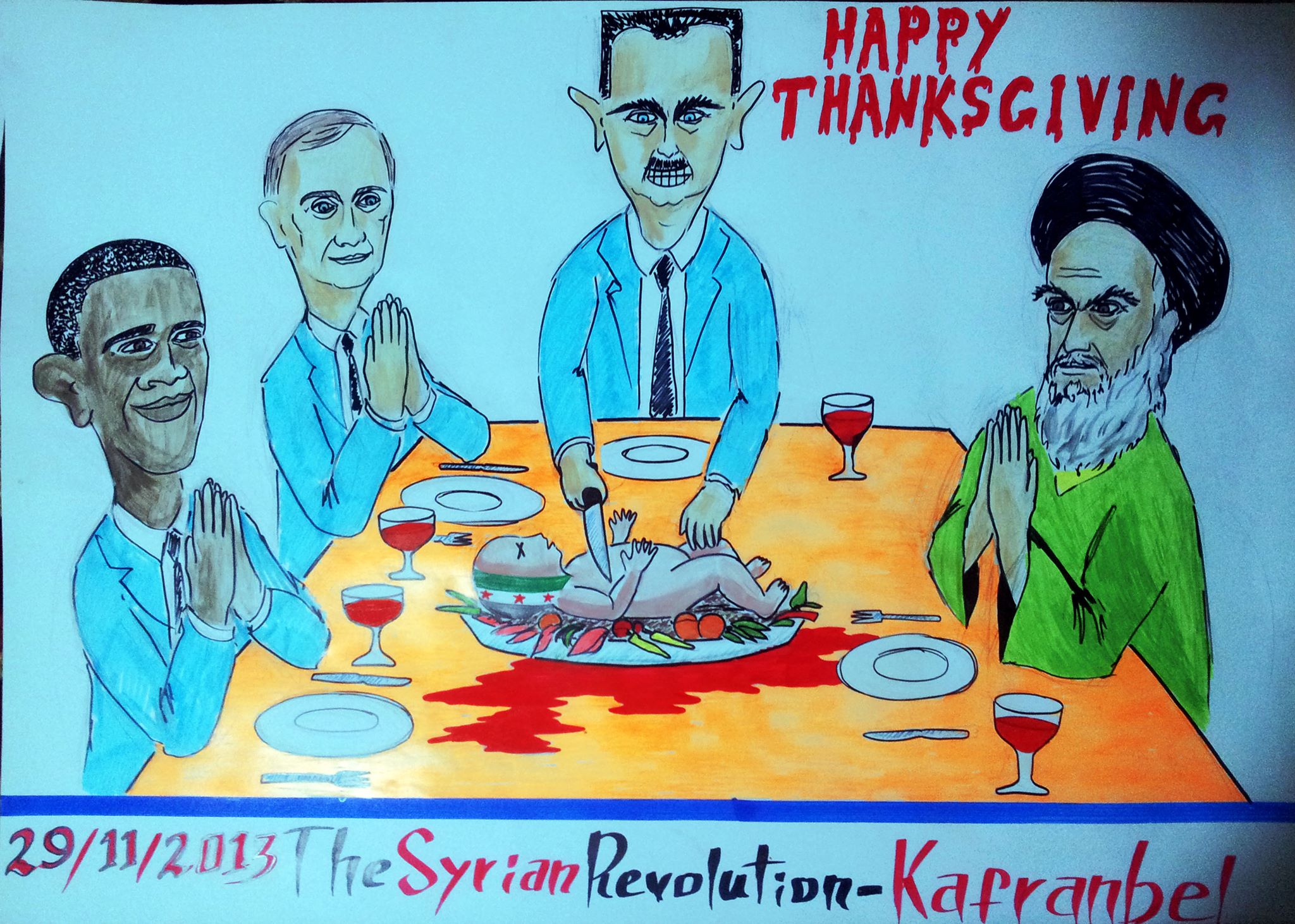
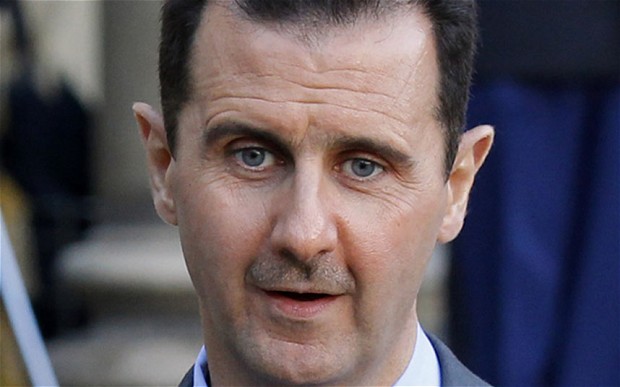
the people of Kafranbel understand the game far better than most professional analysts

In an article for the National, the wonderful Amal Hanano writes against the illusion that perpetuating the Assad regime can lead to anything other than continuing and expanding war.

In Ambiguities of Domination, political science professor Lisa Wedeen examined the Syrian regime’s rule of domination under then-president Hafez Al Assad.

She noted a dual role for Syrians: both propping up the regime’s propaganda and at the same time subverting its power via the symbols and rhetoric of everyday life and popular culture. This seminal work, published in 1999, a year before Al Assad junior took power, explained to outsiders the inner mechanisms of an authoritative regime. Its relevance is significant today under the shadow of Hafez’s son Bashar and with the fate of a blood-soaked Syria, now in ruins.

In a particularly powerful chapter entitled Acting As If, Wedeen writes: “Power manifests itself in the regime’s ability to impose its fictions upon the world.” The complicity of the people within this imposition enforces the regime’s power of domination. In other words, the regime’s power is mainly constructed by the people’s enacted participation in that very construction.

According to Wedeen: “The politics of acting ‘as if’ carries important political consequences: it enforces obedience, induces complicity, identifies and ferrets out some disobedient citizens …”

Indeed, one of the fundamental ways the Syrian people functioned in the police state was by “acting as if”. Acting as if nothing was going on as Hama was pummeled in 1982. Acting as if they loved the leader even though they were terrified of him.

The tragedy of Bashar Al Assad’s rule is that his father’s construct of complicity has, over the past 32 months, bled far beyond Syria’s borders to encompass the entire region and international community.

As world leaders discuss the merits of the Syrian opposition attending Geneva 2 peace talks without preconditions, they flip the narrative of the revolution. A narrative in which Mr Al Assad is upgraded from a brutal dictator that deserves no more than a cell at The Hague to a potential “partner” in the transitional peace process.

The latest demeaning analysis offered to Syrians is to act “as if” Mr Al Assad maintaining power would end the brutal war that was unleashed by Mr Al Assad himself. Governments act as if dragging the Syrian opposition to the negotiation table without any preconditions will result in a political solution to a raging war. World leaders act as if Mr Al Assad’s cooperation in dismantling his chemical weapon stockpiles is reducing the amount of bloodshed, even as the cluster bombs and scud missiles continue to fall onto civilian populations.

Continue reading “As If…”

Max Blumenthal on Syria and the peace movement

Danny Postel, co-editor of The Syria Dilemma, interviews Max Blumenthal, author of Goliath: Life and Loathing in Greater Israel, on his reporting from Syrian refugee camps, his resignation from the newspaper Al Akhbar over its Syria coverage, and the peace movement’s confused and problematic response to the Syrian conflict

For background, see Blumenthal’s resignation letter from al-Akhbar and his report from Syrian refugee camps in Lebanon. Also see Postel’s piece on the antiwar movement and the spirit of internationalism.

Fight the Winter

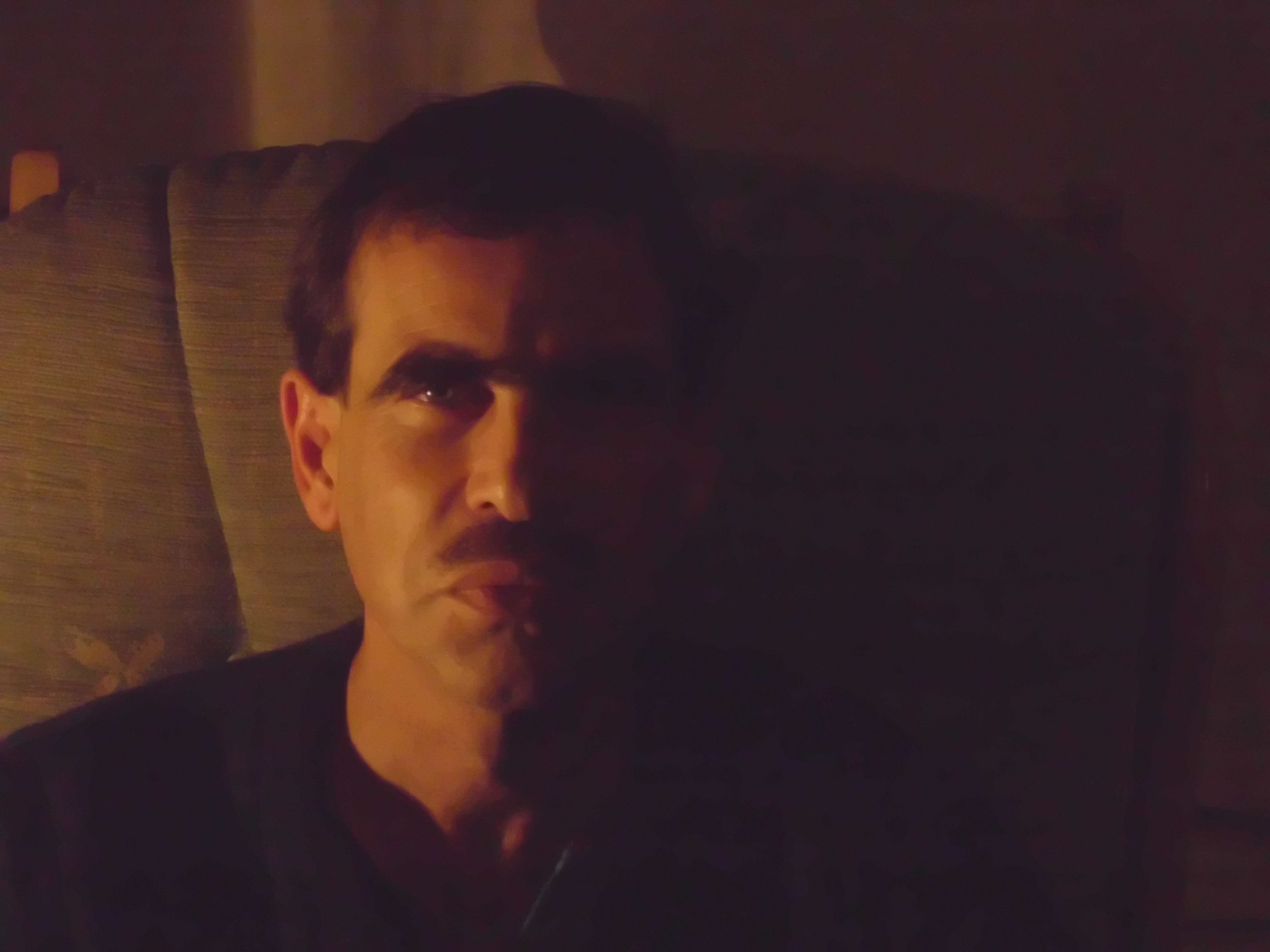
still no beard 003After provoking an armed uprising by his suppression of a non-violent protest movement (using rape, torture and murder on a mass scale), Syrian dictator Bashaar al-Assad lost control of large areas of the country. He then subjected those areas to a scorched earth policy, burning crops, killing livestock, shelling with artillery, dropping barrel bombs and cluster bombs from war planes, firing cruise missiles and sarin gas. Schools, hospitals and bakeries have been particularly targeted, alongside economic infrastructure. As a result a THIRD of Syrians, over seven million people, are now displaced. The Syrian winter is as cold as the Scottish winter, and this year millions of people will not be living in their homes but in half-demolished buildings, under trees, and in tents.

What’s the connection to the strange photograph of me? Well, I have shaved off my beard (the moustache and the central part of my monobrow will go on December 3rd). Such a traumatic assault on my facial hair, my very identity… Why? In the hope that you, dear readers, whatever your take on the conflict in Syria, will sponsor me, or in plainer terms, will donate some money. You can do so here. Every twenty dollars (or equivalent) buys blanket, coat and hat for a Syrian child. (If you remember, donate to Robin/ Wassim/ Team UK). I know the organisers of this charity and can vouch that they are absolutely honest, that every single penny will go to keeping a Syrian child warm this winter. Please do donate, and please share this page. We just have a few days to raise as much as we possibly can.

While I have your attention, please sign this petition to ask the British and French governments to boycott Rosoboronexport, imperialist Russia’s primary arms supplier to Assad’s genocide.

Razan and Leila on the Revolution

Razan Ghazzawi is one of the bravest people I’ve ever had the pleasure to meet. Her blog is here, providing perspectives from on the ground in Syria.

Follow this link to hear her talk on living as a single, unveiled woman in a liberated area of Syria (but one which still suffers Assadist bombardment).

And in her talk, Leila Shrooms of the Tahrir International Collective focuses on the economics of the revolution and the myth of Assad’s ‘socialism’.

A Tale of Two Conferences

On his fine blog, Louis Proyect describes two very different conferences and two very different versions of the left – one statist, which finds itself backing “the neoliberal family dynasty that is bombing working-class tenements” in Syria; the other internationalist, supportive of popular revolution, concerned with the class struggle. The first is the ill-named Stop the War Coalition conference to be held in London on November 30th (it was planning to invite a nun who serves as one of Assad’s chief propagandists and genocide deniers); the second was a Syria solidarity conference held a few days ago in New York.

Louis makes this important point: In the New York conference, “it is important to note that six out of the nine featured speakers were Syrian and that of the three who weren’t, one was Lebanese (Achcar), one was Palestinian (Bodour Hassan), and the other was a graduate student whose dissertation is focused on Syrian politics and who reads and writes in Arabic. What a contrast to the London event where a number of people will essentially be giving the same speech (is there any real difference between Milne, Ali, and Steele? I couldn’t tell the difference between their columns.)” So another distinction: the statist (and orientalist) left isn’t actually interested in hearing from people from the country concerned, unless they are propagandists for fascism. Here’s Louis’s piece in full:

This is a tale of two conferences, one billed as a teach-in on Syria that occurred yesterday at New York University; the other to be held in London on November 30th on Syria as well. They could not be more unalike even though Trotskyists (loosely defined) were in the driver’s seat of both events. As is the case in my write-ups of many movies that I walk out of in disgust after 15 minutes, I will rake the London event over the coals though I will not be attending it, even if someone paid for the airfare.

The London event is organized by the Stop the War Coalition (STWC) that played a key role in opposing George W. Bush’s war on Iraq. To put it as succinctly as possible, they see Syria as a new Iraq war in the making and their mission revolves around the need to oppose Obama’s war plans—something that amounts to busting down an open door. It does not matter to them that Obama never had any intention of invading Syria and imposing “regime change”; nor does it matter that there has been a revolutionary struggle in Syria. Their analysis is based on the struggle between nations and not between classes. In the case of Syria, people like John Rees and Seamus Milne back the neoliberal family dynasty that is bombing working-class tenements simply because the USA opposes it even if that opposition is only verbal. As long as there is a single op-ed piece by Nicholas Kristof taking the Baathists to task or a single speech by Obama filled with crocodile tears about the “Syrian tragedy”, they will remain on Bashar al-Assad’s team.

With almost no interest in what is taking place inside Syria, the STWC conference naturally included only a single Syrian citizen, one Mother Agnes Mariam of the Cross, a diehard supporter of the Baathist dictatorship. When a hue and cry arose over her participation, Owen Jones and Jeremy Scahill told the organizers that they were dropping out. To the great pleasure of those who were protesting her presence, she withdrew. But they are still raising hell over the initial invitation. What would compel “peace” activists like John Rees and Lindsay German to extend an invitation to someone whose reputation as a liar and a warmonger is so well known? I invite you to look at Not George Sabra’s post on Mother Agnes that I am sure helped Scahill make up his mind.

Continue reading “A Tale of Two Conferences”

The Geneva Breakthrough

This is a positive and historic development. Not only will it relieve pressure on ordinary Iranian people, it will also empower the country’s reformists. It will also put the interests of the powerful merchant against the interests of the hardliners. It will erode the power of hawks not just in Iran, but also the US and Israel.

This also creates an opening for a negotiated settlement of the conflict in Syria. Until now Iran’s hardliners have been running amuck in Syria, and the IRGC has been actively at war. Now Iran has something to lose. The US has gained leverage that until now it didn’t have. It is now in a position to pressure Iran to drop its support for Assad. Given the fragility of the entente, the last thing Iran would want is to jeopardise it by continuing a policy with an uncertain end.