This is a photo of brothers Hasan and Husam al Zouabi from Daraa, Syria.
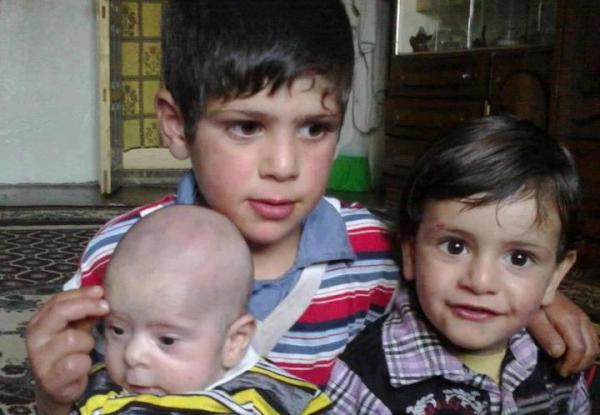
And this is a photo of Hasan and Husam after they met their government.
Continue reading “The day Hasan and Husam met their government”
This is a photo of brothers Hasan and Husam al Zouabi from Daraa, Syria.
And this is a photo of Hasan and Husam after they met their government.
Continue reading “The day Hasan and Husam met their government”

It seems like the beginning of the end for the Baath regime. Its closest ally Iran is already looking to a future beyond Assad. General Manaf Tlass, a scion of the Tlass family — the keystone for four decades of the Sunni-Allawi alliance — has also had enough of the regime brutality and defected to Paris. Wikileaks has also started releasing Syria Files, a trove of documents that include 2,434,899 email exchanges between regime officials and some cronies. So far there isn’t much that’s particularly interesting, except evidence of continuing Italian support for the regime and this PR advice that the regime received from Brown Lloyd James (BLJ) to brush up its image after its bloody crackdown.
Human Rights Watch has an in-depth report on 27 torture centers run by the Syrian intelligence. You can find an interactive map of the locations and their practices here.
Former detainees and defectors have identified the locations, agencies responsible, torture methods used, and, in many cases, the commanders in charge of 27 detention facilities run by Syrian intelligence agencies. The systematic patterns of ill-treatment and torture that Human Rights Watch documented clearly point to a state policy of torture and ill-treatment and therefore constitute a crime against humanity.
 As conspiracy theorists of the left and right muddy the waters with lies and half-truths, as they continue their exclusive focus on the peripheral with utter disregard for the actual, the voices of the Syrians themselves are drowned out. Jadaliyya deserves credit for giving space to these voices and shedding light on the human dimension of the conflict. Amal Hanano is the most compelling of these voices. Here’s from ‘One Year of Hope‘. (I’m borrowing the above title from my good friend Phil Weiss).
The enemy was not one man or even his regime. As questionable motives emerged regionally and internationally, it became very clear that there were no real friends of Syria. As we fought each other, we fought a world that insisted on telling us who we were. Suddenly, everyone was an expert on Syria. Opportunistic pundits sucked the Syrian narrative like leeches, dispensing complex conspiracies, warning of the regional and global political interests at stake while belittling the people’s struggle. Opportunism seeped into the Syrian opposition as well: they splintered into rivaling groups, each betraying the other to prove itself worthy of the Syrian street’s loyalty but in the end, their divisiveness rendered the groups unworthy and incapable of defending those blood-soaked streets. The truth of Syria was lost somewhere in the middle of an axis between east and west, right and left, Sunnis and minorities, along fault lines we had never asked to define us, but they did.
Continue reading “The truth of Syrian opposition is lost in the media’s narrative of hate”
There is never an excuse for torture. Torture on all sides must be condemned. But there is a big difference between a regime carrying out torture as policy and the individual acts of revenge-taking by a guerrilla army which has both its disciplined and undisciplined, even criminal, elements.
Gerald Tan: A new report by Human Rights Watch (HRW) said that Syrian intelligence agencies are running torture centers across the country where detainees are beaten with batons and cables, burned with acid, sexually assaulted, and their fingernails torn out.
In other news from Syria, a respected German daily is reporting that UFOs have made contact with Khalid Abu Salah and joined the Syrian opposition. At an event marking the latest transfer of T-72s and Mi-24s to Syria, Vladimir Putin denounced the UFO intervention as an irresponsible intrusion into the country’s internal affairs.
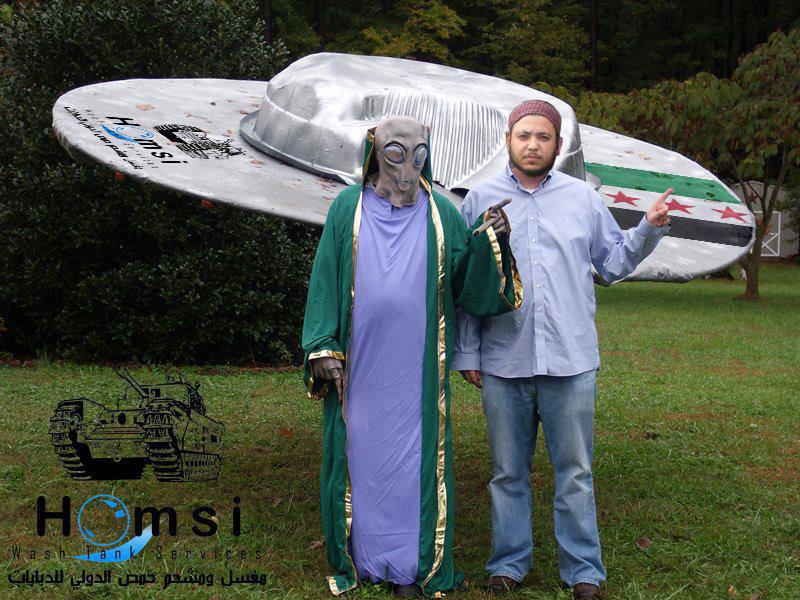
by Martin Rowson

This week I thought I’d describe my adventures with a website called Medialens over a cartoon I recently drew for The Guardian. It featured Bashar al-Assad, in the immediate aftermath of the Houla massacre, smeared in blood and pointing an equally blood-stained finger at his own chest. Also depicted were Vladimir Putin, Wen Jiabao, Ban Ki Moon, Kofi Annan, several cowled figures of Death, Angela Merkel and Christine Lagarde lashing a pile of human bones with euro-laden cats-o’-nine-tails and the sleeping form of David Cameron, snuggled up to an enormous cat dressed in a blue pin-striped suit. The thing was captioned “Who? Me?!?”, although it’s by no means clear who’s saying these words, just as it’s not clear whose blood besmirches Assad, whether it’s his latest alleged victims’, from his earlier ones or, for that matter, whether the blood might be his own.
Anyway, I was asked by Medialens via Twitter (in 140 characters or less, even if a picture is, they say, worth a thousand words) what clear evidence I had for President Assad’s personal involvement in the Houla massacre. So far as I can tell, Medialens turn out to be a couple of blokes called David whose mission is to expose the lies, misrepresentation and manipulation in the “mainstream media”. Continue reading “Life through Medialens – but not as we know it”
The great anti-Zionist Max Blumenthal explains why he has resigned from al-Akhbar, previously a Lebanese leftist newspaper, now a propaganda rag for the sectarian gangster regime in Syria. He examines the disgusting rubbish al-Akhbar has recently published by Amal Saad-Ghorayeb, Shermine Narwani and Ibrahim Amin. The whitewashing, misrepresentation, plain hallucination and outright Islamophobia resorted to by these writers would be comical if the Syrian people were not being slaughtered and if so many idiot ‘leftists’ in the West were not being influenced by them. — R.Y-K.
—
A farewell to Al Akhbar and Assad’s apologists
by Max Blumenthal
“Syrian weapons are being used – most unfortunately – against our camp, while the rulers of Damascus continue to repeat that they are here in Lebanon in order to defend our camp. This is a murderous lie, a lie which pains us more than anyone else… But we wish to inform you that we will fight in defense of this camp with our bare hands if all our ammunition is spent and all our weapons are gone, and that we will tighten our belts so that hunger will not kill us. For we have taken a decision not to surrender and we shall not surrender…”
–open letter from the residents of Tal al Zataar refugee camp to the world, July 13, 1976
I recently learned of a major exodus of key staffers at Al Akhbar caused at least in part by disagreements with the newspaper leadership’s pro-Assad tendency. The revelation helps explain why Al Akhbar English now prominently features the malevolent propaganda of Amal Saad Ghorayeb and the dillentantish quasi-analysis of Sharmine Narwani alongside editor-in-chief Ibrahim al-Amin’s friendly advice for Bashar Assad, whom he attempts to depict as an earnest reformer overwhelmed by events.
When I joined the fledgling Al Akhbar English website last fall, I was excited to contribute my writing on the Israel-Palestine situation and US foreign policy to a paper that I considered one of the most courageous publications in the Arab world. At the time, the Syrian uprising had just begun, and apparently, so had the debates inside Al Akhbar, which reflected the discussions within the wider Lebanese Left. Almost a year later, the results of the debate have become clear on the pages of the paper, where despite the presence of a few dissident voices, the apologia for Assad and his crimes has reached unbearable levels.
I considered responding on my blog to some of the more outlandish ravings published at Al Akhbar, but eventually decided my energy would be better spent on covering the topics I knew best — and which I could discuss with the authority of journalistic experience. Meanwhile, my frustration and embarrassment mounted as one Ghorayeb screed after another appeared on the site, each one more risible than the next.
Following her vehement defense of the Syrian dictator’s use of surgery metaphors to refer to his security forces’ brutal crackdowns, Al Akhbar English featured Ghorayeb’s daftest work to date: an attack on Arab Third Wayers (supporters of the anti-imperialist, anti-authoritarian political tendency) in which she asserted that “the real litmus of Arab intellectuals’ and activists’ commitment to the Palestinian cause is no longer their support for Palestinian rights, but rather, their support for the Assad leadership’s struggle against the imperialist-Zionist-Arab moderate axis’ onslaught against it.”
Continue reading “Blumenthal vs al-Akhbar’s Pro-Asad Propaganda”
Amnesty International’s Donatella Rovera bears witness after her recent visit to Syria.

It has thrown students out of top-floor windows. It has shelled cities from the land and from the air. It has raped women and men and tortured children to death. Now with the massacres at Howleh and Qubair – in which Alawis from nearby villages, accompanied by the army, shelled, shot and stabbed entire families to death – the Syrian regime has escalated its strategy of sectarian provocation. Here Tony Badran explains very well the sick rationale behind these acts.
To a certain extent the regime’s plan has already worked. Now it seems inevitable that sectarian revenge attacks will intensify. In general, sectarian identification is being fortified in the atmosphere of violence created by the regime and added to by the necessary armed response to the regime. Sectarian hatred will deepen so long as the regime survives to play this card.
The regime wants us to understand the conflict in purely sectarian terms. Many Syrians recognise this and are resisting it. At this impossibly difficult time it’s good to remember the Alawi revolutionaries, who are heroes, and crucial to the revolution, heroic in the way Jewish anti-Zionists are heroic.
What do I mean by heroic? A disproportionate number of Alawis owe their livelihood to the regime. To fight for a post-regime future means to fight for a future in which their community will be, at best, less favoured than at present. This takes moral and political courage. Many Alawis have grown up surrounded not, as most Syrians have, by anti-regime mutterings, but by the happy version. To break with this version requires a psychological transformation, something as big as growing up. More concretely, there are family pressures – and family is so important in Syria. Very many Alawis are employed in the security forces. If your uncle is an officer in the mukhabarat, therefore, you don’t find it easy to publicly oppose the regime. It takes courage to do so, and the kind of confidence in your own judgment which will allow you to discount the arguments of your elders and authorities. Only a few people have such strength. (Of course it takes much more strength to live in a Sunni neighbourhood being beseiged and bombed, but this is a different kind of strength.)
 P U L S E