Excerpted from 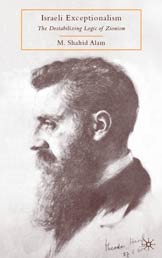 Israeli Exceptionalism (Palgrave: 2009).
by M. Shahid Alam
“My God! Is this the end? Is this the goal for which our fathers
have striven and for whose sake all generations have suffered?
Is this the dream of a return to Zion which our people have
dreamt for centuries: that we now come to Zion to stain its soil
with innocent blood?”
Ahad Ha’am, 1921
This study has employed a dialectical framework for analyzing the destabilizing logic of Zionism. We have examined this logic as it has unfolded through time, driven by the vision of an exclusionary colonialism, drawing into its circuit – aligned with it and against it – nations, peoples, forces, and civilizations whose actions and interactions impinge on the trajectory of Zionism, and, in turn, who are changed by this trajectory.
It would be a bit simplistic to examine the field of interactions among the different actors in this historic drama on the essentialist assumption that these actors and their interests are unchanging. Instead, we need to explore the complex ways in which the Zionists have worked – and, often have succeeded – to alter the behavior of the other political actors in this drama: and, how, in turn, the Zionists respond to these changes. Most importantly, we need to explore all the ways in which the Zionists have succeeded in mobilizing the resources of the United States and other Western powers to serve their specific objectives.
 Today in the House of Commons Britain’s leading neoconservative organisation the
 A couple of years back a leading Scots philosopher, a friend, applied for funding to the Economic and Social Research Council (ESRC), the main public research-funding body in the UK, to study the tradition of non-violence in Islam. After much delay, he received a letter from the ESRC in which an anonymous reviewer informed him that his bid had been rejected because ‘there is no tradition of non-violence in Islam’.
 The Annual Report of the Intelligence and Security Committee (ISC), laid before Parliament last Thursday, confirms that a Government propaganda unit set up to tackle terrorism intervened to influence British public opinion during the Israeli attack on Gaza last year. The report also outlines a number of other steps taken by the Research, Information and Communications Unit (RICU), including the creation of a network of community organisations. RICU is linked to the UK Government’s Prevent programme for preventing “violent extremism.”
 P U L S E