Making Sense of Syria: Robin Yassin-Kassab and Samer Abboud in Dialogue

Robin-Sammer
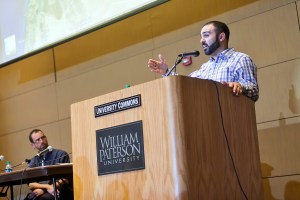
Robin Yassin-Kassab (seated) and Samer Abboud (at podium)

On March 29, the Gandhian Forum for Peace & Justice at William Paterson University in Wayne, New Jersey hosted this event with Robin Yassin-Kassab (co-editor of PULSE and co-author, with Leila Al-Shami, of Burning Country: Syrians in Revolution and War) and Samer Abboud (Associate Professor of Historical and Political Studies at Arcadia University and author of Syria). Watch the video here.

This was the kick-off event in the North American book tour for Burning Country.


Reporting—and Mis-reporting—ISIS

by Gilbert Achcar

86989490_fbe2566b-32d5-4104-87dc-f5314294778b
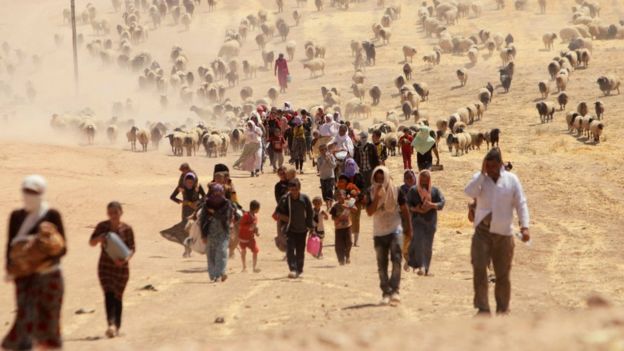
Displaced Iraqis from the Yazidi religious minority flee Islamic State fighters by walking towards the Syrian

Most people prefer to keep referring to the self-proclaimed Islamic State by the acronym of its previous name: ISIS, the Islamic State in Iraq and Syria (or, more accurately ‘al-Sham’—Greater Syria—approximately translated by some as ‘the Levant’, with the acronym hence turned into ISIL). On this thus-named ISIS, close to forty books and counting have been hitherto published in English, of which the three reviewed here are the best-selling in the UK.

Of these, Patrick Cockburn’s was one of the very first books written on ISIS. It came out in 2014 under the title The Jihadis Return. The one reviewed here is an updated edition with a new title. It recapitulates the views that the author developed in his coverage of events in Iraq and Syria for The Independent. It is written in a most readable journalistic style by an author who is well acquainted with this part of the world, having covered it for many years (especially Iraq). However, the book contains hardly any references to substantiate its numerous assertions other than Cockburn’s personal testimony, often quite anecdotal.

Continue reading “Reporting—and Mis-reporting—ISIS”

Who are the Syrian rebels: The Genesis of the armed struggle in Syria

KhiyanaPlenty has been written about the armed struggle in Syria, but on left-wing and alternative media sources much of it has been laden with conspiracy theories, or is merely recycled Assad regime propaganda. In this article, soon to be published as part of a collection about the Syrian Revolution, Mark Boothroyd explores the roots of the armed struggle, and what drove the rebellion to the situation it finds itself in today.

Khiyana: The Unmaking of the Syrian Revolution seeks to uproot the false information, reactionary “anti-imperialist” dogma, slurs and slanders which have characterised much of the analysis of the revolt in Syria. It will contain articles by Idrees Ahmed, Budour Hassan, Sam Charles Hamad, Leila Al-Shami, Javaad Alipoor, Louis Proyect, and Michael Karadjis.

Who are the Syrian Rebels: The Genesis of the Armed Struggle in Syria

With the ongoing offensive in Syria by the Assad regime and its Russian and Iranian backers, there has been a renewed interest in Syria’s armed opposition. Despite the figure of 70,000 “moderate” armed rebels being mentioned in the media and in parliament, much of the coverage still talks about Al-Qaeda and ISIS, despite these being relatively minor forces in the armed conflict between the rebels and the regime.

Many commentators like Independent columnist Robert Fisk1, leading Stop The War Coalition (StWC) officer John Rees, and Unite General Secretary Len McCluskey, have mocked or denied the existence of moderate opposition forces. Criticisms that the rebels are not moderates2, that they are a “rump”3 with no support, or that they are Al-Qaeda or Turkish fascists4 have all emerged. Parts of the left and anti-war movement are complicit in creating a narrative that the opposition are entirely Al-Qaeda or ISIS, obscuring the reality that the overwhelming majority of Syrian rebels remain nationalist, of a democratic, secular or Islamic orientation.

Continue reading “Who are the Syrian rebels: The Genesis of the armed struggle in Syria”
Syria: Under Russia’s fist

Since September 30, 2015 Russia has been carrying out air strikes in Syria in support of its ally President Bashar al-Assad. The campaign has been relentless and growing in intensity, with Russian jets flying 444 combat sorties against more than 1,500 targets between February 10 and 16 alone.

Moscow insists these attacks have only been aimed at fighters from ISIL and other “terrorist groups” such as al-Nusra Front. But monitoring groups, including the Violations Documentation Center and the Syrian Observatory for Human Rights, say thousands of non-combatants have also been killed or wounded. Amnesty International and others have said the bombings may be war crimes. Indeed, Amnesty has also cited consistent reports of second bombardments from planes returning to kill and injure rescue workers, paramedics and civilians attempting to evacuate the wounded and the dead from earlier raids.

So are civilians being deliberately targeted – and could Russia be guilty as charged? In this exclusive report for People & Power, Danish born filmmaker and journalist Nagieb Khaja went to investigate. His remarkable film, shot in Aleppo, Idlib and other rebel-held areas of Syria at the end of last year, is a harrowing, tense and at times breathtaking portrayal of life underneath the Kremlin’s bombs.

North American Book Tour for Burning Country: Syrians in Revolution and War

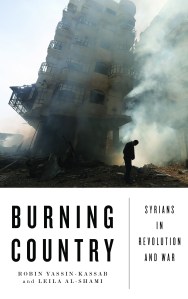
Burning-Country-COVER

Burning Country: Syrians in Revolution and War, co-authored by PULSE co-editor Robin Yassin-Kassab and​ Leila Al-Shami, is “poised to become the definitive book not only on the continuing Syrian conflict but on the country and its society as a whole,” in the words of journalist Hassan Hassan.

Robin and Leila have done several book events in the UK. In March and April they’ll travel across North America to discuss the book. They’ll be in New York; Washington, DC; Los Angeles; Chicago; Boston and Cambridge, Massachusetts; San Francisco and Berkeley, California; Montreal; Toronto; Seattle; Denver and Boulder, Colorado; Madison, Wisconsin; Wayne, New Jersey; and Colchester, Vermont.

The full North American itinerary is here. Get to one of these events and spread the word!


Burning Country could have been titled A People’s History of the Syrian Revolution and War: it provides a view from below that constitutes the perfect antidote to geopolitical reductionism. This book is unique in its combination of first-hand material derived from fieldwork, factual and analytical rigour, and unshakable faith in the Syrian people’s struggle for justice and dignity. —Thomas Pierret, University of Edinburgh

​For decades Syrians have been forbidden from telling their own stories and the story of their country, but here Robin Yassin-Kassab and Leila al-Shami tell the Syrian story. Their words represent the devastated country which has denied them and their compatriots political representation. Burning Country is an indispensable book for those who wish to know the truth about Syria. —Yassin al-Haj Saleh, Syrian writer

Strangers in their own Land

An important documentary on the disgraceful treatment of minorities in Pakistan. The way the country has shirked its duties toward its most vulnerable citizens—Christians, Hindus, Shias, Ahmadis—bespeaks a failure of moral and political leadership. This needs to change. Pakistan’s Sunni majority has a duty to protect these communities from the terror of the extremists among them.

International Legacies of the Genocide in Rwanda

James Traub, journalist and author, gives a presentation addressing how the United States’ reaction to the crisis in Syria does and does not reflect lessons learned from the genocide in Rwanda, during the Symposium on the 20th anniversary of the Genocide against the Tutsi that took place on March 31, 2014.

Syria: ‘Burning Country’ book launch at Amnesty International UK

Robin Yassin-Kassab in conversation with Kristyan Benedict (@KreaseChan) of Amnesty International UK.

Break the Sieges

“We are too weak to walk or to cover the story. I was at the makeshift hospital and there were 200 who fainted today. Yesterday alone seven people were poisoned from eating raw cat meat that wasn’t cooked properly. The situation is really bad. We have infants who died because they didn’t have any milk. Today a family ate thorns.” — a media activist in Madaya.

Continue reading “Break the Sieges”

The Syrian Revolution and the Project of Autonomy

What follows is a series of variations on Yassin al-Haj Saleh’s observation that “Syria is a metaphor for a global crisis of representation.” It describes aspects of the present situation of the Syrian revolution, a process of tremendous strength and courage that has been rendered almost illegible in the West. It also looks from the present to possible futures, which are necessarily speculative, in order to pose three questions for discussion.

By Stephen Hastings-King

Note: This is a revised version of a presentation I made at Hamisch, the Syrian Cultural House in Istanbul, on October 16, 2015. I would like to thank the comrades of Hamisch for their hospitality and for the chance to make something new. Then as now, my hope is to contribute to a widening of conversations about the Syrian revolution and the ways in which the struggles of the Syrian people are interconnected with global struggles for basic human dignity.

=-=-=-=-=

Where I am from there is no political future. There is only repetition of the same. The present is a ubiquitous horizon. Only the details will vary.

Where I am from the future has been privatized. People worry about their children.

We need to make new significations, ways of thinking beyond the horizon of the present.

=-=-=-=-=

What follows is a series of variations on Yassin al-Haj Saleh’s observation that “Syria is a metaphor for a global crisis of representation.” It describes aspects of the present situation of the Syrian revolution, a process of tremendous strength and courage that has been rendered almost illegible in the West. It also looks from the present to possible futures, which are necessarily speculative, in order to pose three questions for discussion. Continue reading “The Syrian Revolution and the Project of Autonomy”