Barack Obama, the US president, has urged countries in the United Nations to get behind Middle East peace efforts in an address at the UN General Assembly. But Ali Hasan Abunimah, a Palestinian-American journalist and co-founder of Electronic Intifada, an independent web site about the Israeli-Palestinian Conflict, said Obama’s speech did not represent anything new. “That bodes very ill for the peace process that he’s so invested in,” Abunimah told Al Jazeera’s Shihab Rattansi, speaking from the US state of Indiana.
“Let’s judge him not by what he says, but what he does.”
Defining what a terrorist is and isn’t is a major dilemma. What one may consider terrorism, another may consider resistance. So where does one draw the line? Reese Erlich tackles that topic in his latest book “Conversations with Terrorists: Middle East Leaders on Politics, Violence, and Empire.” Erlich is a veteran journalist who has covered U.S. foreign policy for decades. He has freelanced for National Public Radio, Radio Deutsche Welle, the Australian Broadcasting Corp. Radio, the Canadian Broadcasting Corp. Radio, and writes for The San Francisco Chronicle and The Dallas Morning News.
Drawing on firsthand interviews and original research, Erlich argues that yesterday’s terrorist is often today’s national leader and that today’s freedom fighter may become tomorrow’s terrorist. By branding all of American’s opponents as “terrorists,” it makes it more difficult to look beyond the individual or the political group and understand what they are really all about. I caught up with Erlich recently and here’s what he had to say.
There is no question that the United States has a relationship with Israel that has no parallel in modern history. Washington gives Israel consistent, almost unconditional diplomatic backing and more foreign aid than any other country. In other words, Israel gets this aid even when it does things that the United States opposes, like building settlements. Furthermore, Israel is rarely criticized by American officials and certainly not by anyone who aspires to high office. Recall what happened last year to Charles Freeman, who was forced to withdraw as head of the National Intelligence Council because he had criticized certain Israeli policies and questioned the merits of the special relationship.
Steve Walt and I argue that there is no good strategic or moral rationale for this special relationship, and that it is largely due to the enormous influence of the Israel lobby. Critics of our claim maintain that the extremely tight bond between the two countries is the result of the fact that most Americans feel a special attachment to Israel. The American people, so the argument goes, are so deeply committed to supporting Israel generously and unreservedly that politicians of all persuasions have no choice but to support the special relationship.
“My God! Is this the end? Is this the goal for which our fathers
have striven and for whose sake all generations have suffered?
Is this the dream of a return to Zion which our people have
dreamt for centuries: that we now come to Zion to stain its soil
with innocent blood?”
Ahad Ha’am, 1921
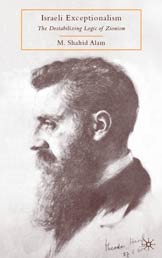
This study has employed a dialectical framework for analyzing the destabilizing logic of Zionism. We have examined this logic as it has unfolded through time, driven by the vision of an exclusionary colonialism, drawing into its circuit – aligned with it and against it – nations, peoples, forces, and civilizations whose actions and interactions impinge on the trajectory of Zionism, and, in turn, who are changed by this trajectory.
It would be a bit simplistic to examine the field of interactions among the different actors in this historic drama on the essentialist assumption that these actors and their interests are unchanging. Instead, we need to explore the complex ways in which the Zionists have worked – and, often have succeeded – to alter the behavior of the other political actors in this drama: and, how, in turn, the Zionists respond to these changes. Most importantly, we need to explore all the ways in which the Zionists have succeeded in mobilizing the resources of the United States and other Western powers to serve their specific objectives.
Tariq Ali will be in Washington, DC on the 16th and New York on the 17th for the launch of his new book The Obama Syndrome: Surrender at Home, War Abroad. If you are in the vicinity, we strongly encourage you to attend.
A few days ago, the West’s favorite Pakistani journalist, Ahmed Rashid, wrote a ‘guest column’ on the BBC website in which he suggested that the Afghan governance model be transferred to Pakistan:
Pakistan’s Reconstruction Trust Fund could be run by a board that included the World Bank, other international lending agencies and independent and prominent Pakistani economists and social welfare figures with no ties to the government.
Pakistanis would still take all the major decisions, but those who did so would not be the cronies of the president, the PM or the opposition leaders.Pakistan’s finance bureaucracy and army would have seats at the table, but certainly no veto powers over how the money is spent.
Their job would be impartial implementation of recovery overseen by the Trust Fund. Such a fund would not just monitor the cash, but help the government put together a non-political, neutral reconstruction effort. It would also help plan long-term economic reforms….
The notion that that the World Bank, IMF and friends are ‘non-political’ and ‘neutral’ is risible and not worth wasting time on, especially given that their supervision of Afghanistan’s largest bank (largely owned and controlled by the Karzai family and just as corrupt as Zardari and his cronies) doesn’t seem to have been all that effective since it collapsed just as the BBC website published the path-breaking text.
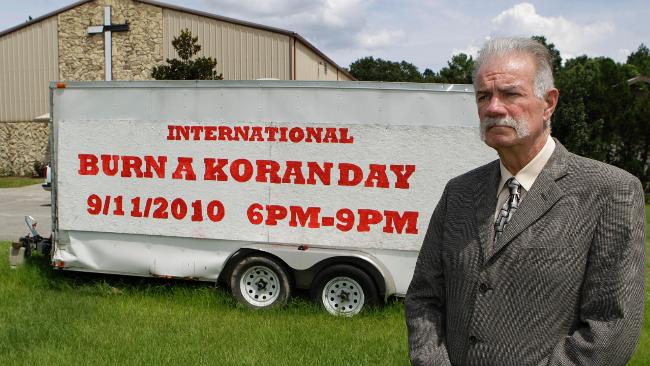
Pastor Terry Jones plans to hold a Koran burning to mark the September 11 terror attacks, despite warnings it would incite more violence (Photo: AP)
by M. Junaid Levesque-Alam
At this point, it’s not even clear whether Jones will go ahead with his pyrotechnics, but the lesson still stands.
Animosity toward Islam has reached such extremes in America that officialdom only rallies against anti-Muslim invective if it interferes with its warring on Muslim countries.
Perhaps it’s just the skeptic and former journalist in me, but that’s my impression as I review the recent blow-up about the planned September 11th Qur’an bonfire.
Terry Jones, the pastor of the tiny Florida church that may conduct the book-burning, has garnered endless—and doubtless desired—attention from media outlets as military commanders and administration officials fret over the fallout of his obscene reimagination of Farenheit 451.
General Petreaus, who is rightly concerned for the welfare of the women and men under his command, warned that Jones’s actions “would undoubtedly be used by extremists in Afghanistan—and around the world—to inflame public opinion and incite violence.”
Petreaus’s pronouncements were followed by an equally onerous message from White House spokesman Robert Gibbs, who averred that any behavior “that puts our troops in harm’s way would be a concern to this administration.”
A visit to the occupied territories of Palestine can change one’s perspectives forever. Such was the case of Anna Baltzer. Baltzer is a Jewish-American granddaughter of Holocaust survivors. In 2002, she was awarded a Fulbright scholarship to teach English in Ankara, Turkey and soon after volunteered with the International Women’s Peace Service in the West Bank. There she was exposed to the Israeli occupation of Palestine. She documented human rights abuses for the IWPS, returned to Palestine/Israel over the years, and published her experiences in a book called “A Witness in Palestine: A Jewish American Woman in the Occupied Territories.”
Baltzer is a leading human rights activist on the Mideast and travels across the country to raise awareness about the Israeli-Palestine conflict. Her appearance on “The Daily Show” with Palestinian human rights activist Mustafa Barghouti was instrumental in raising awareness about life under the Israeli occupation of the West Bank and Gaza. I caught up with Baltzer and we discussed several topics including her “The Daily Show” appearance; occupation myths; Israeli apartheid and the boycott, divestment, and sanctions campaign; and the Mideast peace talks in Washington, DC.
John Mearsheimer, Robert Malley, and Nabil Shaath on Al Jazeera’s Empire looking at the Israeli-Palestinian talks and the unattainability of the promised land. Continue reading “The Peace Procession”
Nixon already tried this in Vietnam. ‘Asian boys to fight Asian boys.’ It failed. In Iraq the Sahwa militias succeeded only as a result of particular circumstances. In Afghanistan, where blood feuds last generations, it can only sow the seeds of permanent civil war.
People & Power examines dangerous conflicts between the US and NATO strategies in the fight against the Taliban.
 Erlich is a veteran journalist who has covered U.S. foreign policy for decades. He has freelanced for National Public Radio, Radio Deutsche Welle, the Australian Broadcasting Corp. Radio, the Canadian Broadcasting Corp. Radio, and writes for The San Francisco Chronicle and The Dallas Morning News.


 P U L S E
