Hope? – Obama, Abbas, Abunimah and Morrisons

Bell on Obama
Steve Bell

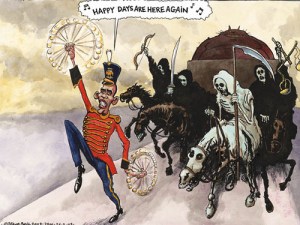
The hope invested by many in Barack Obama has dissolved. Dare I sing ‘I told you so’? I do. The audacious hope of Obamamania was always faith-based, founded on the believer’s premise that the handsome candidate didn’t mean what he actually said, that we should read his words esoterically, as code for profound radicalism. Now reality bites, and we discover that his promises to AIPAC and the military were solid and literal.

It’s certainly something that a black man has become president of a country built by African slaves, although we must place this in the context of the fierce racist backlash since his election (would those guardians of the constitution raving about the tree of liberty being watered by the blood of tyrants be quite so eager to wear their guns on their sleeves if the president were white and not a jumped-up negro? I doubt it). But that’s the achievement of Obama’s skin colour, not his policy; in fact it’s the achievement of the people who voted for him. Another achievement is that – in the company of war criminals such as Shimon Peres, Yitzhak Rabin and Henry Kissinger – Obama has already won the Nobel peace prize. Hooray!

Continue reading “Hope? – Obama, Abbas, Abunimah and Morrisons”

Don’t repeat Vietnam in Afghanistan

A superb presentation by the great Daniel Ellsberg who suggests that the counter-insurgency plan in Afganistan is similar to Vietnam.

Part One (of Two)

Continue reading “Don’t repeat Vietnam in Afghanistan”

Warlord as Nobel Laureate

from Mother Jones magazine

by William Blum

“It is forbidden to kill; therefore all murderers are punished unless they kill in large numbers and to the sound of trumpets.” — Voltaire

Question: How many countries do you have to be at war with to be disqualified from receiving the Nobel Peace Prize?

Answer: Five. Barack Obama has waged war against only Pakistan, Afghanistan, Iraq and Somalia. He’s holding off on Iran until he actually gets the prize.

Somalian civil society and court system are so devastated from decades of war that one wouldn’t expect its citizens to have the means to raise serious legal challenges to Washington’s apparent belief that it can drop bombs on that sad land whenever it appears to serve the empire’s needs. But a group of Pakistanis, calling themselves “Lawyers Front for Defense of the Constitution”, and remembering just enough of their country’s more civilized past, has filed suit before the nation’s High Court to make the federal government stop American drone attacks on countless innocent civilians. The group declared that a Pakistan Army spokesman claimed to have the capability to shoot down the drones, but the government had made a policy decision not to. (1)

Continue reading “Warlord as Nobel Laureate”

Pakistan creates its own enemy

Funeral for the eight civilians killed in the Pakistani military's failed attempt to assassinate militant leader Mangal Bagh Afridi (EPA)

The is a version of my Le Monde Diplomatique article updated for the Arabic, French, German, Italian, Norwegian, and Portuguese editions. It is also on Counterpunch, December 4-6, 2009 (It also appears in the February 2010 issue of the Japanese monthly Sekai)

On the day I arrived in Peshawar mid-September, the evening stillness was broken by nine loud explosions, each preceded by the sucking sound of a projectile as it arced into Hayatabad, the suburban sprawl west of the city. Their target was a Frontier Constabulary post guarding the fence that separates the city from the tribal region of Khyber.

When I lived here seven years ago, Hayatabad hosted many Afghan refugees; those with fewer resources lived in the slums of Kacha Garhi, along the Jamrud Road to the Khyber Pass. Many established businesses here and dominated commerce and transportation in parts of the city. Some would temporarily migrate to Afghanistan in summer where it was cooler. But Peshawar was a sanctuary, as Afghanistan was perpetually at war. Now the remaining Afghans are leaving because Afghanistan feels safer. There are checkpoints all over the city, many kidnappings, and during my visit, there were at least three suicide bombings and four rocket attacks, many of them targeting Hayatabad.

Continue reading “Pakistan creates its own enemy”

Robert Greenwald on Afghanistan

AfghanRobert Greenwald of Brave New Films speaks about Afghanistan on Bob McChesney’s excellent Media Matters.

Robert Greenwald and McChesney discuss Afghanistan

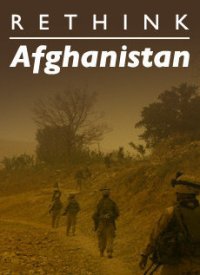
Robert Greenwald is a producer, director and political activist. Greenwald is the founder and president of Brave New Films. Under Greenwald’s direction, Brave New Films has produced a series of short political videos, including the Fox Attacks and Real McCain campaigns. Robert Greenwald’s Brave New Foundation is currently producing Rethink Afghanistan, a groundbreaking documentary being released online in real-time; the film features experts from Afghanistan, Pakistan and the U.S. discussing the United States’ flawed strategy in Afghanista

Chomsky: Palestine and the region in the Obama era

Tariq Ali and Noam Chomsky speak in London on the Israel-Palestine question. I think Tariq’s suggestions are eminently sensible, whereas once again Chomsky’s analysis leaves me underwhelmed. I don’t think he has anything of value to contribute to this debate any more. Worse, he is telling Palestinians that UNGAR 194 is no longer useful and that they should forgo the right of return. Curiously, he still continues to insist that Israel is merely a pawn in the belligerent US designs against Iran. I also found it disingenuous that while he has remained consistent in his opposition to BDS, his argument hasn’t. While in the past he would insist that everything Israel does was at the behest of the US, hence its the imperial patron that needs to be boycotted, now he says public opinion is not ready for it.

Hearts, Minds, and Dollars

POLITICS: U.S. in Pakistan’s Mind: Nothing But Aversion

Analysis by Muhammad Idrees Ahmad

With Nato supply convoys passing through the FATA region, US military hardware frequently falls into the hands of insurgents.

PESHAWAR, Pakistan, Oct 30 (IPS) – To the west of Peshawar on the Jamrud Road that leads to the historic Khyber Pass sits the Karkhano Market, a series of shopping plazas whose usual offering of contraband is now supplemented by standard issue U.S. military equipment, including combat fatigues, night vision goggles, body armour and army knives.

Beyond the market is a checkpoint, which separates the city from the semi-autonomous tribal region of Khyber. In the past, if one lingered near the barrier long enough, one was usually approached by someone from the far side selling hashish, alcohol, guns, or even rocket-propelled grenade launchers. These days such salesman could also be selling U.S. semi-automatics, sniper rifles and hand guns. Those who buy do it less for their quality—the AK-47 still remains the weapon of choice here—than as mementos of a dying Empire.

The realisation may be dawning slowly on some U.S. allies, but here everyone is convinced that Western forces have lost the war. However, at a time when in Afghanistan the efficacy of force as a counterinsurgency tool is being increasingly questioned, there is a newfound affinity for it in Pakistan.

Continue reading “Hearts, Minds, and Dollars”

Goldstone and the Kids

Illustration by Carlos Latuff

Anything that happens in my world, now, seems just that little bit more ironic, since Obama was awarded the Nobel Peace Prize. Not that I credit the institution with too much merit, considering its list of peace-fakers, but the propaganda of this ill-executed award bothers me, nevertheless. While it’s easy to discredit Obama as an initiator of peace just for the sheer amassing of dead Afghans, this year I’d like to take it to my own little corner of the world.

Politics of Human Rights

Another action against peace, which the Obama administration has taken, is the pressure it applied in the UN to bury the Goldstone report:

Unsurprisingly, an early ally in the Israeli campaign for impunity was the Obama Administration, whose UN ambassador, Susan Rice, expressed “very serious concerns” about the report and trashed Goldstone’s mandate as “unbalanced, one-sided and basically unacceptable.” (Rice was acting true to her word; in April she told the newspaper Politico that one of the main reasons the Obama Administration decided to join the UN Human Rights Council was to fight what she called “the anti-Israel crap.”) [Electronic Intifada]

Continue reading “Goldstone and the Kids”

Nobel Prize for Public Speaking

Robert Fisk, Richard Murphy and Azzam Tamimi discuss the Nobel Peace Prize to Barack Obama. Does he deserve the prize? And what has he achieved? Or was the award granted in the hope he would succeed in the future?

Peeling away the “Obama phenomenon”: An interview with Paul Street

obama-book3 How progressive is Barack Obama? It’s a question pundits, bloggers, and journalists have trouble grappling with. But one individual goes beyond the Obama phenomenon andinvestigates who Obama is and what he’s all about. In Barack Obama and the Future of American Politics, author Paul Street cuts to the chase and takes a closer look at the man who became the 44th president of the United States. What Street uncovers is a man crafted by campaign consultants with political beliefs consistent with elite party interests.

Street is an independent journalist, policy adviser, and historian. He is a former vice-president for research and planning at the Chicago Urban League, and author of Racial Oppression in the Global Metropolis: a Living Black Chicago History and Segregated Schools: Educational Apartheid in the Post-Civil Rights Era.

I caught up with Street to discuss his new book by Paradigm Publishers.

Continue reading “Peeling away the “Obama phenomenon”: An interview with Paul Street”