‘Obama Talks Democracy, Endorses Dictatorship’

https://i0.wp.com/palestinethinktank.com/wp-content/uploads/2008/12/mubarak-gaza.jpg

And here’s one more on Obama’s speech in Cairo. Adam Morrow and Khaled Moussa Al-Omrani of IPS give an overview of what human rights activists in Cairo think of “the speech no other president could make” as Jonathan Freedland put it in his typically deferential commentary in the Guardian.  As opposed to seeing the speech as “sensitive, supple and sophisticated” (Freedland), opposition journalist and reform campaigner Abdel-Halim Kandil argues that “Obama’s visit was a show of support for both the dictatorial Egyptian regime and the criminal policies of Israel regarding the Palestinians…It represents an acknowledgement of Egypt’s role in serving U.S. and Israeli policy objectives, while totally overlooking the regime’s dismal record on human rights and political reform.” For more on this, see Ann’s analysis of the spectrum of responses to the speech posted below.

Egyptian officials are lining up to praise U.S. President Barack Obama’s address to the Islamic world delivered in Cairo Thursday. But local campaigners for political reform say the speech was disappointingly light on the issues of democracy and human rights.

“Obama spoke very briefly and in very general terms on these two subjects,” opposition journalist and reform campaigner Abdel-Halim Kandil told IPS. “Despite the hype, Obama’s speech was little more than an exercise in public relations.”

Continue reading “‘Obama Talks Democracy, Endorses Dictatorship’”
A Bush in sheep’s clothing

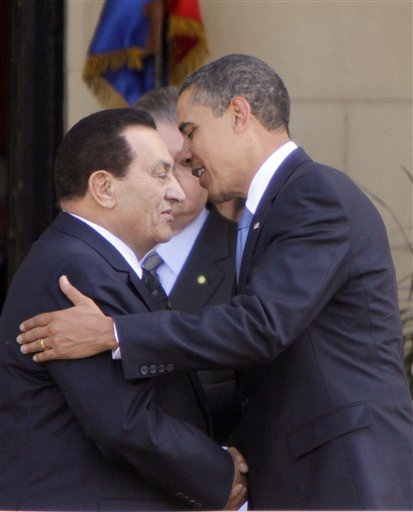
Mubarak-Obama
Obama meets the Egyptian dictator

Ali Abunimah puts a bit of perspective on Obama’s call for a “new beginning” by taking to task the US President’s reference to “America and Islam”. This is the same old terminology in use by the Americans which refers to the former as a “concrete specific place”, with the latter reducing over a billion people to a “single, coherent entity” (to borrow a phrase from Edward Said).

Once you strip away the mujamalat – the courtesies exchanged between guest and host – the substance of President Obama’s speech in Cairo indicates there is likely to be little real change in US policy. It is not necessary to divine Obama’s intentions – he may be utterly sincere and I believe he is. It is his analysis and prescriptions that in most regards maintain flawed American policies intact.

Though he pledged to “speak the truth as best I can”, there was much the president left out. He spoke of tension between “America and Islam” – the former a concrete specific place, the latter a vague construct subsuming peoples, practices, histories and countries more varied than similar.

Continue reading “A Bush in sheep’s clothing”

Robert Fisk: Police state is the wrong venue for Obama’s speech

Egyptian President Hosni Mubarak

For Obama’s Cairo speech to have any resonance among Arabs, writes Robert Fisk, he would have to deliver his lecture from Gaza and not one of the world’s worst human rights violators, Egypt.

Maybe Barack Obama chose Egypt for his “great message” to Muslims tomorrow because it contains a quarter of the world’s Arab population, but he is also coming to one of the region’s most repressed, undemocratic and ruthless police states. Egyptian human rights groups – when they are not themselves being harassed or closed down by the authorities – have recorded a breathtaking list of police torture, extra-judicial killings, political imprisonments and state-sanctioned assaults on opposition figures that continues to this day.

The sad truth is that so far did the US descend in moral power under George W Bush that Obama would probably have to deliver his lecture in the occupied West Bank, even Gaza, to change the deep resentment and fury that has built up among Muslims over the past eight years. This, of course, Obama will not do. So Egypt, sadly, it has to be, though he will see nothing of the squalor and fear in which Egyptians live. Continue reading “Robert Fisk: Police state is the wrong venue for Obama’s speech”

Obama’s Cairo speech

In March US President Barack Obama made a direct address to the Iranian people to coincide with the festival of Nowruz, a sensitive and respectful message unheard of in the previous 30 years of non-existent diplomatic relations between the two countries. Now this week sees President Obama begin a tour of the Middle East and Europe in which he will “reach out to the Muslim world” in a speech in Cairo on Thursday. But with the political landscape changing, particularly the frosty relationship between the US President  and new Israeli Prime Minister Benyamin Netanyahu, can we expect a similarly progressive message to the wider Muslim world this time around?

In The Nation Robert Dreyfuss argues that for Obama, merely being “a repudiation of George W. Bush’s wrecking-ball approach to the Middle East” will not be enough. In order to make progress, Obama must pick apart the ““Islamofascist” ball of wax” that the ‘war on terror’ falsely suggested. To do so, says Dreyfuss, he must recognize the diverse political spectrum that currently exists across the region and approach future relations accordingly. Continue reading “Obama’s Cairo speech”

Jeff Blankfort on AIPAC and Jinsa

jeffreyBlankfortJeff Blankfort on Flashpoints Radio examining the recent letter to Obama that exposed the hand of AIPAC, and the neocon Jewish Institute for National Security Affairs (JINSA) essay calling for US military attacks on ‘partisan’ media.

Jeff Blankfort – Flashpoints Radio (18:25): MP3

Mirrors: Eduardo Galeano speaks

Mirrors by Eduardo Galeano

The great Uruguayan writer Eduardo Galeano joins Democracy Now for an hour to discuss literature, politics and much more. (The rest of the videos are below)

Fresh Off Worldwide Attention for Joining Obama’s Book Collection, Uruguayan Author Eduardo Galeano Returns with “Mirrors: Stories of Almost Everyone”

We spend the hour with one of Latin America’s most acclaimed writers, Eduardo Galeano. The Uruguayan novelist and journalist recently made headlines around the world when Venezuelan President Hugo Chavez gave President Obama a copy of Galeano’s classic work, The Open Veins of Latin America. Eduardo Galeano’s latest book is Mirrors: Stories of Almost Everyone. We speak to Galeano about his reaction to the Chavez-Obama book exchange, media and politics in Latin America, his assessment of Obama, and more.

Continue reading “Mirrors: Eduardo Galeano speaks”

Busted, Pentagon

Abu Ghraib (Fernando Botero)

Why The Photos Probably Do Show Detainees Sodomized and Raped. Naomi Wolf explains:

(MIA: I am not quite sure why this is being treated as new information when Seymour Hersh had reported on the videos of Iraqi children being sodomized soldiers five years back, and again three years later in his profile on Gen. Antony Taguba Hersh revealed that there were cases of rape, and that Taguba had seen ‘a video of a male American soldier in uniform sodomizing a female detainee’. It was likewise revealed in an earlier investigation that an investigator from the mercenary firm Titan Corp., named Adil Nakhla was charged with sodomizing an Iraqi boy).

The Telegraph of London broke the news – because the US press is in a drugged stupor — that the photos Obama is refusing to release of detainee abuse depict, among other sexual tortures, an American soldier raping a female detainee and a male translator raping a male prisoner. The paper claims the photos also show anal rape of prisoners with foreign objects such as wires and lightsticks. Major General Antonio Taguba calls the images `horrific’ and `indecent’ (but absurdly agrees that Obama should not release them – proving once again that the definition of hypocrisy is the assertion that the truth is in poor taste).

Predictably, a few hours later the Pentagon issues a formal denial.

Continue reading “Busted, Pentagon”

FAIR on the NYT’s Pentagon Propaganda

nytFairness and Accuracy in Reporting (FAIR) has an action alert on the New York TimesPentagon Propaganda, detailing its misleading report on Guantánamo and terrorism. This comes as the same paper last year published David Barstow’s revelations about the Pentagon’s hidden hand in “news” coverage to generate pro-war propaganda and favourable coverage for the Bush administration, for which he has won a Pulitzer Prize for investigative reporting. (See also this interview on Democracy Now earlier this month). The NYT continues to try to have it both ways: (selectively) exposing propaganda as well as exercising it as an extension of the US military and political establishment. FAIR does well to keep the scrutiny turned right up:

While former Vice President Dick Cheney has been front and center in the media debate over the current White House’s national security policies, he’s not the only one trying to challenge the White House’s message. The New York Times published a front-page article (5/21/09) that bolstered the notion that former Guantánamo prisoners “return” to terrorist activity.

The remarkably credulous Times story, under the headline “1 in 7 Freed Detainees Rejoins Fight, Report Finds,” was based on a Pentagon report leaked to the paper before its release yesterday evening. The article emphasized the notion that former prisoners “returned to terrorism or militant activity”–without adequately explaining the definition of either term, or examining whether those former detainees were ever “terrorists” in the first place.

Continue reading “FAIR on the NYT’s Pentagon Propaganda”

Why aid to Pakistan won’t make a difference

MIDEAST ISRAEL LOBBY CRITICS
Stephen Walt

Stephen Walt highlights why the House of Congress’ pledge of $1.5 billion per annum non-military aid for Pakistan isn’t going to do much to change the effect of disasterous American meddling.

At the New Yorker blog, Steve Coll reports that the U.S. Congress is preparing a five-year $1.5 billion per annum non-military aid package for Pakistan, with full support from the Obama administration. (You can read the text of the legislation, entitled the “Enhanced Partnership with Pakistan Act,” here.)

This step sounds impressive, until one remembers that Pakistan’s population is nearly 180 million and its GDP in 2006 was about $144 billion. So the aid package amounts to around a 1 percent increase in Pakistani GDP, which works out to about $8 for each Pakistani. In other words, the U.S. Congress is going to increase their per capita income from $850 per year to about $858. (It’s actually less than that, because some of the money goes to administrative expenses, auditing, and the like.) Continue reading “Why aid to Pakistan won’t make a difference”

‘These colours don’t run’

From Colombian painter Francisco Boteros series depicting US abuse of Iraqi detainees.
From Colombian painter Fernando Botero's series depicting US abuse of Iraqi detainees.

Guantanamo, Abu Ghraib, and Bagram are well known. Less so the police detention centers where the innocents caught in the ‘war on terror’ dragnet were subjected to similar abuses. Inigo Thomas reveals:

In his remarks to the American Enterprise Institute last week, Dick Cheney said that inmates at Guantánamo should remain imprisoned on Cuba because they are too dangerous to be incarcerated in American jails. What about the Americans arrested and jailed under the terms of the war on terror? Should they be incarcerated on Cuba, or does Cheney suppose that Americans are, regardless of what they have done, inherently less dangerous than other people and therefore don’t need to be jailed at Guantánamo?

Nor – surely – can Cheney have forgotten that immediately after 9/11, hundreds of men were rounded up by the FBI and other police forces in the US and imprisoned in high security American jails: 760 in total, 184 of whom were considered especially interesting by the authorities. Just over half of them were interred at the Metropolitan Detention Center in Brooklyn, a former warehouse on the waterfront overlooking the harbour and the Statue of Liberty. The story was covered by the New York Times, but it was treated, mostly, as local news and carried in the ‘New York Region’ section of the paper.

Continue reading “‘These colours don’t run’”