Award-winning economist, Joseph Stiglitz, author of Freefall: Free Markets and the Sinking of the Global Economy, lays out not only the course of the financial crisis which began in 2007, but its underlying causes, and shows why much more radical reforms are needed than are currently being contemplated if we are to avoid similar ‘systemic’ crises in the future. Showing why the bailout has been only marginally effective and how it could have been much more so, and outlines the enormous opportunity – not yet taken – to design a new global financial architecture.
In Kabul, Afghanistan’s beleaguered capitol city, a young woman befriended me during December of 2010. She was eager to talk about her views, help us better understand the history of her country, and form lasting relationships. Now, she is too frightened to return a phone call from visiting westerners. The last time I saw her, during the spring of 2011, she was extremely anxious because, weeks earlier, U.S. Joint Special Operations Commandos (JSOC) had arrested her brother-in-law. The family has no idea how to find him. Once, someone working for the International Commission of the Red Cross called the family to say that he was still alive and in the custody of the International Security Assistance Forces, (ISAF). Numerous families in Afghanistan experience similar misery and fear after night raids that effectively “disappear” family members who are held incommunicado and sometimes turned over to Afghan National Police or the dreaded National Directorate of Security, (NDS).
An October 22, 2011 New York Times report about the findings of UN researchers who interviewed 324 Afghans detained by security forces, found that half of those who were in detention sites run by the NDS told of torture which included beatings, twisting of genitals, stress positions, suspension, and threatened sexual assault. Of the 324 interviewed, 89 had been handed over to the Afghan intelligence service or the police by U.S./NATO international military forces.
Even though high commanders in the ranks of the U.S. JSOC acknowledge that 50% of the time the night raids and drone attacks “get” the wrong person, (Washington Post, September 3, 2011), the U.S. war planners have steadily escalated reliance on these tactics.
Consider the killing of three brothers in the Nemati family who lived in the Sayyidabad village in Afghanistan’s Wardak province. Ismail, age 25, and Buranullah, age 23, had returned from their studies in Kabul to celebrate the start of Ramadan with their family in August of 2010. With their brother Faridullah, age 17, they went to the family guest room to study for exams. They were joined by their younger brother, Wahidullah, age 13.
An initial U.S. military press release on August 12th, 2010, indicated that U.S. forces had captured an important Taliban figure nearby and had taken fire from the Nemati home where they believed Taliban fighters were being hosted as guests. Indeed, two Taliban fighters had stopped at the home two days earlier, asking for food. Fearful of repercussions if they didn’t feed them, the family had given them food.
Smart analysis from one of Washington’s leading cassandras. Brzezinski opposed the Iraq war, has been warning against any confrontation with Iran, and has denounced the grotesque inequalities that beset the unregulated US economy.
In yet another insightful interview with Radio Open Source, Yale professor David Bromich analyzes the political failings of the US president Barack Obama. He observes:
David Bromwich
At a time of crisis you hope for something more than proficiency of maneuver. You hope for consistency of explanation and the kind of reassurance that can come to people in a democracy from actually learning from somebody who is leading them where they are headed. … It’s not beyond a capable president actually to give a lesson in history. What real leadership comes from is finding the principle and the action that goes with it on which people could agree though they don’t yet realize that they would agree, what they most care about it even though it hasn’t yet found words, what their longterm interests, not their present opinions are… [Leadership comes from] deciding what the commitments are, standing to them, and then repeating, phrase by phrase and precept by precept, what it is you believe and how B follows A and C follows B.
The following is a lecture by John Bellamy Foster, Editor of Monthly Review and Co-Author (with Fred Magdoff) of The Great Financial Crisis: Causes and Consequences.
Alli McCracken being arrested by the police for protesting at the Congressional hearing
“Assault? Who — or what — did I assault?” I asked the police officer incredulously as I sat in his office at the police station, handcuffed to the wall. “Well, looks like it was Leon Panetta himself,” the officer responded as he flipped through a pile of paperwork.
Me? A 22-year-old mild-mannered peace activist, assaulted the Secretary of Defense? I had simply tried to tell him how I felt about the wars. On the morning of October 13th about 25 activists who are occupying Washington DC, as part of the nationwide occupations, went on a field trip to Congress. We wanted to attend the House Armed Services Committee hearing where Leon Panetta, the Secretary of Defense, and Martin Dempsy, Chairman of the Joint Chiefs of Staff, were testifying about “lessons learned by the Department of Defense over the preceding decade” and “how those lessons might be applied in the future in light of anticipated reductions in defense spending.” After all, these hearings are open to the public. And shouldn’t we have a say in where our money is being spent?
As a peace activist with the group CODEPINK for the past 10 months, I have done my fair share of sending letters and emails and delivering petitions to our government representatives, asking them to stop pouring trillions of our taxpayer dollars into the endless cycle of death, destruction and reconstruction halfway across the world. There are so many critical things that we could spend that money on here in America, such as education, healthcare, helping the homeless, the elderly, the disabled, the veterans.
“All wars, whether just or unjust, disastrous or victorious, are waged against the child.” — Eglantyne Jebb, founder of Save the Children, 1919.
In Kabul, the children are everywhere. You see them scrounging through trash. You see them doing manual labor in the auto body shops, the butchers, and the construction sites. They carry teapots and glasses from shop to shop. You see them moving through the snarled traffic swirling small pots of pungent incense, warding off evil spirits and trying to collect small change. They can be found sleeping in doorways or in the rubble of destroyed buildings. It is estimated that 70,000 children live on the streets of Kabul.
The big news story on CNN this morning is the excitement generated as hundreds of people line up to buy the newest iphone. I can’t stop thinking of the children sitting in the dirt of the refugee camp, or running down the path pushing old bicycle tires, or the young boy sitting next to his overflowing sacks of collected detritus. He has a deep infection on the corner of his mouth that looks terribly infected. These images contrast with an image of an old grandfather, dressed in a spotless all white shalwar kameez squatting on the sidewalk outside a huge iron gate, embracing his beautiful young grand daughter in a huge hug, each smiling broadly, one of the few moments of joy I have witnessed on the streets of Kabul.
In Afghanistan, one in five children die before their 5th birthday, (41% of the deaths occur in the first month of life). For the children who make it past the first month, many perish due to preventable and highly treatable conditions including diarrhea and pneumonia. Malnourishment affects 39% of the children, compared to 25% at the start of the U.S. invasion. 52% don’t have access to clean water. 94% of births are not registered. The children are afforded very little legal protection, especially girls, who are stilled banned from schools in many regions, used as collateral to settle debts, and married through arranged marriages as young as 10 years old. Though not currently an issue, HIV/AIDS looms as a catastrophic possibility as drug addiction increases significantly, even among women and children. Only 16% of women use modern contraception, and children on the streets are vulnerable to sexual exploitation. This is why the “State of the World’s Mothers” report issued in May 2011 by Save the Children ranked Afghanistan last, with only Somalia providing worse outcomes for their children.
A message from the father of the murdered nine-year-old Ibrahim Shayban to Russia, China and Bashaar al-Asad.
The Russian and Chinese vetoes to protect the Syrian regime from UN Security Council condemnation are reminiscent of all those American vetoes to protect Israel. Both countries have their reasons for shielding the Syrian regime: Russia’s naval base at Tartus, discomfort over the way the Libya No Fly Zone slipped into more overt intervention, the fear that UN condemnation may one day focus on Russian abuses in Chechnya and Chinese abuses in Tibet and Xinjiang. But both countries should consider their own interests more creatively. Ultimately, their influence in Syria and the wider region will depend on their image in Syrian and Arab eyes. The Syrian regime will not be there for ever. The Syrian people will.
Iran is another state which has repeatedly shot itself in the foot since the Arab revolutions began, first by mischaracterising as Islamic uprisings the deposings of Mubarak, Bin Ali and Qaddafi, then by opposing the revolution which seems most similar to Iran’s in 79 – the Syrian revolution. Iran used to be popular in Syria even amongst many sectarian-minded Sunni Muslims. It used to be popular in the wider Arab region. This popularity was Iran’s best guarantee against marginalisation and even military attack from the region’s pro-Western forces. But its popularity has evaporated this year.
Back to Ibrahim. He was martyred while leaving a mosque in the Qaboon suburb of Damascus. His funeral was held today in Meydan, in the heart of the city. Here’s some footage. Apparently insecurity forces killed two of the mourners when they came out of the mosque into the street.
Commentators have been telling us that central Damascus remains quiet. It’s true that many areas have been quiet, either because the upper middle class inhabitants still support the regime or are sitting on the fence, or because of the overbearing police and mukhabarat presence on the streets. Damascus has certainly not slipped out of regime control, as Homs, Hama, Deir ez-Zor and Idlib sometimes have. Yet Damascus has been bubbling for a long time. Pro-regime commentators will say that Kafar Souseh (which has demonstrated frequently since Shaikh Rifa’i of the Rifa’i mosque was shot) is a suburb, not the city itself – which is true, if Camden Town isn’t part of London. Suburbs further out – like Harasta, Douma, Muadamiya – have been veritable war zones for months. Imagine if Streatham, Hackney, Tottenham and Ealing were in a state of war and commentators told us ‘London remains quiet.’ And Meydan and Rukn ad-Deen have witnessed frequent, large demonstrations, and savage repression. These places are as central as Chelsea and Kensington. Smaller, briefer demonstrations have occurred in high-class Malki, in Sha‘alaan, Shaikh Muhiyudeen, Baghdad Street, Muhajireen. You can’t get more central. The last place is within earshot of Bashaar al-Asad’s house. If the quietness of Damascus reassures the regime, I think they’d better start panicking.
Today in Afghanistan people feel an unnamable horror lurking just below the surface of their everyday lives. It has been described as a tension, a feeling of pressing apprehension, as if a breaking point is about to be breached. People wake each day with this feeling; it accompanies them through their dreams each night.
Driving through the streets of Kabul I watch people set about their business deliberately. There is little laughter, the absence of joy as palpable as the heavy brown dust swirling through the streets choking off the sun.
We turn down a pock marked dirt road. Reminded of a video game my son used to love, we swerve from side to side to miss as many obstacles as possible, including oncoming traffic of all varieties, crashing through spine-jarring potholes with regularity. We spot the large pink building behind a huge steel gate. The guard points to a door and tells us to call inside.
We have arrived at the New Learning Center, a school serving the children of Afghanistan. It was founded and directed by Andeisha Farid, a young Afghan woman, who was herself a displaced person during the Soviet war and grew up in refugee camps in Iran and Pakistan. Andeisha had one simple idea. If she could help one child, that child would return to her family and influence the family. In turn, the family would influence the village, the village would influence the province, the province would influence the country. This simple idea has turned into 11 orphanages, serving 700 children, and the New Learning Center, newly opened in May 2011.
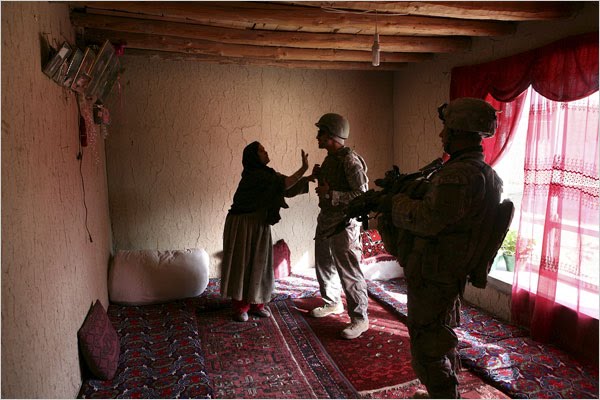 In Kabul, Afghanistan’s beleaguered capitol city, a young woman befriended me during December of 2010. She was eager to talk about her views, help us better understand the history of her country, and form lasting relationships. Now, she is too frightened to return a phone call from visiting westerners. The last time I saw her, during the spring of 2011, she was extremely anxious because, weeks earlier, U.S. Joint Special Operations Commandos (JSOC) had arrested her brother-in-law. The family has no idea how to find him. Once, someone working for the International Commission of the Red Cross called the family to say that he was still alive and in the custody of the International Security Assistance Forces, (ISAF). Numerous families in Afghanistan experience similar misery and fear after night raids that effectively “disappear” family members who are held incommunicado and sometimes turned over to Afghan National Police or the dreaded National Directorate of Security, (NDS).

 In Kabul, the children are everywhere. You see them scrounging through trash. You see them doing manual labor in the auto body shops, the butchers, and the construction sites. They carry teapots and glasses from shop to shop. You see them moving through the snarled traffic swirling small pots of pungent incense, warding off evil spirits and trying to collect small change. They can be found sleeping in doorways or in the rubble of destroyed buildings. It is estimated that 70,000 children live on the streets of Kabul.
