(via Paul Woodward)
Yemen’s Brave Women Revolutionaries
(via Paul Woodward)
(via Paul Woodward)
I am going through a period of (relatively) silent reflection on Syria. Of course, in Syria history continues to move at a rapid pace. At least 44 people were murdered by the regime yesterday. Today there is news of 17 soldiers killed by army deserters in Homs, a city which now appears to be in the early stages of a civil war. Syria’s criminal regime has brought this catastrophe on the country.
I’m remaining quiet for a while, but here are some highly recommended sites and articles. First, Walls is rapidly becoming the successor blog to Syria Comment, a space for intelligent discussion of the situation. Syria Comment was perceived by many (including me) to have lost its bearings. It always had a pro-regime and somewhat anti-Sunni slant; as the regime proved its stupidity and it became clear that the country would come closer to disintegration so long as the regime retained power, SC only reinforced its loyalty. Its reporting of events in Syria was highly selective, it gave a false view of the protestors, their motivations and leaders, it sometimes repeated absurd regime propaganda verbatim, and it even stooped to repeating false regime slanders of opposition figures. Now that Joshua Landis has taken a back seat the site is in less academic, even more blatantly partial hands. So it’s really good to see the Walls blog attracting SC’s best commentors and building such a big audience.
Al Jazeera’s People and Power investigates the tycoon duo’s ununderground campaign to swing the balance of US power for Republicans.
Boyce and Ndikumana, authors of ‘Africa’s Odious Debts’, argue that under international law, debts incurred by dictators should not be enforceable.
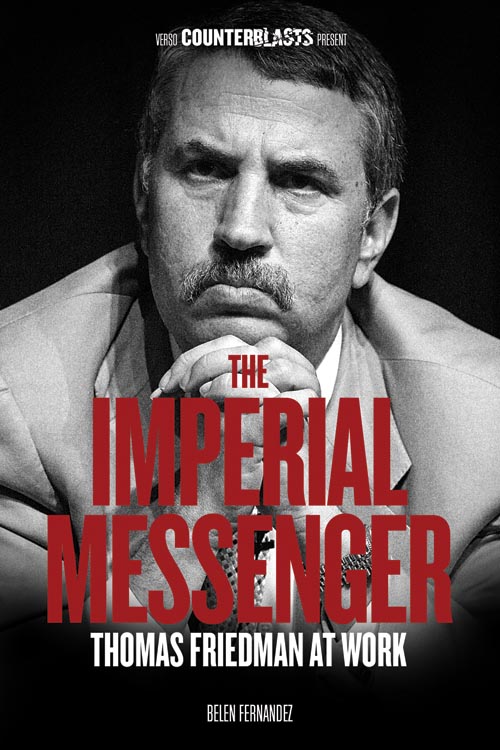 Jadaliyya recently interviewed PULSE co-editor Belén Fernández about her book The Imperial Messenger: Thomas Friedman at Work, to be released by Verso Nov. 7. The interview appears in Jadaliyya’s New Texts Out Now (NEWTON) section and includes an excerpt from the book. The following is the start of the interview:
Jadaliyya: Why did you write this book?
Belén Fernández: I asked myself this question several thousand times, particularly during my third rereading of every Friedman column published since 1995.
The idea for the book came about in a far less climactic fashion than Friedman’s ideas tend to occur—i.e. it did not involve “Quarter-Pounder[ing] my way around the world,” being struck by a “bolt out of the blue that must have hit somewhere between the McDonald’s in Tiananmen Square in Beijing, the McDonald’s in Tahrir Square in Cairo and the McDonald’s off Zion Square in Jerusalem,” and unfurling the Golden Arches Theory of Conflict Prevention, according to which American fast food is the key to world peace.
Rather, in May of 2009, following a four-month hitchhiking trip through Colombia, Ecuador, and Venezuela, I returned to Buenos Aires, where my parents were living at the time. Though up to that point I had been blessedly sheltered from the phenomenon that is Thomas Friedman and had only read a smattering of his dispatches over the years, he happened to publish a spate of articles that summer which caught my attention.
Topics ranged from how Iraqis should appreciate the US military legacy of “a million acts of kindness and a profound example of how much people of different backgrounds can accomplish when they work together” in their country, to how Barack Obama had defeated Mahmoud Ahmadinejad in the Lebanese elections, which somehow indicated a triumph of Lebanese sovereignty. Also reported by Friedman that summer was the encouraging fact that the more than 50,000 Facebook fans of Iranian opposition leader Mir Hossein Mousavi far exceeded the capacity of a mosque, thus reiterating the positive role technology can play in the hands of proper Muslims, as opposed to those concerned with conducting “J.O.L.” (Jihad Online).
Michael Moore talks to CNN’s Piers Morgan about the OWS and more.
By Claire Chambers
 What does it mean to be a writer of Muslim heritage in the UK today? Is there such a thing as ‘Muslim fiction’? If so, is it cultural background or belief that makes writing (or identity) Muslim?
My book, British Muslim Fictions: Interviews with Contemporary Writers (Basingstoke: Palgrave Macmillan, 2011), is the first in a two-part book project, which seeks answers to these complex questions. It is a collection of conversations with writers who live or work in Britain and have an intimate relationship with Islam, whether they are religious, cultural, or even – paradoxically – atheist Muslims, and whether South Asian, Arab, African, or European.
Over thirteen interviews, I talked to Anglophone writers including Aamer Hussein, Fadia Faqir, Hanif Kureishi, Leila Aboulela, Abdulrazak Gurnah, and PULSE’s own Robin Yassin-Kassab. This is a group of writers who are highly diverse but, like a loosely connected and often discordant family, they have much in common, through their connections both to Islam and the United Kingdom. As well as discussing their literary techniques and the impact that their Muslim heritage has had on them, I became increasingly persuaded that this body of writing shares certain preoccupations (relating to gender, class, the war on terror, al-Andalus, the Rushdie Affair, and a cosmopolitan outlook), and is some of the most important and politically engaged fiction of recent years.
As you can tell from my name, I am not from a Muslim background myself, although I was fortunate enough to grow up in Leeds in West Yorkshire, surrounded by many South Asian Muslim friends. As clichéd as it may sound, my worldview has also been crucially shaped by my gap year, 1993-94, which I spent teaching English in Peshawar, Pakistan, at the age of eighteen. I went on to specialize in South Asian literature in English as a postgraduate student, and continue to fuel my interest by return visits to the Indian subcontinent and by working with diasporic communities.
by Mark Weisbrot
This article was written for the Guardian’s Comment is free prior to Argentine President Cristina Fernández de Kirchner’s reelection yesterday.
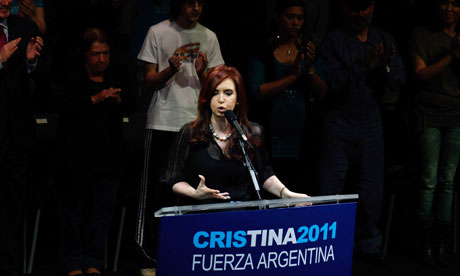
Cristina Fernandez de Kirchner is expected to coast to re-election as president of Argentina on Sunday, despite having faced hostility from the media for most of her presidency, and from many of the most powerful economic interests in the country. So it seems a good time to ask why this might happen.
Yes, it’s the economy. Since Argentina defaulted on $95bn of international debt nine years ago and blew off the International Monetary Fund, the economy has done remarkably well. For the years 2002-2011, using the IMF‘s projections for the end of this year, Argentina has chalked up real GDP growth of about 94%. This is the fastest economic growth in the western hemisphere – about twice that of Brazil, for example, which has also improved enormously over past performance. Since President Fernandez or her late husband Nestor Kirchner, who preceded her as president, were running the country for eight of these nine years, it shouldn’t be surprising that voters will reward her with another term.
The benefits of growth don’t always trickle down, but in this case, the Argentine government has made sure that many did. Poverty and extreme poverty have been reduced by about two thirds since their peak in 2002, and employment has increased to record levels. Social spending by the government has nearly tripled in real terms. In 2009, the government implemented a cash transfer program for children that now reaches the households of more than 3.5 million children. It is probably the largest such program, relative to national income, in Latin America.
Continue reading “Cristina Kirchner and Argentina’s good fortune”
Cornel West speaks about inequality, injustice and America’s policy of routine extrajudicial killing.
by William A. Cook
“ … disregard and contempt for human rights have resulted in barbarous acts which have outraged the conscience of mankind, and the advent of a world in which human beings shall enjoy freedom of speech and belief and freedom from fear and want has been proclaimed as the highest aspiration of the common people …” — United Nations Universal Declaration of Human Rights.
 Today the American people, in concert with their brothers and sisters around the world, proclaim the rights to which they are entitled by birth and citizenship, by Constitutional law and Proclamation, and by membership in the collective body of nations that has universalized recognition of these rights for all humanity. And today, in cities and hamlets across this nation, and in many nations around the world, people gather in peace to demand of their governments recognition of these rights that have been abrogated by the few and denied to many.
Citizens no longer control their government; they are slaves to it. Representatives no longer serve the citizen seeking their consent to govern, they are servants of the corporations and lobbies that control the economic system to which the citizen is enslaved. Presidents no longer lead, they are the obedient lackeys of their corporate overseers. Freedom of speech and belief and freedom from fear and want do not determine the needs of humans, economics of the market place supersedes all at the expense of the citizen and human rights. We exist in a corporate world of unending wars, of vengeance and recrimination, of fear as a commodity that imprisons the mind, of greed that destroys the resources of this planet without remorse, and of insatiable arrogance that harbors no concern for those it destroys.

