Web of Lies

by Maysaloon

banner reads: My Sect Is Freedom

It is quite amazing to see the web of lies being woven now that the situation in Syria becomes critical. The official narrative, and one which a considerable chunk of the Syrian population wish desperately to believe, is that the protests are being provoked by unknown foreign elements that are trying to destabilise the country. The official media is focusing exclusively on the deaths of members of the security services, ignoring the hundreds of deaths amongst the mostly peaceful protesters that have taken to the streets across Syria. I say that many people wish desperately to believe the official narrative because many people simply don’t want to see more bloodshed and death on the streets of Syria. Many people are also afraid and don’t wish to be seen as accepting the fact that the Syrian government is now at war with its own people.
Continue reading “Web of Lies”

The ethnic cleansing of Lifta

Should this old Palestinian village be saved from Israeli development?

The clip is over the fold.
Continue reading “The ethnic cleansing of Lifta”

الجمعة العظيمة

بالأمس القريب رفع الرئيس بشار الأسد قانون الطوارىء, وحلّ محاكم أمن الدولة سيئة السمعة وسمح بالتظاهر السلمي. ولكن بعد صدور المرسوم الرئاسي تقدم أحد المحامين في الحسكة بطلب إذن لتظاهرة سلمية فاعتقلته قوات الأمن.

واليوم , يوم “الجمعة العظيمة” قامت مظاهرة ضخمة, سلمية وعزلاء في كل المناطق السورية. لجأ الجيش والشرطة والميليشيات إلى استخدام الذخيرة الحية والعصي الكهربائية والغاز المسيل للدموع ضد المتظاهرين. قٌتِل على الأقل 88 ابناً وابنة من أبناء السوريين, ومنعت قوى النظام بعض المصابين من تلقّي المساعدة الطبية اللازمة, بينما تمّ اعتقال مصابين آخرين من فوق أسرّتهم في المشفى. يمكن رؤية هذا

Continue reading “الجمعة العظيمة”

Four Points on Syria

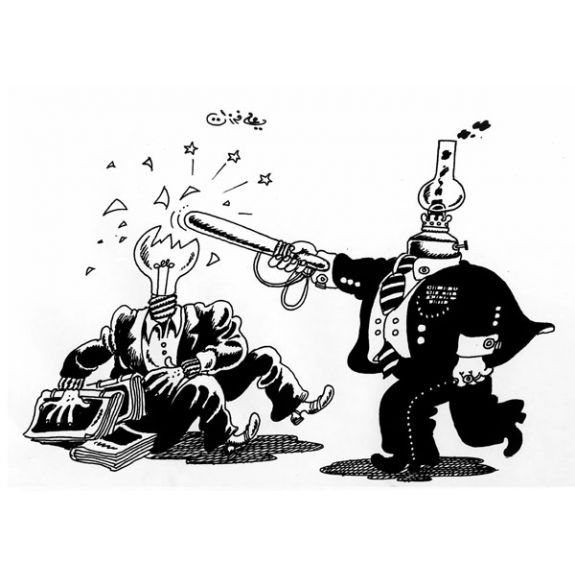
picture by Ali Farzat

1. Obama Should Shut Up

Obama’s claim that the Syrian regime is receiving Iranian assistance to repress protests is a statement which could inflame sectarian hatred inside Syria, as Obama’s Zionist advisors know very well. (This because Iran is Shia, a target of Saudi-Wahhabi propaganda, and the Syrian dictator is an Alawi, whereas the majority of Syrians are Sunnis). Obama gave no evidence to support his claim. The regime may be using Iranian bullets and tear gas. The Egyptian, Tunisian, and Libyan regimes have recently used American bullets and tear gas against their respective peoples. And America has offered its full support to the Saudi occupation of Bahrain and the Khalifa reign of terror there, which includes midnight arrests, extrajudicial executions, the destruction of Shia mosques, and assaults on hospitals and medical staff. The United States continues to assist the same dictatorships it has assisted for decades, and to function as the lifeline of the Zionist apartheid state. Obama’s statement could be a message to the Asad regime: if you distance Iran and the resistance, we will help you survive this crisis. But the Asad regime knows its only popularity arises from its support of resistance. Alternatively, Obama may have decided that Bashaar will fall, and the message is to the Syrian people, to encourage sectarian hatred amongst them and make it more difficult for them to build a stable, inclusive nation after the Asads capable of confronting the Zionist project.

Continue reading “Four Points on Syria”

The evolution of Arab revolutions

The Arab Spring is in full bloom. Peaceful uprisings in Tunisia and Egypt sparked a democratic tide that has swept across the region.

In Libya, Yemen, Syria and Bahrain, it is now a tale of two protests, with the situation deteriorating into widespread violence and outright war.

It seems some regimes will stop at nothing to resist change. So with no unified leadership or clear agenda, and with domestic complications in each and every country, is this truly a revolution? And if this is an Awakening — what path will it follow — that of Turkey? Of Iran? Or rather a third way, an Arab way. Empire finds out.

Continue reading “The evolution of Arab revolutions”

Fisk on the Syrian Uprising

The veteran Middle East reporter for the UK’s Independent newspaper discusses the shooting of protesters on “Great Friday”.

Fisk argues that the Syrian president is fast losing control of the situation, though he is unlikely to go quietly.

With his belated concessions, Assad is “is now enduring the failures that he committed 11 years ago,” the journalist says.

Great Friday

banner reads: was the martyr Hatem Hana, a Christian, also a Salafi?

Yesterday President Bashaar al-Asad lifted the Emergency Law, dissolved the notorious State Security Courts, and legalised peaceful protests.

After the president’s decree, a lawyer asked permission to hold a protest in Hasakeh. He was detained by security forces.

Today – ‘Great Friday’ – large, peaceful, unarmed protests were held in all regions of the country. Police, army and militia used tear gas, electric rods and live ammunition against the people. At least 88 sons and daughters of Syria were murdered. Regime forces prevented some of the wounded from receiving medical help. Other wounded have been arrested from their hospital beds. (Here are ugly scenes in Homs).

Damascus is under lockdown, mukhabarat clustering on every corner. Someone I know tried to cross the city today for entirely apolitical reasons. During the journey he was taken off the bus (with everyone else) and marched to a police station where he was questioned and his details recorded. But protests and gunfire still roared from the suburbs as far into the city’s heart as Meedan.

Words are one thing, actions another. The president’s words have no meaning at all.

Continue reading “Great Friday”

The Dimensionality of Reading

Arnold Weinstein is one of the greatest teachers of literature, and I owe my own rediscovery of the pleasures of reading in good part to him. He always brings riveting insights to familiar works, but without the tedious blather of theory. Enjoy this fascinating discussion with Weinstein from Brown University’s excellent Radio Open Source with Christopher Lydon.

Colombia’s Wayuu: Still Holding on at the Top of the Continent

Wayuu children at Playa del Pilón de Azúcar, Cabo de la Vela, Colombia (Photo by Ken Kelley)

by Ken Kelley

Sitting for hours in the market of Uribia in the Colombian department of La Guajira, watching indigenous Wayuu women in long flowing dresses selling smuggled gasoline and other Venezuelan wares, I started to wonder if I would ever reach the tiny fishing village of Cabo de la Vela on the Guajira Peninsula.

I kept getting conflicting stories as to whether the truck for Cabo had already left and whether there would be another that day. I was almost ready to backtrack to the city of Riohacha when two more travelers appeared, followed by the truck, into which were then loaded all kinds of goods plus myself and the other passengers. We set off.

Located on the northernmost tip of South America, the arid Guajira Peninsula straddles the border of Venezuela and Colombia. Until recently, it was rarely visited by outsiders, due in part to its Wild West reputation as a hub for trafficking in humans, drugs, and other items, and as the home of the strong-willed Wayuu, who were never subjugated by the Spanish and who have lived on their own terms in the La Guajira desert for centuries.

Continue reading “Colombia’s Wayuu: Still Holding on at the Top of the Continent”

The Fight Continues

Xan Rice reports for the Guardian from besieged Misrata.

The resistance from the rebels – from all the people in Misrata – seems remarkable given their limited armoury and experience. That they have managed to keep Gaddafi’s forces to one side of the city seems a miracle, or at least a masterclass in guerrilla warfare.

At least a thousand have been killed in Misrata, 3000 are injured, and 300,000 huddle in a small section of the city away from the frontlines. Qaddafi’s forces are using sniper fire, heavy artillery and, Israel-style, illegal cluster bombs.

But there is some good news. This film shows the people of Misrata celebrating the recapture of a bank and insurance building. This film shows the people of revolutionary Nalut receiving news of the elimination of a Qaddafi commander. For those who tell us that Libya is split east-west, Nalut is in western Libya. According to the UN, 11,000 have fled Qaddafi’s attacks on Nalut for Tunisia in recent days. This film is from the western mountains. A revolutionary fighter announces the capture of ‘Libyan mercenaries’ – so-called because the regime bought them – and his plan to have them tried in Zawiya and Sabrata, the cities in which they committed their crimes, once freedom comes. Meanwhile, revolutionaries today captured the Wazin border crossing, forcing Qaddafi forces to surrender to Tunisian troops.