Sovereignty

Photo by Amr Abdallah Dalsh/ Reuters

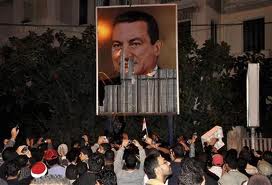
My past experience talking to Egyptians, in Egypt and around the world, is that 95% of them hate Husni Mubarak and the humiliation he’s brought upon their once great country. When I ask of their hopes for change, they answer with the bitter resignation common to all Arabs: “Nothing will change. His son will come after him. People are more interested in football, or their next meal.” Arabs from other countries also despair of escaping their state of stagnation. Some like to repeat the Arabic phrase al-‘arab jarab, or ‘the Arabs are scabies.’

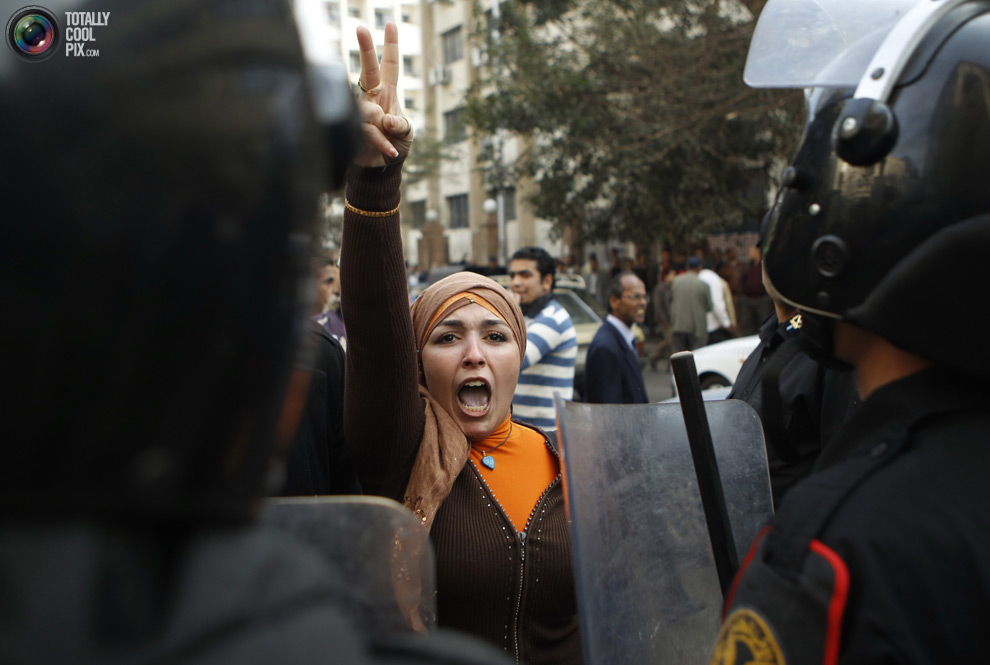
But that was then. That was until the Tunisian revolution, which has now reached the centre of the Arab world. Egypt’s Friday of Rage was a beautiful revolutionary moment, when individuals, having witnessed the strength of their protesting compatriots over the previous days, suddenly realised they were not alone. After Friday prayers, a nation claimed sovereignty over its streets – young people, the unemployed, professionals, workers, students, families. The people who didn’t demonstrate provided food, drinks and tear gas remedies to those who did (which means that womens’ participation has been much greater than TV pictures show). On at least one occasion, Christians guarded a Muslim mass prayer under assault by police.

And in Suez, Luxor, Alexandria and Cairo they defeated the police. They torched police stations and police vehicles, as well as the headquarters of the ruling (and absurdly named) National Democratic Party. (The Israeli embassy, meanwhile, has helicoptered its entire staff out of Cairo. One slogan being chanted: ya mubarak ya ameel/ ba’at biladak l-isra’il, or ‘Mubarak you Foreign Agent, You Sold your Country to Israel.’ Tonight the only Israeli flag flying in the Arab world is in Amman.)

Continue reading “Sovereignty”

Misr/Egypt in 140 characters or less

by Parvez Sharma

US television networks and an endless parade of mostly white men pundits (brought out and dusted off with their cobwebs) should take lessons from Al-Jazeera in live reportage, in not having pundits talk over the chants of a mass of humanity, in having Arab reporters covering what they know best, in remarkably evocative and courageous camerawork and in just being able to cover history like no other television network has ever been able to do before. And yes, I also mean that CNN during the first Gulf War was not as good as this.

It is so important to remember that the vast MAJORITY of those on the streets around the country do not have the time, the ability, the resources (including smartphones) and certainly no access to working mobile phone service. This revolution is JUST NOT BEING TWITTERED by the people who are actually protesting.

The only people tweeting are either reporters with huge bureaus and live cameras to back them or people like me reporting from the cyber-frontlines talking to the few friends in Cairo we can reach on their landlines.

To tweet this revolution and Egypt’s complex back-story in 140 characters or less is impossible.

Interestingly Al-Jazeera which is doing a stellar job is also more interested in covering the revolution (amazingly) in what is essentially wide-shots to show the extent of the chaos. Ayman’s camera is focused on the thousands in Tahrir. Not many correspondents are able to get to neighborhoods like Rihab, Mohandasin, Zamalek, Maadi—which cyber-reporters/tweeters like me are able to do by talking only on landlines (mobiles are not working) to our friends—ordinary citizens. Hopefully this below, is an example of that.

Continue reading “Misr/Egypt in 140 characters or less”

Tunisia in Syria?

The Guardian published this piece on Syria tacked onto the end of this piece on Egypt. Unfortunately they cut my paragraphs on sectarianism, the most important part of my argument. I should add that, after today’s great revolutionary awakening in Egypt, I am no longer certain of anything. Everything has changed.

2008 demonstration against US bombing of Syria. photo - Xinhua/ Reuters

With its young population, and a bureaucracy run by the same authoritarian party for four decades, Syria is by no means exempt from the pan-Arab crisis of unemployment, low wages and the stifling of civil society, conditions which have now brought revolution to Tunisia. Nevertheless, in the short to medium term it seems highly unlikely that the Syrian regime will face a Tunisia-style challenge.

A state-controlled Syrian newspaper blamed the Tunisian revolution on the Bin Ali regime’s “political approach of relying on ‘friends’ to protect them.” Tunisia’s status as Western client was only a minor motivator for the uprising there, but still al-Watan’s analysis will be shared by many Syrians. Unlike the majority of Arab states, Syria’s foreign policy is broadly in line with public opinion – and in Syria foreign policy, which has the potential to immediately translate into a domestic security issue, matters a great deal. The regime has kept the country in a delicate position of no war with, but also no surrender to, Israel (which occupies the Golan Heights), and has pursued close cooperation with Lebanese and Palestinian resistance movements as well as emerging regional powers such as Turkey and Iran. This is appreciated by ‘the street’, and the president himself is no hate figure in the mould of Ben Ali or Mubarak. Where his father engineered a Stalinist personality cult, mild-mannered Bashaar al-Asad enjoys a reasonable level of genuine popularity. Much is made of his low-security visits to theatres and ice cream parlours.

Continue reading “Tunisia in Syria?”

A Crucial Moment

Whose day will it be?

Today is crucial, and could go very badly. The Egyptian gangster regime and its backers have clearly decided to use maximum force to end the popular challenge. At 12.34 this morning, Egypt’s entire internet service was closed down – the largest shutdown in history. Mobile phone services have also been suspended, and al-Jazeera has been taken off the Egyptian air. An al-Jazeera journalist has been beaten up by regime thugs. There are reports that French and British journalists have also been beaten or detained. A CNN crew have had their cameras smashed. Obviously, news is harder to come by today.

Last night senior members of the Muslim Brotherhood were arrested (see Jonathan Wright’s reflection on the Brotherhood role). Now it seems Muhammad al-Baradei has been arrested after leading a protest in Giza. Protests have erupted in Cairo, in Sinai’s al-Arish, in Minya and Assiut in upper Egypt, in Ismailiya, in Alexandria. Roads leading to Suez, where regime forces have lost control, have been closed.

In the circumstances, protestors are remarkably well-organised. And a few reports are coming through of soldiers (in Suez and Alexandria) refusing to attack the people. Latest: 20,000 people have taken over Qasr el-Nil bridge in central Cairo. And Ayman Nour of the Ghad Party is in intensive care after being beaten by police.

Continue reading “A Crucial Moment”

Chas Freeman: US no longer qualified to mediate Middle East Peace

Ambassador Chas Freeman at a New America Foundation talk, moderated by Steve Clemons. Amb. Freeman’s current book is America’s Misadventures in the Middle East.

Vodpod videos no longer available.

The U.S. should not enable Israel’s self-destructiveness

“I don’t believe that playing the role of enabler to an alcoholic is an act of kindness and I don’t believe playing the role of enabler to a country that is setting itself for catastrophe is responsible either.  I think we have a very sad situation in this country in which any criticism of whatever it is that the current government of Israel is doing is immediately cited as evidence of anti-Israel bias or as evidence of antisemitism.” (Video: 21:46)

The U.S. is no longer qualified to mediate Mideast peace

“The United States essentially has disqualified itself as a mediator. I say that with great sadness because I believe on many occasions in the past we had opportunities to broker peace. I think there has been the implicit promise of peace on many occasions and we did not do that. We cannot play the role of mediator because of the political hammerlock that the right wing in Israel through its supporters here exercises in our politics. We’re simply biased. We’re not capable. If you doubt that read the so-called Palestine Papers and see what we were doing.”  (Video 22:38)

Erekat condemns Palestine Papers

…and determines that the source of the present Israeli-Palestinian impasse is not Israeli rejectionism or PA collaboration, but the skulduggery of journalists Clayton Swisher, Alastair Crooke and Wadah Khanfar!

Solidarity in Action

Novelist and Palfest founder Ahdaf Soueif writes from Cairo for the Guardian. “For some time,” she says, “Egypt has felt as though it is under occupation. Today, downtown Cairo was under siege.”

Patience is a virtue – maybe even the supreme one in Egypt’s popular hierarchy of values, but patience also has its limits and, now, at last, it seems as if we’ve arrived at ours. And fittingly, it’s the young of the country who are leading us. They’ve had enough of unemployment, deteriorating education, corruption, police brutality and political impotence.

As is now well known, they organised Tuesday’s protests over Facebook and in closed virtual and actual meetings. Talk about grassroots! “They” is some 20 groups that have sprung up over the last five years. The question has always been how and when will they coalesce? They did on Tuesday; they fused, and with them multitudes of Egyptians young and old – inspired by what happened in Tunis.

They organised protests from Assiut in the south, to Sheikh Zuwayyid in Sinai, and Alexandria, Suez and other cities the length and breadth of Egypt. For Cairo they chose three locations: Shubra, Matariyya and Arab League Street. These were strategic choices: naturally crowded neighbourhoods, with lots of side streets off the main road. Young activists started their march in nearby areas, collected a following and by the time they reached, for example, Arab League Street, they were 20,000 marching.

Continue reading “Solidarity in Action”

People Power in the Middle East

M. Shahid Alam

From his weekly perch at CNN, Fareed Zakaria, speculated last Sunday (or the Sunday before) whether George Bush could take credit for the events that were unfolding in Tunisia, whether this was the late fruit of the neoconservative project to bring ‘democracy’ to the Middle East.

It is quite extraordinary watching Zakaria – a Muslim born and raised in India, and scion of a leading political family – mimic with such facility the language of America’s ruling classes, and show scarce a trace of empathy for the world’s oppressed, despite his propinquity to them by reason of history and geography. He does have a bias for India, but here too he only shows a concern for India’s strategic interests, not the interests of its subjugated classes, minorities and ethnicities. This I offer only as an aside about how easy it is for members of the upper classes in countries like India, Pakistan or Egypt to slip into an American skin whenever that dissimulation offers greater personal advantages.

As a cover for deepening US control over the Middle East – here is the latest civilizing mission for you – the neoconservatives in the Bush administration argued that the Islamic world produces ‘terrorists’ because it lives under autocracies. To solve the ‘terrorist’ problem, therefore, the US would have to bring democracy to the Middle East. This demagoguery only reveals the bankruptcy of America’s political class. It is a shame when the President of the United States and his neoconservative puppet-masters peddle such absurdities without being greeted by squeals of laughter – and shouted down as hypocritical, as farcical.

Who has been the leading ally and sponsor these past decades of nearly all the despotisms in the Middle East – those of royal pedigree and others seeking to become royalties?

Regardless, the real plan of United States failed miserably. It was dispatched to its grave by a people’s resistance in Iraq, Afghanistan and Pakistan.

Continue reading “People Power in the Middle East”

Is Mubarak’s Rule Threatened?

Al-Jazeera’s Inside Story asks what the future holds. Kefaya activist Rabab el-Mahdi and writer Afshin Rattansi provide excellent analysis.