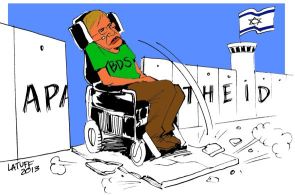
 My article for the “10 Reasons for a Cultural Boycott of Israel” campaign has prompted requests for a similar article about the academic boycott. So without further ado: 10 reasons for an academic boycott of Israel.
Continue reading “10 Reasons for an Academic Boycott of Israel”
The Guns of August
The Guns of August is a documentary film based on Barbara Tuchman’s Pulitzer Prize winning history on the outbreak of World War I.
Brave New World, A Discussion
Melvyn Bragg and guests David Bradshaw, Daniel Pick and Michele Barrett discuss Aldous Huxley’s dystopian 1932 novel, Brave New World.
A Leftist Response to Leftist Delusions on Syria
This excellent piece was written by Shiar in response to Stop the War’s Lindsey German (who can’t even get the Syrian president’s first name right) and was first published at the Syria News Wire.
“Being anti-imperialist yet West-centric,” writes Shiar, “just does not work: it is still Orientalism. This Orientalist (and statist) world view is so dominant within the Western Left that even a mass, popular uprising is reduced to a Western-manufactured conspiracy (which is, incidentally, the same line as that the Syrian regime has been repeating). It not only ignores facts on the ground and the complex political dynamics at play in those countries, but also overlooks those people’s agency and reduces them to either some inferior and stupid stereotype (Islamist terrorists) or some romanticised mythical version that is compatible with the dominant Western values (pro-democracy, peaceful, etc.).”
I have no idea where you get your news about Syria from, but it strikes me that it’s probably mostly from the Guardian, BBC and other establishment mouthpieces (when it comes to foreign policy anyway). For how else can one explain your sudden realisation that Syria is only now “descending into hell”? Really?! All this death and destruction over the past 26 months has not been hellish enough for you? Only now, when your beloved mainstream media start to recycle some state propaganda nonsense about the conflict in Syria taking (yet another) dangerous turn or crossing some ‘red line’, do your alarm bells start to ring?
You see, information sources are not just about information; they also shape your perspective. As a Leftist activist, one would have thought you would mention – at least once, in passing – the popular uprising or the revolution, what Syrians think and want, or anything remotely related to people. Instead, all you obsess about is big politics from a statist perspective: regime change, foreign intervention, regional war, Israel, Iran, bla bla bla. Continue reading “A Leftist Response to Leftist Delusions on Syria”
I, Claudius
I, Claudius is a 1976 BBC Television adaptation of Robert Graves’s I, Claudius and Claudius the God. Written by Jack Pulman, it proved one of the corporation’s most successful drama serials of all time.
It starred Derek Jacobi as Claudius, with Siân Phillips, Brian Blessed, George Baker, John Hurt and Patrick Stewart.
Graves’s I, Claudius is in the List Muse 100 Best Novels of All Time and the Modern Library’s 100 Best Novels.
For the DVDs try here in the UK and here in the USA.
Source: Wikipedia; For an episode guide see here. There’s a documentary on the series here and there’s a humourous tribute to the show by Sesame Street here.
1. A Touch of Murder
Ambiguous drone policies cast doubt on Obama’s lofty pledges
An earlier version of this appeared in The National last week.

It was a “season of fear,” he said. Government trimming facts and evidence “to fit ideological predispositions”; making “decisions based on fear rather than foresight; setting aside principles “as luxuries that we could no longer afford”. “In other words,” he concluded, “we went off course”.
We “cannot keep this country safe unless we enlist the power of our most fundamental values”, he said. Institutions will have to be updated with “an abiding confidence in the rule of law and due process; in checks and balances and accountability.”
It was a fine speech: thoughtful, bold, idealistic. US president Barack Obama delivered it at the National Archives in Washington, on May 21, 2009.
Last Thursday, when President Obama again addressed the question of national security, he sounded equally high-minded. But where in his first speech he had to address the excesses of his predecessor; this time he had his own to consider. The most serious of these were born of Obama’s inability to deliver fully on promises he made in 2009.
At the National Archives speech, Obama had vowed to end torture, shut down CIA black sites, and close Guantanamo. It was the clean break he had promised his base. But faced with a Republican backlash, Obama caved. Torture and black sites were abolished, but Guantanamo remained. Torture memos were released, but torturers roamed free. And to shield himself against charges of weakness, Obama escalated the covert war.
Continue reading “Ambiguous drone policies cast doubt on Obama’s lofty pledges”
Joseph Stiglitz and Paul Krugman on the Economy
What do you get when you put two of the most well known and most widely cited economists in the world, both Nobel laureates, on stage together? A healthy dose of economic reality. Jojn Joseph Stiglitz and Paul Krugman for a conversation on the economy.
Azmi Bishara on Syria
The subtitled last few minutes of a Jazeera Arabic interview with the great Palestinian thinker, in which Azmi expresses his disgust with those who fail to recognise the incredible revolutionary spirit of the Syrian people. “The Syrian people are the ones who turned out to be strong!” he exclaims. “An admirable, heroic, great people! In the face of planes and tanks and artillery. I salute the people of al-Qusair! … This is what we ought to be impressed by!”
Tales in a Kabul Restaurant
by Kathy Kelly
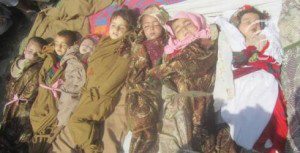
May 21, 2013 – Kabul–Since 2009, Voices for Creative Nonviolence has maintained a grim record we call the “The Afghan Atrocities Update” which gives the dates, locations, numbers and names of Afghan civilians killed by NATO forces. Even with details culled from news reports, these data can’t help but merge into one large statistic, something about terrible pain that’s worth caring about but that is happening very far away.
It’s one thing to chronicle sparse details about these U.S. led NATO attacks. It’s quite another to sit across from Afghan men as they try, having broken down in tears, to regain sufficient composure to finish telling us their stories. Last night, at a restaurant in Kabul, I and two friends from the Afghan Peace Volunteers met with five Pashtun men from Afghanistan’s northern and eastern provinces. The men had agreed to tell us about their experiences living in areas affected by regular drone attacks, aerial bombings and night raids. Each of them noted that they also fear Taliban threats and attacks. “What can we do,” they asked, “when both sides are targeting us?”
Everybody has to buy bread
The following piece appears on the London Review of Books Blog.

For most of the world’s media, Pakistan’s general election was about terrorism. Candidates were identified according to their attitude towards the Taliban, and labelled as ‘secular’ or ‘conservative’. Little was said about party platforms. Circumstances appeared to justify the focus. There was a savage campaign of intimidation by domestic extremists in the run-up to the vote. More than a hundred people died, most of them members of the outgoing ruling coalition parties. The Awami National Party (ANP) and the Pakistan People’s Party (PPP) said they were targeted because of their uncompromising attitude towards the Taliban and avowedly secular views. There is some truth to this; but their enthusiastic embrace of the ‘global war on terror’ was a more immediate cause.
Despite the violence, turnout was nearly 60 per cent, the highest in Pakistan’s history. Youth participation was unprecedented. Critics of the ‘war on terror’ roundly defeated its supporters. Imran Khan’s Pakistan Tehreek-e-Insaf (PTI), which has taken a consistent antiwar position, crushed the ANP in the north-west. The PTI did particularly well in Swat, Dir and the Federally Adminstered Tribal Areas, where most of Pakistan’s counterinsurgency operations and US drone attacks are carried out. Also leery of the war, Nawaz Sharif’s Pakistan Muslim League (PML-N) evicted the PPP from Punjab, Pakistan’s richest, most populous and developed province.
Terrorism may be foremost in the minds of Western observers; Pakistanis are more worried about the economy, education and corruption. Opinion polls showed that people’s biggest concerns are inflation and unemployment, as well as power outages and high energy costs, which have stunted economic growth and caused much misery: 20-hour blackouts are not unknown. Not all Pakistanis are exposed to terrorist violence; everyone has to buy bread.
You can read the rest here.

