The great scholar Kenneth Waltz has recently passed away. Waltz is famous for writing Man, The State, and War, a classic of International Relations, which is number one in Stephen Walt’s top ten IR books list and made the List Muse top 100 nonfiction books list. More recently he wrote an article on Why Iran Should Get The Bomb, and spoke on Israel and the US. In the following hour-long interview, Waltz describes his life and work in detail.
The Jenin Jenin Amendment: Israel from Ethnocracy to Fascism

Last Monday, on the 6th of May, Israel’s Ministerial Committee for Legislation decided to approve the “Jenin Jenin Amendment” in a paramilitary hearing. The amendment [Hebrew] is an addition to the Israeli Defamation Law [Hebrew], stating that army personnel and the state can sue individuals, who expose army violence, for libel, without proving damages. The amendment comes as a reaction to Israel’s Supreme Court rejecting soldiers’ class action suit of defamation against actor/director Mohammad Bakri, for his documentary Jenin Jenin (watch it in full here), in which Palestinian testimonies describe their experiences of the 2002 massacre perpetrated by Israel’s army in the besieged refugee camp.
Continue reading “The Jenin Jenin Amendment: Israel from Ethnocracy to Fascism”
The Rise of the West
William H. McNeill talks about the study of history and how he came to write The Rise of the West.
Immediate Responses to Israel’s Attack
 Israel’s attack on Assad’s military bases on Mount Qassioun above Damascus have provoked mixed feelings amongst Syrians. On the one hand, Syrians have been well aware for over two years that Assad’s army is designed not to confront Zionism but to slaughter the Syrian people. For a year and a half Mount Qassioun has been the launching pad for for artillery and missile attacks on civilian areas of Damascus and its suburbs. On the other hand, hatred and mistrust of Israel rightly runs very deep indeed among the people, far deeper than among the regime which, despite all its rhetoric, has not once (since 1973) responded to Israeli violations of Syrian sovereignty. Syrians know that Israel’s attack is an attempt to exploit the revolutionary situation for Israel’s own ends, that it is part of Israel’s confrontation with Iran – something Syrians want no part of, however much they may hate Iran’s criminal support of the genocidal Assad regime – and that it offers grist to Assad’s propaganda mill.
Here are some immediate responses to Israel’s attack. The Syrian National Coalition released this statement, including this line: “The Coalition holds the Assad regime fully responsible for weakening the Syrian Army by exhausting its forces in a losing battle against the Syrian people.” Many Arabic language Youtube videos show various Free Army and Salafist militias condemning both Israel and Assad’s regime.
I wrote this on Facebook:
Assad responds to the Israeli attack by escalating his sectarian massacres on the coast and his bombardment of Syrian cities, including the Palestinian refugee camp at Yarmouk. Infantile so-called ‘anti-imperialists’ everywhere cheer on Assad’s ‘heroic resistance’.
By ‘sectarian massacres on the coast’ I was referring specifically to the ongoing slaughter of Sunnis in al-Bayda and other areas of Banyas, causing thousands to flee the area.
Thomas Pierret on the Syrian Revolution

I hate to link to the Angry Arab for various reasons. This is the man who, on the one hand, was only able to mention Juliano Mer Khamis, the martyred Palestinian founder of Balata refugee camp’s Freedom Theatre, in the context of slandering his mother’s ethnicity (yes, she was an Israeli Jew, but one who chose to marry a Palestinian – and Juliano was a man who could have used his mother’s identity to live between the bars and beaches of Tel Aviv, but chose to live and work in occupied Nablus instead). On the other hand he slanders serious scholars like Mearsheimer and Walt, men who have done such important work on exposing the machinations of the Israel Lobby in the US, by accusing them of anti-semitism. (I wonder why he, an American-based academic, has had so much less trouble with people like Campus Watch than real intellectuals like Edward Said and Norman Finkelstein, who made much less dramatic anti-Israel statements). His coverage of the Syrian Revolution has been appalling. He has relied on informants such as ‘an American friend’ to inform his readership that the revolutionary suburbs of Damascus are ‘like Kandahar’ (usually he is overquick to accuse Western commentators of Islamophobia). He has consistently exaggerated the barbarism and sectarianism of elements of the Syrian resistance while consistently underestimating or ignoring the sectarianism and barbarism of the Syrian regime. The questions he poses in this interview with Syria expert Thomas Pierret expose his sectarian bias, but Pierret’s responses are so clear and well-informed that the post deserves reposting here.
“1) You and I have disagreed on Syria, do you think that Syria experts have been wrong in the last years especially with the regular and constant predictions of the imminent fall of the regime?
The generalisation is problematic. Such predictions were rather made by journalists, who have the good excuse of not being Syria experts, and Western officials, who often did so for a bad reason, i.e. in order to justify their inaction: if Asad is about to fall, then there is no need to do anything to stop him.
“Experts” did not collectively agree upon the imminent fall of the regime. In early April 2011, I published an op-ed in the French newspaper Le Monde. The last sentence said this: “Nothing guarantees the success of the Syrian revolution, and if it happens at all, it will certainly be long, and painful” . I was not the only one to think that way. I clearly remember a conversation I had at the same time with Steven Heydemann, who was even more pessimistic than I was: he predicted that the regime would use its full military might against the opposition, and that none would act to stop it.
I must admit that later developments made me over-optimistic at times, but overall, I do not think I have seriously under-estimated the solidity of the regime.
Why Support the Syrian Revolution
Those infantile apologists for fascism who imagine against the facts that Syria’s popular revolution is a foreign conspiracy won’t like this piece by Michael Neumann, a frequent contributor to Counterpunch and the son of Franz Neumann, the analyst of modern fascism. It is however, one of the most morally compelling pieces on Syria that I have read. Originally published at Insufficient Respect.
Many reasons are given for supporting either the Syrian revolution or the units of the Free Syrian Army (FSA). But while there is sympathy for the Syrian people, hardly ever do those reasons speak to or from Syrian needs. Instead the appeal is to the quite narrow interests of others, always in negative terms: not supporting the FSA will encourage Islamic extremism, invite a regional conflagration, squander opportunities to ‘have a say in Syria’s future'(!), counter-productively encourage uncontrolled arms proliferation, leave a legacy of anti-Western sentiment in S yria. Syrians are essentially seen either as a menace, or as weaklings likely incapable of countering some menace in their midst.
 yria. Syrians are essentially seen either as a menace, or as weaklings likely incapable of countering some menace in their midst.
Of course the idea here is that solid reasons can only rest on hard-headed realism, not sloppy sentiment. But there may be at least two other reasons rooted in a less myopic assessment of the situation. They invoke principles and large historical opportunities – which does not distinguish them from the sort of ‘higher’ motives that in fact drive a good deal of political activity. They do have implications for the whole world, but they originate not only in the interests but also in the achievements of the Syrian people and their revolution One reason is ‘negative’, the other, positive.
The negative reason has to do with what Syrians suffer.
It’s taken me a while to realize that most people probably don’t really know the full extent of Assad’s cruelties, or how they compare to the cruelty we know has been inflicted in so many times and places. It’s not the sort of material that makes the front pages. An appendix to this post gives some details. For several reasons, none solely sufficient but in combination decisive, the horrors of Syria have unique significance.
First there is the sheer barbarism. Many régimes which have inflicted tortures perhaps as ghastly as Assad’s – Chile’s Pinochet and the Iran under the Shah come to mind – do not quite match his barbarism for one simple reason: Assad’s tortures are not confined to adults, much less to those who have ever posed any threat, but also to children not into their teens. The torture of injured people in their hospital beds, and of medical staff, is also very unusual. Sometimes victims are tortured in order to reveal information, or at least to admit to something, whether or not they did it. Often they are simply tortured to death, simply to have them die in agony.
Second there is the scale of it. Those tortured run into the tens, perhaps the hundreds of thousands. Multiple deaths under torture are reported almost daily. Perhaps as many suffered in Cambodia, or Rwanda, or the Congo; no figures are available.
Solidarity with Syria
Published at the Global Campaign of Solidarity with the Syrian Revolution, this petition in support of the Syrian people’s struggle against dictatorship and genocide has been signed by leftist luminaries such as Norman Finkelstein, Gilbert Achcar and Tariq Ali (how good it is to welcome the latter back), academics of the stature of Frederic Jameson, Syrian intellectuals such as Yassin al-Haj Saleh, novelists such as Khaled Khalifa, and on the ground activists such as Razan Ghazzawi.
Who we are
As intellectuals, academics, activists, artists, concerned citizens, and social movements we stand in solidarity with the Syrian revolution and people’s struggle against dictatorship. Join us on Facebook.
Solidarity With the Syrian Struggle for Dignity and FreedomWe, the undersigned, stand in solidarity with the millions of Syrians who have been struggling for dignity and freedom since March 2011. We call on people of the world to pressure the Syrian regime to end its oppression of and war on the Syrian people. We demand that Bashar al-Asad leave immediately without excuses so that Syria can begin a speedy recovery towards a democratic future.
Since March 2011, Asad’s regime has steadily escalated its violence against the Syrian people, launching Scud missiles, using weapons banned by the Geneva Convention such as cluster bombs and incendiary munitions, and using aerial bombardment. The regime has detained and tortured tens of thousands of people and committed untold massacres.
It has refused political settlements that do not include Asad in power, and it has polarized the society through strategic acts of violence and by sowing seeds of division. The regime has also, since the early days of the uprising, sought to internationalize the crisis in order to place it within geopolitical battles that would only strengthen the regime.
Staying true to the logics of an authoritarian regime, Asad could never accept the legitimate demands of the Syrian people for freedom and dignity. Thus, there is no hope for a free, unified, and independent Syria so long as his regime remains in power.This is a revolt that was sparked by the children of Deraa and the sit-ins and demonstrations of the youth in the cities, the peasants of the rural areas, and the dispossessed and marginalized of Syria. It is they who rallied non-violently through protests and songs and chants, before the regime’s brutal crackdown.
Since then, the regime has pushed for the militarization of the Syrian nonviolent movement. As a result, young men took up arms, first out of self-defense. Lately, this has resulted in attempts by some groups fighting the regime to force a climate of polarization, and negation of the Other politically, socially and culturally. These acts that are in themselves against the revolution for freedom and dignity.Yet, the revolution for freedom and dignity remains steadfast. It is for this reason that we, the undersigned, appeal to those of you in the global civil society, not to ineffective and manipulative governments, to defend the gains of the Syrian revolutionaries, and to spread our vision: freedom from authoritarianism and support of Syrians’ revolution as an integral part of the struggles for freedom and dignity in the region and around the world.
The fight in Syria is an extension of the fight for freedom regionally and worldwide. It cannot be divorced from the struggles of the Bahrainis, Egyptians, Tunisians, Libyans, Yemenis, and other peoples who have revolted against oppression and authoritarianism as well as against those seeking to usurp or destroy the uprisings and divert them for their own agendas. It is connected to the Palestinians’ struggle for freedom, dignity and equality.
The revolution in Syria is a fundamental part of the North African revolutions, yet, it is also an extension of the Zapatista revolt in Mexico, the landless movement in Brazil, the European and North American revolts against neoliberal exploitation, and an echo of Iranian, Russian, and Chinese movements for freedom.The Syrian revolution has confronted a world upside down, one where states that were allegedly friends of the Arabs such as Russia, China, and Iran have stood in support of the slaughter of people, while states that never supported democracy or independence, especially the US and their Gulf allies, have intervened in support of the revolutionaries. They have done so with clear cynical self interest. In fact, their intervention tried to crush and subvert the uprising, while selling illusions and deceptive lies.
Given that regional and world powers have left the Syrian people alone, we ask you to lend your support to those Syrians still fighting for justice, dignity, and freedom, and who have withstood the deafening sounds of the battle, as well as rejected the illusions sold by the enemies of freedom.
As intellectuals, academics, activists, artists, concerned citizens, and social movements we stand in solidarity with the Syrian people to emphasize the revolutionary dimension of their struggle and to prevent the geopolitical battles and proxy wars taking place in their country. We ask you to lend your support to all Syrians from all backgrounds asking for a peaceful transition of power, one where all Syrians can have a voice and decide their own fate.
We also reject all attempts of any group to monopolize power, and to impose its own agenda, or to impose unitary or homogenous identities on the Syrian people. We ask you to support those people and organizations on the ground that still uphold the ideals for a free and democratic Syria.
Continue reading “Solidarity with Syria”
The Wall
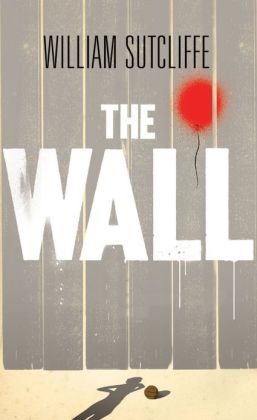 This review was published at the Independent.
Joshua lives in a brand new town called Amarias. He shares his brand new house with his mother who, since his father’s death in battle, has been “like a pane of glass riddled with cracks that was still somehow sitting there in the frame,” and also with tree-killing Liev, the “anti-father” whose cloying unpleasantness is a great pleasure to read.
One day, chasing a lost football and propelled by an overbearing curiosity, Joshua discovers a tunnel which leads under a wall to an entirely different world – one containing both danger and kindness, and a beguiling young girl. As storytellers from CS Lewis to Philip Pullman know, there’s something archetypal about holes in walls opening onto entirely unexpected realms; and tunnels to wonderland have been evoking rebirth since ancient cave painters squeezed through crevices to make their sacred art. William Sutcliffe employs all this rites-of-passage symbolism with a very light touch, and crafts his novel with sustained suspense.
The new world is not named (not until page 80 is it called “the Occupied Zone”; and the words ‘Israel’ and ‘Palestine’ are never mentioned) – in this way the book avoids being self-professedly ‘political’ – yet the place is described with great accuracy and atmospheric precision. An “aftertaste of violence is hanging in the air, like a bad smell.” The houses are close-packed, unpainted, unfinished. The shops spill onto cracked streets which are “both enticingly alive and strangely depressing.” Those who know will recognise “the mournful wail of a solo voice backed by violins” as the Egyptian diva Um Kalthoum, but Joshua doesn’t know. He doesn’t even speak the language, though the inhabitants speak his.
Amarias, on his side of the wall, with its lawns and pools and rows of identical houses, is clean and fresh “as if a magic spell has conjured it up out of thin air.” Once Joshua has tasted forbidden knowledge, the town, and the fact that no-one around Joshua seems to recognise the absurd ephemerality of its situation, become darkly surreal.
Ten Months of the Muslim Brotherhood
Sarah Eltantawi sums up a disappointing ten months in Egypt. This was published at Fair Observer.
As I write this, a Coptic cathedral in Cairo’s Qalioubiyya has been attacked by masked gunmen during a funeral for victims of an earlier sectarian clash. If you had told me one year ago that I would be writing such a sentence about Egypt, I would probably not have believed you. It is not that there hasn’t been a long and worsening problem with sectarian attacks in Egypt – we only need to remember the horrific attack on the church in Alexandria on New Year’s Eve, 2010-2011, which foreshadowed the revolution to put this serious problem in perspective. But masked gunmen firing automatic rifles during a funeral? These were the problems, for example, of post-invasion Iraq, or a Pakistan which has been bedeviled for years now by a steadily failing state.
The Egyptian Government’s Performance
The unelected public prosecutor’s recent issuance of an arrest warrant for the country’s most famous satirist, Bassem Youssef, known as Egypt’s “Jon Stewart” (of the popular American television show “The Daily Show”) for allegedly insulting Mohammed Morsi and insulting Islam is another recent ominous event, not least because there appeared to be little attempt to distinguish the two offenses. What has happened to bring Egypt to this point, just under ten months after the Muslim Brotherhood took power?
Before commencing a short review of the Muslim Brotherhood’s performance thus far, a word on the analytic frame employed to analyze the government’s performance. In what follows, I will list a number of important issues facing Egypt, and give a short synopsis of the progress that has been made or the lack thereof. There are observers of Egypt who would not find such an exercise useful in the first place. Their contention is that it is unrealistic to expect a transitional government to have accomplished much, especially under worsening economic conditions and in the context of a polarized country with a recalcitrant and unfocused opposition.
This is how I felt for the first six months. And while it remains utterly unrealistic to expect the government to have solved the massive problems facing Egypt, it is certainly fair enough to note what the government has been focusing on, what the government has been neglecting, and certain patterns of their actions.
A.J.P. Taylor: How Wars Begin, and How Wars End
Historian A.J.P. Taylor, author of the famous and controversial Origins of the Second World War, gives a series of talks for the BBC on the causes of war, titled How Wars Begin; and for Channel 4 on How Wars End.
How Wars Begin
Continue reading “A.J.P. Taylor: How Wars Begin, and How Wars End”

