The Haitian Revolution

Even if you have been watching Democracy Now’s outstanding coverage of the Haitian tragedy, the despicable neglect with which the United States and other rich countries have treated the disaster-struck nation, you still can’t fathom the depth of outrage the Haitians feel unless you put it into the context of its tortured history. Here is an excellent overview from C. S. Soong’s Against the Grain.

It was a cataclysmic event, the first and only successful slave revolution in the Americas. In 1791 brutally exploited slaves on a small Caribbean island rose up and eventually won emancipation. Their story, a legacy that has inspired and instructed people and nations for centuries, is told in Laurent Dubois’s Avengers of the New World.

Worst decision since Dred Scott

The US Supreme Court has ruled that as a legal ‘person’ a corporation can spend unlimited amounts in an election campaign to elect its preferred candidates. The lax campaign financing rules already allowed lobby groups such as AIPAC to funnel massive amounts to candidates through individuals. Instead of reforming the system, as people like Ralph Nader have been demanding for years, the court further hacks away at democratic checks and balances. The ruling has been rightly compared to the Dred Scott case justifying slavery. Here is a clip of Robert Weissman summing up what consequences this might have for US democracy (to the extent that it exists) followed by a statement by Ralph Nader. (For Americans who want to save their democracy, here is a campaign they can join: http://www.movetoamend.org/. Also check out Public Citizen’s proposed action).

Continue reading “Worst decision since Dred Scott”

The Tyranny of Positivity

My friend’s childhood friend recently passed away after a painful bout with cancer. She was abandoned by her boyfriend because she was ‘too negative’ about her illness. A mutual friend of my friend’s also blamed the ailing woman for being too negative. If she couldn’t be positive about her disease, then she must in part have been responsible for her own decline. Or so the thinking goes.

If there is anything unique about this story, it is the nationality of the cast: they are Italian. In the United States, this is the norm. People who suffer from debilitating diseases are not only expected to endure the pain but also to put on a brave face. If they don’t, then friends can abandon them with a clear conscience. They just aren’t being positive, and hence are the architects of their own decline.

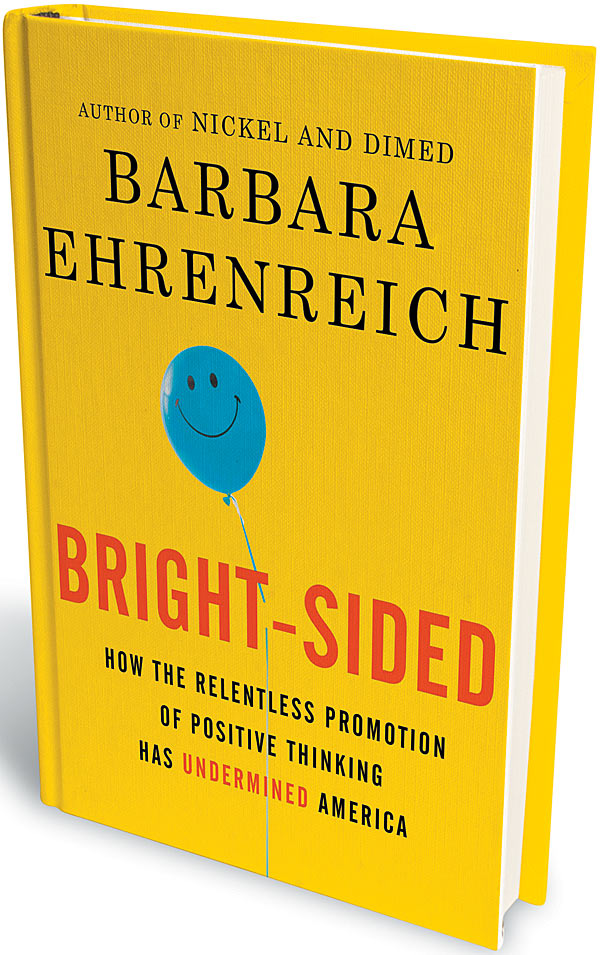
Positivity became the reigning attitudinal orthodoxy around the time of the ‘Reagan Revolution’, but it has its roots farther back in Calvinist theology. God rewards piety and hard work with success; failure, perforce, is evidence of sloth. Sidney Blumenthal once ironically summed up the mindset as ‘God takes most pleasure in people who are most pleased’. Reagan turned positivity into the central tenet of American civic religion. This also freed the New Right from the responsibility of caring for the destitute and vulnerable: if they aren’t doing well the fault must necessarily lie with them. It has come to a point, notes Barbara Ehrenreich in this excellent interview on Media Matters, that even people who lose their jobs are expected to be positive about it. Since a negative attitude will merely prove that their dismissal was justified.

As for illness, Tony Judt ends a recent essay about the torment of enduring nights while suffering from ALS thus: ‘Loss is loss, and nothing is gained by calling it by a nicer name. My nights are intriguing; but I could do without them.’


Continue reading “The Tyranny of Positivity”

The Ever-changing Narrative of Guantanamo: Guantanamo Suicides now Guantanamo murders?

According to a joint investigation for Harper’s Magazine and NBC, the infamous Guantanamo suicides – or so we were told at the time-  of three detainees in June 2006, were in actuality probably murders. The new investigation reveals that  the deaths of 37 year old Yemeni, Salah Ahmed al-Salami and two Saudis, Talal al-Zahrani, 22, and Mani Shaman al-Utaybi, 30, most probably resulted from suffocation under conditions of harsh interrogation and torture.  At the time of the event in question, the camp’s commander interpreted the deaths of these men as “an act of asymmetrical warfare”, rather than desperation.

Based on the six-month investigation, here are some of the findings that compelled Harper’s and NBC to claim that – contra to the widely accepted narrative of suicide –  the evidence now points towards murder:

Continue reading “The Ever-changing Narrative of Guantanamo: Guantanamo Suicides now Guantanamo murders?”

Tough Minds and Tender Hearts

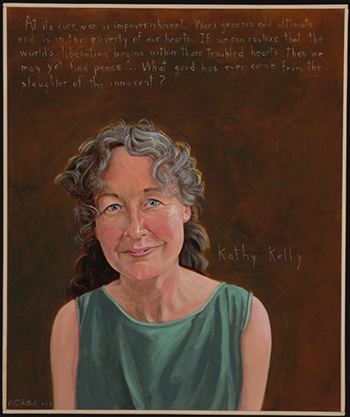
by Kathy Kelley

I spent Martin Luther King, Jr’s birthday in Washington, D.C. as part of the Witness Against Torture fast, which campaigns to end all forms of torture and has worked steadily for an end to indefinite detention of people imprisoned in Guantanamo, Bagram, and other secret sites where the U.S. has held and tortured prisoners.  We’re on day 9 of a twelve day fast to shut down Guantanamo, end torture, and build justice

The community gathered for the fast has grown over the past week.  This means, however, that as more people sleep on the floor of St. Stephen’s church, there is a rising cacophony of snoring.  Our good friend, Fr. Bill Pickard, suggested trying to hear the snores as an orchestra, when I told him I’d slept fitfully last night.

There is a young boy in Mir Ali, a town in North Waziristan, in Pakistan, who also lies awake at night, unable to sleep.  Israr Khan Dawar is 17 years old.  He told an AP reporter, on January 14th, that he and his family and friends had gotten used to the drones.  But now, at night, the sound grows louder and the drones are flying closer, so he and his family realize they could be a target.  He braces himself in fear of an attack.

Continue reading “Tough Minds and Tender Hearts”

From the Belly of the Beast: An Inside look into the Israeli Justice System

Looking mighty dangerous from where I'm standing..

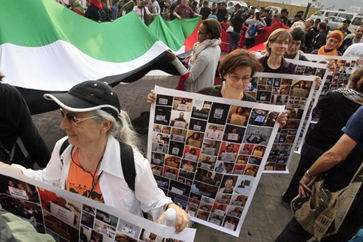
“Sorry baby, I won’t be able to make it tonight, I’m in the police van.” A sentence every Israeli pro-Palestinian activist will utter soon enough, just as I have, this Friday afternoon. Already 70 activists have been wrongfully arrested during the weekly protests in Sheikh Jarrah, under the charges that we riot, conduct unlicensed demonstrations and assault officers.

Demonstrating in Israel 2010
Our day started at Al-Ma’asara village, where the army has escalated its repression of the local popular struggle [1,2]. Fortunately, this week’s demonstration was as calm as a demonstration can be, when you’re surrounded by hostile armed forces, and we were relieved that there were no incidents out of the ordinary occupation. (Unfortunately, the one week I don’t go to Bil’in, an escalation occurs, and I wasn’t there alongside my friends.) The protest was kept short and we all hopped in the cars to get to Sheikh Jarrah.

Continue reading “From the Belly of the Beast: An Inside look into the Israeli Justice System”

America’s Quaking Racial Divide

Martin Luther King Jr

On Martin Luther King Jr. Day, Andrew Oxford reflects on America’s extant racial divide and the lingering threat of white nationalism.

In the preface to his monumental study of the contemporary American white supremacist movement (1), Leonard Zeskind points to the Sarajevo Haggadah for a pertinent lesson on race and society. A Hebrew text of stories, songs, and prayers written by Spanish Jews around 1314, it arrived in the Yugo peninsula with Sephardic Jews fleeing the Inquisition. In the nineteenth century, it was entered into the Sarajevo Museum and saved from invading Germans during World War II by the Croation curator. For the duration of the war, it was guarded by Muslim clerics and it currently resides in the vaults of the Serbian National Bank while it is revered as a cultural icon of all peoples of the region. Reflecting upon the curious history of this relic, Zeskind writes:

It is useful to remember that at one time a hodgepodge of religious and ethnic groups lived together in relative harmony. Places like Sarajevo were cosmopolitan centers of learning and culture for centuries. But in a matter of a few historical seconds, the whole place went up in flames, like a refugee hostel attacked by arsonists…

The United States, unlike the former Yugoslavia, has well cemented the foundations of its federal order in the 150 years since our own Civil War, and the election of a black man, Barack Obama, has broken the white monopoly on the presidency. Nevertheless, collective identities based on race and religion have remained just under the skin of American life. As such, we will continue to be vulnerable to the machinations of … white nationalists … particularly as population demographics shift in the next few decades. For those of us who hope to protect and extend our multiracial democracy, and the cosmopolitanism of the type that preserved the Sarajevo Haggadah, we ignore this white nationalist movement at our own peril.

Continue reading “America’s Quaking Racial Divide”

The GFM, Palestinian Non-Violence and International Solidarity

Writer, graduate student and organizer Max Ajl was in Cairo earlier this month along with 1,300 other activists who had gathered from all over the world to protest the illegal blockade of Gaza.  The following is an article written by Ajl which includes his reflections on the Gaza Freedom March (he was a principal organizer) and the concept of international solidarity and non-violence in the Palestinian context.

I’m going to discuss the utility of non-violent resistance as it applies to resolving the Israel-Palestine conflict and, specifically, the occupation and blockade of the Gaza strip.  Even more specifically, I’m going to discuss the Gaza Freedom March (GFM), of which I’m one of the organizers.  But before discussing Palestinian non-violence, several things must be clarified.  One is that no one — least of all me, a Jewish kid from Brooklyn — has the slightest right to dictate to the Palestinians how to end the blockade or resist the occupation.  Another is the need to avoid the nearly inevitable antiseptic air to talk by Westerners discussing Palestinian non-violence.  Antiseptic, because it is cleansed of the complicating grit of the occupation within which non-violence must take place.  There’s also usually a tacit subtext, usually a four-word question: Where Is Their Gandhi?  That question could not be more in error.  I hope to show why.

Continue reading “The GFM, Palestinian Non-Violence and International Solidarity”

Haiti and the Instruments of Death

This is how the ‘International Community’ (read the West) is responding to the tragedy in Haiti: still no aid, yet plenty of guns. US has taken control of the Port-au-Prince airport and according to Al Jazeera it is turning back aircraft with much needed aid from other nations.

Don’t miss Patrick Cockburn’s brilliant piece. Here are some highlights:

The rhetoric from Washington has been very different during these two disasters, but the outcome may be much the same. In both cases very little aid arrived at the time it was most needed and, in the case of Port-au-Prince, when people trapped under collapsed buildings were still alive…In New Orleans and Port-au-Prince there is the same official terror of looting by local people, so the first outside help to arrive is in the shape of armed troops. The US currently has 3,500 soldiers, 2,200 marines and 300 medical personnel on their way to Haiti…

A sour Haitian joke says that when a Haitian minister skims 15 per cent of aid money it is called “corruption” and when an NGO or aid agency takes 50 per cent it is called “overheads”…

Continue reading “Haiti and the Instruments of Death”

Inviting David Brooks to My Class

The Zionists are prisoners of a bad dream: they must first free themselves, break free from the prison in which they can only play the part of tormentors, if they and especially their Palestinian victims are to live normal lives.
M. Shahid Alam

On January 12, the New York Times carried an article by David Brooks on Jews and Israel. It so caught my eye, I decided to bring its conservative author to my class on the economic history of the Middle East. I sent my students the link to this article, asked them to read it carefully, and come to the next class prepared to discuss and dissect its contents.

My students recalled various parts of the NYT article but no one could explain its substance. They recalled David Brooks’ focus on the singular intellectual achievements of American Jews, the enviable record of Israeli Jews as innovators and entrepreneurs, the mobility of Israel’s innovators, etc. One student even spoke of what was not in the article or in the history of Jews – centuries of Jewish struggle to create a Jewish state in Palestine.

But they offered no comments about Brooks’ motivation. Why had he decided to brag about Jewish achievements, a temptation normally eschewed by urbane Jews. In my previous class, while discussing Edward Said’s critique of Orientalism, I had discussed how knowledge is suborned by power, how it is perverted by tribalism, and how Western writers had crafted their writings about the Middle East to serve the interests of colonial powers. Not surprisingly, this critique had not yet sunk in.

I coaxed my students, asking them directly to explore if David Brooks had an axe (or more than one) to grind. Was there an elephant in the room they had missed? What was the subtext of the op-ed?

Continue reading “Inviting David Brooks to My Class”