Chris Hedges speaking at the Tabernacle Church fundraiser for www.ustogaza.org in Philadelphia on September 10, 2010.
Continue reading “Chris Hedges lends support to USToGaza.org”
Chris Hedges speaking at the Tabernacle Church fundraiser for www.ustogaza.org in Philadelphia on September 10, 2010.
Continue reading “Chris Hedges lends support to USToGaza.org”
Chris Hedges, Richard Bulliet and Zachary Lockman on Al Jazeera’s excellent Empire with Marwan Bishara.
On the 9th anniversary of 9/11, the fault lines between the US and the Muslim world seem to have expanded. As America’s internal cultural wars begin to affect its foreign policy, what are the options for President Obama? Which is the real US: The one that fights for Muslims in Iraq and Afghanistan, or the one that considers US Muslims as the enemy within? And have Osama bin Laden’s hopes of driving a wedge between the US and the Muslim world become a reality?
by Saffi Ullah Ahmad
Human rights activists and lawyers are mourning Lord Thomas Bingham of Cornhill who died on Saturday, 11 September, aged 76, following a struggle with cancer. A towering figure, many consider him to have been the foremost British jurist of the modern era.
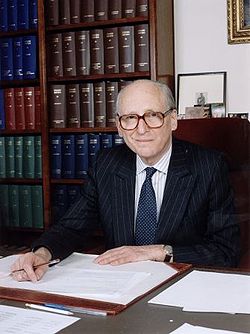
The son of two doctors, Thomas Bingham read modern history at Balliol College, Oxford and went on to pursue a career at the bar. Recognised as a formidable opponent in the courtroom (he was recently described by a senior barrister as having an ‘alpha-plus’ mind, and by other members of the judiciary as ‘frighteningly clever’), he quickly rose to prominence in the legal world, going on to hold the three top legal posts in the country; Master of the Rolls (1992-96), Lord Chief Justice (1996-2000) and senior Law Lord (2000-2008).
Known for being a staunch advocate of judicial independence and human rights, with a fiercely independent legal mind, he was never one to shy away from challenging the government. In the aftermath of 9/11, and throughout the ‘war on terror,’ his was a prominent voice amongst Law Lords standing against the excesses of the executive. Rejecting the British Government’s arguments relating to anti-terror legislation on numerous occasions, he stood firmly against the indefinite detainment of foreign nationals without charge and the use of evidence obtained by torture in what were highly influential and lengthy judgments that resonated around the world.
As a senior judge, Lord Bingham was instrumental in the introduction of the Human Rights Act (1996), which saw the incorporation of the European Convention of Human Rights (ECHR) in to British domestic law. He was of the opinion that human rights were non-negotiable and regularly hit back at affronts to the system of due process.
Continue reading “Losing Britain’s Greatest Modern Day Jurist”
by Kathy Kelly
 In the early 1970’s, I spent two summers slinging pork loins in a Chicago meat-packing factory. Rose Packing Company paid a handful of college students $2.25 an hour to process pork. Donning combat boots, yellow rubber aprons, goggles, hairnets and floor length white smocks that didn’t stay white very long, we’d arrive on the factory floor. Surrounded by deafening machinery, we’d step over small pools of blood and waste, adjusting ourselves to the rancid odors, as we headed to our posts. I’d step onto a milk crate in front of a huge bin full of thawing pork loins. Then, swinging a big, steel T-hook, I’d stab a large pork loin, pull it out of the pile, and plop it on a conveyor belt carrying meat into the pickle juice machine. Sometimes a roar from a foreman would indicate a switch to processing Canadian pork butts, which involved swiftly shoving metal chips behind rectangular cuts of meat. On occasion, I’d be assigned to a machine that squirted meat waste meat into a plastic tubing, part of the process for making hot dogs. I soon became a vegetarian.
But, up until some months ago, if anyone had ever said to me, “Kathy Kelly, you slaughtered animals,” I’m sure I would have denied it, and maybe even felt a bit indignant. Recently, I realized that in fact I did participate in animal slaughter. It’s similar, isn’t it, to widely held perceptions here in the United States about our responsibility for killing people in Afghanistan, in Pakistan, in Iraq and other areas where the U.S. routinely kills civilians.
Tariq Ali will be in Washington, DC on the 16th and New York on the 17th for the launch of his new book The Obama Syndrome: Surrender at Home, War Abroad. If you are in the vicinity, we strongly encourage you to attend.
 Continue reading “The Obama Syndrome – Booklaunch in DC and NY”
by Steven Harkins
Conspiracy theories exist in ‘the realm of myth’, where ‘imaginations run wild, fears trump facts, and evidence is ignored’ [i]. This is according to a website created by the US State Department to debunk a range of outlandish conspiracy theories.
Among the theories criticized on the website are conspiracies regarding the assassination of JFK, the moon landings, and the September 11th attacks [ii]. Alongside these well-known sources of wild speculation is the subject of depleted uranium (DU). The website states:
Uranium evokes very powerful fears. It is associated with atomic weapons, mass annihilation, radiation sickness, cancer and birth defects. Depleted uranium evokes these same fears, despite the fact that it has been depleted of much of its radioactivity. Fear-based associations can be more powerful than logic and facts. Compare how you feel about tungsten to how you feel about depleted uranium. Both are heavy metals, but “depleted uranium” might sound scarier to you [iii].
So the US State Department argue that when it comes to conspiracy theories ‘evidence is ignored’ and that it is ‘fear-based associations’ and not ‘logic and facts’ that have caused people to make a connection between birth defects, cancer and depleted uranium.
Continue reading “Evidence of WMD found in Iraq: The tragic legacy of Depleted Uranium”
Tens of thousands of people across Indian-administered Kashmir have joined protests against Indian rule in the Himalayan region. The Indian police has been battling to contain demonstrations for months, ignited by the killing of a 17-year-old student by police in June.
Al Jazeera’s Nilanjan Chowdhury reports.
Free Gaza’s Lauren Booth has an open video letter to the people of Israel.
Thirteen people were killed and hundreds wounded last week in Mozambique when police cracked down on a three-day protest over a 30 percent hike in the price of bread. The UN says the riots in Mozambique should be a wake-up call for governments that have ignored food security problems since the global food crisis of 2008, when countries around the world saw angry protests in the streets over the rising prices of basic food items. In this extremely informative interview on Democracy Now!, Raj Patel connects the dots between climate change, financial speculation, land grabs across Africa, food sovereignity and global hunger.
Also check out Johann Hari’s recent article on the “speculation-starvation-bubble” behind the 2008 global ‘food crisis’, below the fold.
Continue reading “Mozambique’s Food Riots – the True Face of Global Warming”
 P U L S E
