In three days of fighting 18 Palestinians have been killed and dozens injured, while two Israelis have been wounded.
Month: April 2011
Syrian Protests and Bullets
Three films from demonstrations in Syria yesterday. People protested in the suburbs of Damascus, Hama, Dera’a, the Kurdish north east, the desert town Raqqa and elsewhere. The first film shows a large crowd in Lattakia chanting ash-sha’ab yureed isqaat al-nizam – The People Want the Fall of the Regime. No reservations there. The second film shows security forces firing live ammunition at protestors in Homs. The third is Tartus. They’re chanting bi-rooh bi-dam nafdeek ya Dara’a – With Our Souls and Blood We Sacrifice for you, O Dara’a.
Cage and Wave

This interview with Syria Comment’s Joshua Landis is well worth watching for background on Syria’s sectarian divisions and their influence on current events. I agree with most of what he says but I differ with his interpretation.
Two basic points of Syrian history come through very clearly. Firstly, Syria is not a unified nation in the way that Egypt is. There has been some form or other of centralised control in the Nile valley for thousands of years. Syria’s geography and demography – it’s a country of mountains, competing market cities and desert oases – means that power in Syria has always been much more divided, and that Syrians would feel more at home in an all-encompassing nation larger than the borders drawn by imperialists. Landis points out that in Syria’s brief democracy (the late 40s and early 50s) not one political party accepted the country’s borders. They sought instead either a unified pan-Arab state or a restitution of Bilad ash-Sham, the zone of enormous diversity between the Taurus mountains, the southern desert and the Euphrates river which nevertheless constitutes one market area and enjoys a common Levantine culture. Bilad ash-Sham is sliced today into Syria, Lebanon, Jordan, Palestine-Israel, and a sliver of Turkey.
Secondly, Landis identifies the crucial power division determining politics in contemporary Syria. The pre-police state parliament was dominated by the urban Sunni merchant class, the traditional elite. The army which would soon make the parliament irrelevant was inherited from the French occupation. Partly because the wealthier classes shied away from the army, but mainly for the usual divide-and-rule reasons, the French built a military of minorities – Alawis, Christians, Druze, and marginalised rural Sunnis. The victory of the military over the parliament, and of the military wing of the Ba’ath party over all other parties, was a victory of the countryside over the city, of the periphery over the centre, of sectarian minorities over the Sunni majority. The Ba’ath years therefore oversaw a social revolution in the sense that previously distanced and despised rural classes moved to the cities and entered elites.
The Arab Awakening
The End of a Dictator. An excellent Al Jazeera documentary about the fall of Hosni Mubarak.
Driven by its youth, Egypt’s revolution embraced all sectors of society. As the fear barrier was broken, destinies were transformed by the tumultuous events. This film offers an examination of the demise of the Mubarak regime through the eyes of people whose lives were, until now, defined by it.
A Call from Home
By Majid Maqbool
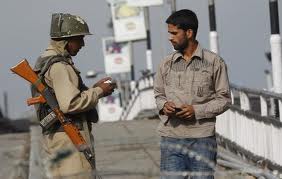
“Card chukha seath thavaan?”
(Do you carry the ID card with you?)
Mother worries over frequent phone calls
Away from home, home enters questions
‘Identity’ printed on a piece of paper
cuts through her voice; a discomforting lullaby:
“Card gase hamashe seath thavun”
(always carry the ID card with you)
Home leaves a permanent imprint…
On scattered notes, stamped on memories
At home, mother would tiptoe after me
At the door, before endless blessings, she always asked –
That question mothers have for their sons –
“Card tultha seath?”
(are you carrying your ID card?)
From Delhi now, your question settles on my unrest
Identity – detached from the card – hangs heavy
This is not Kashmir, mother
“Toete gase card seath thavun…”
(Still you must carry the card with you…)
The line dropped on this insistence
I kept redialing, to rest her concerns,
her unfinished questions, unanswered
Hello..helloo… mother
Can you hear me?
I left the card at home, mother
In the back pocket of my worn-out jeans

Find: a fading photograph, scrutinized edges
And no trace of those unrecognized questions
forever inked on my memory
For troops to question my absence
The proof I left behind is not enough
That frisked ID card remains
like a festering wound, pocketed pain
I carry everywhere
Majid Maqbool is a young journalist/writer from Kashmir. Some of his writings can be found on his blog maqboolvoice.blogspot.com.
Israel’s new assault on Gaza

The densely populated Gaza enclave is once again under Israeli aerial attack. Five people have been killed and over 30 injured already. Max Blumenthal calls the assault ‘Operation Goldstone,’ since Israel seems to be taking encouragement from the Judge’s partial retraction of his earlier report. Over at the Electronic Intifada Rami Almeghari reports:
As Palestinians were preparing for their weekend this Thursday afternoon, all of a sudden barrages of Israeli artillery fire and air raids by warplanes struck several regions of the Gaza Strip. Five Palestinians were killed and about thirty more injured.
Israeli shells struck farm land, homes, a mosque and an ambulance, and the injured were evacuated to al-Shifa hospital in Gaza City, Kamal Adwan hospital in northern Gaza and the Abu Yousif al-Najjar hospital in southern Gaza…
Sources at the al-Shifa hospital in Gaza City said that they received six injuries earlier this afternoon; among them were two women and several children.
Lion of the Desert
Link TV profiles the great Libyan revolutionary Omar al-Mukhtar.
Herbert Marcuse on the Frankfurt School
Herbert Marcuse gained world renown during the 1960s as a philosopher, social theorist and political activist; his most famous work is One-Dimensional Man, which had a strong influence on the New Left. Here he’s interviewed by Bryan Magee on the Frankfurt School.
Continue reading “Herbert Marcuse on the Frankfurt School”
Crossfire
A Daily Show classic: Colbert and Carell debate the Iraq war.
Rape in the US military
There were 19,000 in the year 2010 alone according to the Pentagon. Congresswoman Jackie Speier speaks out. (Also see Democracy Now’s coverage of rape in the ranks)
 P U L S E