Philip Levine: A Workingman’s Voice

By Feroz Rather

With a serene and distant view of the hills of Sierra Nevada, on 9 August, 2011, I sat in a library at California State University Fresno, reading The Simple Truth, a collection of poems by Philip Levine. The day after, Mr. Levine, 83, was being nominated by the Library of Congress the next poet laureate of the United States. The felicitations, however, had made their way to the poet’s home here in Fresno and thrilled the entire community of writers in the Central Valley of California. Brandi Spaethe, a friend and fellow writer in our MFA program, broke the news to me. And while walking this beautiful campus dotted with maple trees, with an ecstatic gusto of a poet-in-the-making, she fell into long recitations of many touching poems from the book.

Philip Levine was born in Detroit, Michigan, to Russian-Jewish immigrant parents in 1928, a year before the Great Depression started paralyzing the economy of the US. Levine was educated in Detroit public schools and at Wayne State University, Michigan’s only urban public research university. After graduation, Levine worked a number of industrial jobs, including the night shift at the Cheverolet Gear and Axle factory in 1953, working on his poems in his off hours.   In the fall of the same year, he journeyed to the University of Iowa to attend a poetry workshop. In his autobiographical account, The Bread of Time, he recalls: “The attraction at Iowa was Robert Lowell, whose Lord’s Weary Castle had received the Pulitzer Prize.”Afterwards, he became Stegner Fellow at Stanford University. And then in 1958, he came to Fresno and began teaching English and writing at California State University and which went on for 34 years.


Continue reading “Philip Levine: A Workingman’s Voice”

Shahid: A Ghazal

by Manash Bhattacharjee

To Najeeb Mubarki

Agha Shahid Ali (1949-2001)
Kashmiris will murmur the blessed word, Shahid,
when the Beloved no longer has to witness Shahid.
 
The day Paradise was lost, who was at the gates?
We only know boots of Hell marched in Shahid.
 
Rizwan couldn’t return to console his father –
he found refuge for days in your nightmares Shahid.
 
The Beloved left behind growing nights of sand    
and stars never slept in your deserted eyes Shahid. 
 
Mother’s death flung you into longing’s hollow arms.
Love’s ironic fate earned you her illness Shahid.
 
Continue reading “Shahid: A Ghazal”

Kargas

The following is cross-posted from Lobelog.com. 

Iran’s Zahedan airport is located on a road named for Allama Iqbal, the great Indian philosopher whom Pakistan after partition adopted as its national poet. The shaheen, or eagle, features prominently in Iqbal’s poetry, as a symbol of vigour, dignity and daring. It is contrasted against the figure of the kargas, or vulture, which represents cunning, cowardice and ignobility. It is the latter appellation that the region frequently applies to the CIA drones which today menace the skies from Waziristan, Kandahar to Zahedan. But shaheen or kargas, they are both ferocious; and it is a feat to capture either. Small wonder then, that some in Iran see cause for celebration in the capture of CIA’s RQ-170 Sentinel drone, a stealth surveillance craft manufactured by Lockheed Martin.

This is not the first time the CIA has delivered one of its most advanced aircraft for inevitable reverse engineering to its putative enemy. On April 9, 1960, people at the Zahedan airport watched anxiously as an aircraft with unusually wide wings approached from the north-east. The Lockheed U-2C was on a top-secret spying mission for the CIA, but its target was not Iran. Indeed, it was coming in to land after being chased by several fighter planes. Over the previous 8 hours, the plane had photographed four strategic Soviet military sites from an altitude of 70,000 feet, well out of the reach of the Russian MiGs and Sukhois. It embarked on its mission from the Badaber air force base 10 miles to the south of Peshawar.

Continue reading “Kargas”

The Terrible Beauty of Wikileaks

The following appears in The Arabs Are Alive, edited by Ziauddin Sardar and Robin Yassin-Kassab. 

On 7 December 2010, Tunisian despot Zine el Abidine Ben Ali’s regime blocked internet access to the Beirut daily Al-Akhbar for publishing a US embassy cable which painted the dictator, his wife and her family in a deeply unflattering light. In the July 2009 cable, US ambassador Robert Godec had accused Ben Ali’s regime of having ‘lost touch with the Tunisian people…[tolerating] no advice or criticism whether domestic or international,’ and of increasingly relying ‘on the police for control and focus on preserving power.’ The cable mentioned the growing ‘corruption in the inner circle,’ particularly around first lady Leila Trabelsi and her family, whom it said the Tunisians ‘intensely dislike, even hate.’ It finally concluded that ‘anger is growing at Tunisia’s high unemployment and regional inequities. As a consequence, the risks to the regime’s long-term stability are increasing.’

Ten days later in Sidi Bouzid, 26-year-old street vendor Muhammad Bouazizi immolated himself in front of the local municipality building after his vegetable cart was confiscated by Faida Hamdi, a female municipal official who had then slapped him, spat in his face, and insulted his dead father. Anguished friends and sympathizers soon took to the streets to protest, and Youtube, Facebook and Twitter helped spread the fire further—the long deferred anger of the Tunisians had finally erupted. On 4 January 2011, when Bouazizi succumbed to his wounds, the 5,000 mourners at his funeral were heard chanting, ‘Farewell, Mohammed, we will avenge you. We weep for you today. We will make those who caused your death weep.’ Ten days later, as the protests reached a crescendo, Ben Ali and his wife hoarded their loot and decamped to Saudi Arabia. Some suggested that Wikileaks had drawn first blood.

Continue reading “The Terrible Beauty of Wikileaks”

Sarmada

A slightly shorter version of this review appeared in The Independent.

Places have moods, this novel reminds us. Sometimes Sarmada, a mountain village rising from the Hauran plain of southern Syria, is all “oblivion, dust and tedium”; at other times it’s a shimmering delight, each rock, tree, spring, cliff and cave owning rich meanings and histories. Sarmada is also “a Sheherazade”, a generator of tales, so many tales we can’t possibly hear them all. “I thought about telling her the joke about the overweight fortune-teller,” Azzam writes, “but..”

Like the Arabian Nights, “Sarmada” contains stories within a frame story. The frame and trigger is a meeting with Azza Tawfiq, an expert in chaos theory at the Sorbonne who (following the Druze tenet of transmigration) believes she lived in Sarmada in a past life as a murdered girl called Hela Mansour. Bemused, disbelieving, the narrator returns from “chasing dreams in Paris and delusions in Dubai” to excavate the village’s memories, at first on Azza’s behalf.

Continue reading “Sarmada”

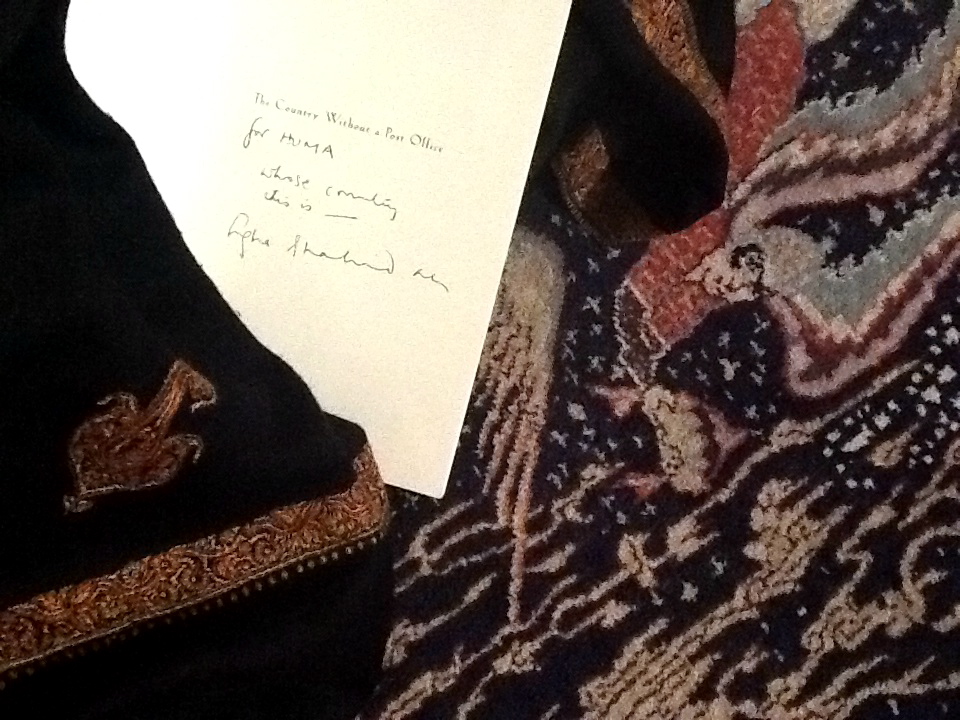
A Passport Of The Country Without A Post Office

The genocide in Kashmir is not over yet, but the land fertilized by the blood of innumerable, amaranthine martyrs is blossoming bouquets of tulips and roses in quick succession. New possibilities of spring, of poetry, of Azadi, of freedom, of peace are here, and they are unstanchable. I wish you were here, Shahid: Beloved, Witness, and perhaps with the slip of tongue, even Shahd, or Honey.

by Huma Dar

Passport to The Country Without A Post Office

I met Shahid between noon and one pm, in the Lipman Room of Barrows Hall, almost exactly thirteen years ago, on December 3, 1998.  He’d come to recite from The Country Without A Post Office (1997) for the Lunch Poems Reading Series at UC Berkeley.  His jokes, tinged with a very particular Kashmiri black humor — irreverent, risqué, ridiculous — mirrored my family’s wacky one.  All that heartache about Kashmir, finding not many kindred souls around, found solace in Shahid’s scriptured lament, “After the August Wedding in Lahore, Pakistan.”

A brigadier says, The boys of Kashmir
break so quickly, we make their bodies sing,
on the rack, till no song is left to sing.
“Butterflies pause / On their passage Cashmere –”
And happiness: must it only bring pain?
The century is ending.  It is pain
from which love departs into all new pain:
Freedom’s terrible thirst, flooding Kashmir,
is bringing love to its tormented glass.
Stranger, who will inherit the last night
of the past?  Of what shall I not sing, and sing?

Continue reading “A Passport Of The Country Without A Post Office”

Should we call it murder?

The following address was delivered by Stephen Lewis – former UN Special Envoy for HIV/AIDS in Africa and one of today’s most important global health advocates – on the eve of World AIDS Day at the Yale School of Public Health. 

The Global Fund to Fight AIDS, Tuberculosis and Malaria has been the international financial armada in the battle against the three diseases. The collapse of the next round of Global Fund grants, known as Round 11, is the most serious, catastrophic setback in the Fund’s decade of existence. Hiding behind the banner of the financial crisis, the donor countries have clearly decided that if budgetary cuts are to be made, the Global Fund can be among the first to go.

It’s terribly important to recognize the moral implications. It’s not just the fact that people will die; it’s the fact that those who have made the decision know that people will die. How does that get rationalized? How does that get dealt with in the inner sanctums of development ministries and cabinet discussions? What in God’s name do they say to each other?

Continue reading “Should we call it murder?”

London 2012 and the Bhopal Disaster

by Saffi Ullah Ahmad

As the 2012 London Olympics approach, a furore has erupted surrounding the £7m sponsorship of the games by the controversial Dow Chemical Company, which is connected with the world’s worst industrial catastrophe, in the Indian city of Bhopal. Lingering effects of the disaster continue to kill and maim people trapped by poverty.

The company has been commissioned to produce a specialized decorative wrap for the Olympic stadium.  Members of Parliament from across the political spectrum, former Mayor of London Ken Livingstone, and leading human rights groups including Amnesty International have expressed dismay at the London 2012 Organising Committee (LOCOG)’s decision and rumours have circulated regarding a possible Indian boycott. In protest to the deal, thousands of survivors of the disaster burned effigies of the chairman of London 2012, Lord Sebastian Coe, on Friday. A larger group of protestors blocked five of Bhopal’s train lines on Saturday 3 December, the 27th anniversary of the disaster, in the face of fierce police beatings.

Gross negligence on the part of the Union Carbide Corporation, now a wholly owned subsidiary of Dow, culminated in a fatal explosion in a pesticide factory on 2-3 December 1984, releasing 40 tonnes of highly toxic gas which laid waste to one of the poorest regions in India.

Continue reading “London 2012 and the Bhopal Disaster”

The Spirit Level: Why Equality is Better for Everyone

In August, at Marxism 2011, Richard Wilkinson gave the following talk on his book, co-authored with Kate Pickett, The Spirit Level: Why Equality is Better for Everyone.