From Vanunu to the New Jew

Mordechai Vanunu breaks the rules

I cannot keep silent … Disaster follows disaster; the land lies in ruins … My people are fools; they do not know me.” Jeremiah 4:19

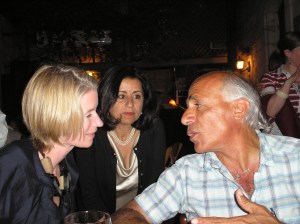
Mordechai Vanunu is a Moroccan Jew, born in Marrakesh. Today he credits his humanity to having been born in an Arab country rather than in the Jewish state. He was nine when he was taken to Israel. He attended an ultra orthodox school, and after his military service became a nuclear technician at the Dimona plant. At this time his anti-Zionist politics developed. Later he flirted with Buddhism, converted to Christianity, and in London in 1986 told the Sunday Times what he knew of Israel’s nuclear weapons programme, backing his claims with photographic evidence.

He was then caught in a ‘honey trap’, lured by a beautiful woman from London to Italy, drugged and kidnapped in Rome by Mossad (with the connivance of British, French and Italian intelligence services), and brought back to Israel, where he served 18 years in prison for his truth-telling, twelve of them in solitary confinement. He says he survived because of his strong will (“the first thing I did in prison was give up smoking”), and by playing opera records. He refused to converse with the only human beings available – his guards. His lawyer describes him as “the most stubborn, principled, and tough person I have ever met.”

Continue reading “From Vanunu to the New Jew”

Like Cattle in an Abbatoir

Debborah Moggach and Suheir Hammad respond to conditions in Hebron/al-Khalil

More on Palfest. Deborah Moggach, author of 16 novels and the screenplay for ‘Pride and Prejudice’, describes her week on the West Bank, below. It is important that this is on the Books pages, rather than the news pages, of the Guardian – culture offers an opportunity to reach people beyond the usual channels. Read to the end for Sousan Hammad’s beautifully-written piece on the literature festival.

I’m still recovering from a tumultuous week in Palestine where, between 23 and 28 May, 16 writers from around the world took part in the Palestine Festival of Literature (Palfest). It was started last year by Ahdaf Soueif as a way of bringing poets, journalists, publishers and novelists to the occupied territories to celebrate, in Edward Said’s words, “the power of culture over the culture of power”. There’s nothing else quite like it: due to the restrictions on movement, it is we, the visitors, who bring the mountain to Muhammad, travelling around in a bus visiting towns in the West Bank to do readings with Palestinian writers, stage music and poetry events, conduct workshops with students and visit refugee camps. This year’s group included Michael Palin, Henning Mankell, Claire Messud, Jamal Mahjoub, Abdulrazak Gurnah and the dazzling poet/performer Suheir Hammad.

Continue reading “Like Cattle in an Abbatoir”

Suheir Hammad


Suheir Hammad is one of the Palfest participants who deserves a post to herself. A Palestinian-American, Suheir was born to refugee parents in Amman. She spent her first years in civil war Beirut before moving to Brooklyn, where drugs and gang wars raged. She is a poet, prosewriter and actress. Her poetry erases any distance between the personal and political, and is humane, passionate and particular. Greatly influenced in its rhythm, diction and pacing by New York hip hop, it fits snugly into the tradition of Palestinian oral delivery exemplified by the late poet Mahmoud Darwish.

Suheir stars in the film Salt of this Sea, but it is surely time someone directed her in a poetry performance DVD. You have to hear her read to really appreciate what she does. A good place to start is the poem First Writing Since, which concerns 9/11. Here is We Spend the Fourth of July in Bed. And one for Rachel Corrie. Here is part one and part two of an al-Jazeera International interview, and here she is reading for Palfest in Ramallah. I hope the Palfest film-makers have more to come. The most powerful part of her reading in Ramallah – powerful enough to bring the audience to tears – was her series of poems for Gaza:

Jeremy Harding describes Suheir as “a younger, image-conscious, thoughtful militant for Palestine, one of a new generation who do the writing, while the Israelis oblige by extending the wall.”

Ali Abunimah on Obama’s Lecture

Watching Obama in Cairo (AHMAD GHARABLI/AFP/Getty Images)

Personally, I found it unpleasant to see Obama lecturing the Arabs, and the handpicked audience clapping ecstatically whenever the President (rather like Napoleon in Cairo) made an Islamic allusion. Most depressingly, Obama’s address was heavily influenced by the Bernard Lewis school of Orientalism – Arab and Muslim anger is caused by the cultural trauma of modernity and a “self-defeating focus on the past,” rather than by present realities, such as the ethnic cleansing of Palestine, the occupations of Iraq and Afghanistan, the destabilisation of Pakistan and Somalia, the unwelcome military bases in the Muslim world, and the support of dictatorial regimes such as Mubarak’s. Obama’s assumptions repeated falsities, such as the notion that Arab regimes focus on Palestine to distract the people from their own failings. In fact the Arab regimes do everything they can to take the focus off Palestine, as the Palestinian tragedy is the key symbol of the bankruptcy of the client regimes. And Obama mocked violent resistance while not saying a word about the 1400 just killed in Gaza or the million slaughtered in Iraq.

The best response I’ve seen to the speech is by Ali Abunimah, posted here at PULSE, who studies Obama’s phrases well: “Suffered in pursuit of a homeland? The pain of dislocation? They already had a homeland. They suffered from being ethnically cleansed and dispossessed of it and prevented from returning on the grounds that they are from the wrong ethno-national group. Why is that still so hard to say?”

Facts in the Air

The web, writes Palfest participant Jeremy Harding, is one of the few places where Palestinians, losing ground by the day to the realities of occupation and settlement, can make their aspirations plain. Jeremy’s first diary piece on Palestine is here.

A good way to grasp what’s happening to East Jerusalem and the Occupied Territories is from the air. Google Earth can do that for you, but there’s a history of contention: in 2006, users created tags for Palestinian villages that were destroyed during the war of 1948-49; the following year Fatah’s al-Aqsa Brigades were said to be checking potential Israeli military targets against Google Earth pictures; last year there was a controversy over the Israeli coastal town of Kiryat Yam, when a user called Thameen Darby posted a note claiming it was formerly a Palestinian locality ‘evacuated and destroyed after the 1948 Arab-Israeli war’. Kiryat Yam, its residents protested as they reached for the nearest lawyer, was built in the 1930s.

Continue reading “Facts in the Air”

Cultural Liberation

Robin Yassin-Kassab and Jeremy Harding with students at Bir Zeit.

Jeremy Harding, one of the Palfest writers, hints at the crucial role culture will play in the liberation of Palestine. Read on to see the great Suheir Hammad.

Last week, the Palestine Festival of Literature organised a discussion about travel and writing at the Dar Annadwa cultural centre in Bethlehem. One of Palfest’s star guests, touring the West Bank and East Jersualem, was Michael Palin, whose early glories, before his reinvention as a traveller, were much on people’s minds. He spoke well about growing up in Sheffield and cultivating a passion for Hemingway, but the audience was delighted when someone suggested that living under Israeli occupation was a bit like being in the Terry Gilliam movie Brazil. As the panellists stood up and tidied their books, a young Palestinian in the seat in front of me said she couldn’t believe we were all with Palin in Bethlehem – Bethlehem! – and no one had thought to ask about Monty Python’s Life of Brian. But with two other writers on the stage, there’d been a lot of ground to cover.

Continue reading “Cultural Liberation”

Palfest 09: a Participant’s First Response

At the Qalandia checkpoint separating Ramallah from Jerusalem. Leila Khaled's head peeks out between the I and O of Hip Hop.

I have just returned from a physically, mentally and emotionally exhausting week in Palestine. I was a participant in Palfest 09, the second Palestine Festival of Literature. It was a great honour to be in the company of writers like Michael Palin and Debborah Moggach, and Claire Messud, MJ Vassanji, Abdulrazak Gurnah, Ahdaf Soueif and Jamal Mahjoub, the lawyer for Guantanamo Bay prisoners Ahmad Ghappour, Palestinian poets Suheir Hammad and Nathalie Handal, and all the others. I’ll do a post at some point on everybody there. It was an even greater honour to meet Palestinian academics, students, and people on the streets and in the camps, to witness their incredible resilience and creative intelligence. Something fearless in them slipped into me, and gave me optimism. A people like this can not be kept down indefinitely.

They will stand up, even if I can’t tell how they possibly can. What I saw in Palestine confirmed me in my belief that a two-state solution is impossible, but also made me very pessimistic about the only real solution, the one-state solution – such is the level of Zionist hatred and arrogance, so deeply entrenched is Zionist settlement on the landscape and Zionist assumptions in the minds of Israeli Jews.

Continue reading “Palfest 09: a Participant’s First Response”

Manufacturing Consent for Apartheid

Ali Abunimah, author of “One Country,” discussed here, exposes One Voice, a Zionist organisation posing as pro-peace pollsters, and shows that the supposed consensus among Palestinians and Israelis for the mythical two-state solution does not exist. The one-state solution seems increasingly viable to Palestinians, and this reality may panic ‘realist’ Zionists to arrange a formal bantustan settlement during the Obama term. This is a fertile moment, argues Ali, “when no vision carries a consensus among Palestinians, underscoring the urgent need for an inclusive debate about all possible democratic outcomes.”

How do Palestinians living under Israeli military occupation and siege see their world, especially after Israel’s massacre of more than 1,400 people, mostly civilians, in the occupied Gaza Strip three months ago?

Two recent surveys shed light on this question, although one — published on 22 April by the pro-Israel organization One Voice — appears intended to influence international opinion in a direction more amenable to Israel, rather than to record faithfully the views of Palestinians or Israelis (“OV Poll: Popular Mandate for Negotiated Two State Solution,” accessed 30 April 2009). The other — a more credible survey — was published in March by the Oslo-based Fafo Institute for Applied International Studies and funded by the Norwegian government (“Surveying Palestinian opinions March 2009,” accessed 30 April 2009).

Continue reading “Manufacturing Consent for Apartheid”

What is Education?

Thanks to Adrian Barnes of the Rossland Telegraph for sending me this transcription of David Foster Wallace’s address to US college graduates in 2005.

If anybody feels like perspiring, I’d advise you to go ahead, because I’m sure going to. Greetings and congratulations to Kenyon’s graduating class of 2005. There are these two young fish swimming along and they happen to meet an older fish swimming the other way, who nods at them and says “Morning, boys. How’s the water?” And the two young fish swim on for a bit, and then eventually one of them looks over at the other and goes “What the hell is water?”

This is a standard requirement of US commencement speeches, the deployment of didactic little parable-ish stories. The story [“thing”] turns out to be one of the better, less bullshitty conventions of the genre, but if you’re worried that I plan to present myself here as the wise, older fish explaining what water is to you younger fish, please don’t be. I am not the wise old fish. The point of the fish story is merely that the most obvious, important realities are often the ones that are hardest to see and talk about. Stated as an English sentence, of course, this is just a banal platitude, but the fact is that in the day to day trenches of adult existence, banal platitudes can have a life or death importance, or so I wish to suggest to you on this dry and lovely morning.

Continue reading “What is Education?”

Rant against Hypocrisy

If Israel is not a racist state, if Zionism is not a racist ideology, then I do not speak English.

I don’t quite know why, but hypocrisy is the element in political discourse which catalyses my most murderous responses. Perhaps it’s because I like language, or respect it, and believe it shouldn’t be raped.

Continue reading “Rant against Hypocrisy”