Archaeology of Revolutionary Knowledge

My review of Pankaj Mishra’s From the Ruins of Empire which first appeared in Guernica.

As tsar Alexander III sat down for an evening’s entertainment at the St. Petersburg opera in late 1887, he little knew that the performance would be upstaged by one far more dramatic. Shortly after the curtains rose, a slender, goateed man with azure eyes, dressed in robe and turban, got up from a box nearby and proclaimed loudly: “I intend to say the evening prayer—Allah-u-Akbar!” The audience sat bemused and soldiers waited impatiently as the man proceeded unperturbed with his evening prayers. His sole companion, the Russian-born intellectual Abdurreshid Ibrahim, squirmed in fear of his life.

Jamal ud-Din al-Afghani was determined to recruit Russian support in his campaign against the British. Having failed to secure an audience with the tsar, he had decided to use his daring as a calling card. The tsar’s curiosity was duly piqued and Afghani had his hearing.

This could be a scene out of Tolstoy or Lermontov; but so extraordinary a figure was Afghani (1838-97) that inserting him into fiction would have compromised verisimilitude. So, renowned essayist and novelist Pankaj Mishra has opted for the genres of historical essay and intellectual biography to profile the lives of Afghani and other equally remarkable figures in From the Ruins of Empire: The intellectuals who remade Asia.

The book is a refreshing break from lachrymose histories of the East’s victimhood and laments about its past glories. It concerns a group of intellectuals who responded to the threat of western dominance with vigour and imagination. Together they engendered the intellectual currents that have shaped the last century of the region’s history. Continue reading “Archaeology of Revolutionary Knowledge”
Woman in the Crossfire

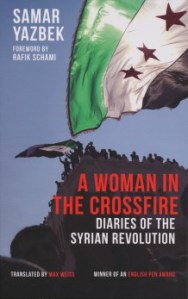
womaninthecrossfire_72A Woman in the Crossfire: Diaries of the Syrian Revolution’ by novelist Samar Yazbek is part journalism, part personal memoir, and all literature. It’s literature of the instantaneous sort, a staggered snapshot of the first four months of the revolution, a public history of  “a country succumbing to the forces of death,” and an interior history too. Yazbek tells us about her headaches, her insomnia and Xanax addiction, her crying fits, her fears for her daughter and herself, her constant panic. How sometimes in the speeded-up context the rush of information precedes all feeling: “The daily news of killing,” she writes, “was more present inside of me than any emotion.”

Samar Yazbek has always been problematic. Having consecrated herself “to the promise of a mysterious freedom in life,” she left home (in Jableh, on the coast) at sixteen, later divorced her husband and lived in Damascus, a single mother, working in journalism and writing sexually controversial novels. When Syria rose up against the Asad regime she publically supported the victims and their cries for freedom. And she’s an Alawi, a member of the president’s largely loyalist sect, of a well-known family. As an unveiled and obviously independent woman, a secularist and daughter of a minority community, her support for the revolution proved the lie of regime propaganda, which characterised the uprising as Salafist from the start.

So leaflets slandering her were distributed in the mountains. She was called a traitor, made  recipient of death threats, publically disowned by family and hometown. Naturally she was visited by the mukhabarat and made to experience, vicariously at least, the domestic wing of regime propaganda – for the theatre of blood is as important inside Syria as the projection of civilised moderation used to be abroad – by being walked through a display of meat-hooked and flayed torturees.

Continue reading “Woman in the Crossfire”

Nod

Books which are published by small publishing houses are rarely reviewed by big newspapers, and this is a shame, because small publishing houses often publish excellent work. One example is “The Madman of Freedom Square” by the brilliant Hassan Blasim, published by Comma Press. Another is “Nod”, by Adrian Barnes.

The plot is a grand metaphor worthy of Jose Saramago. For no apparent reason (though people scramble for political and spiritual explanations) people stop sleeping. Only about one in ten thousand people are spared the insomnia plague, and these quickly become victims of an anti-sleeper mass frenzy. The Awakened, as they become known, suffer gradual degeneration through irritability and clumsiness, detachment and madness, to death. Our narrator, a writer of obscure books on obscure words and phrases, is one of the remaining sleepers. Being an expert on words, he reminds us that ‘Nod’ has two somewhat contradictory meanings – both the pleasant sleepy land we send children to, and the land of Nod, the barren desolation to which God sent Cain. The narrator has to watch as his long-term girlfriend and just about everyone else around him degenerate.

Continue reading “Nod”

In Praise of Hatred

I was honoured to be asked to write the introduction to the English translation of Khaled Khalifa‘s third novel, In Praise of Hatred– set in Syria in the 1980s and essential background reading for the current tragedy. Four paragraphs of the introduction are reprinted below, and then Maya Jaggi’s review in the Guardian.

So how brave and necessary it was to write a fiction of the events. In our narrator’s harsh euphemism, Alawis are “the other sect” and the Ba‘ath Party is “the atheist party”, but the historical references are unmistakeable. Khalifa plays one of the noblest roles available to a writer: he breaks a taboo in order to hold a mirror to a traumatised society, to force exploration of the trauma and therefore, perhaps, acceptance and learning. He offers a way to digest the tragedy, or at least to chew on its cud. In this respect he stands in the company of such contemporary chroniclers of political transformation and social breakdown as Gunter Grass and JM Coetzee.

In purely literary terms as well as politically, the novel rises to a daunting challenge: how to represent recent Syrian history, which has often been stranger and more terrible than fiction.

For a start, it’s a perceptive study of radicalisation understood in human rather than academic terms. It accurately portrays violent Islamism as a modernist phenomenon, a response to physical and cultural aggression which draws upon Trotsky, Che and Regis Debray as much as the Qur’an, and contrasts it with the more representative Sufism of Syrian Sunnis.

Next, it examines the dramatic transformations of character undergone by people living under such strain, the bucklings and reformations, the varieties of madness. The characters here are fully realised and entirely flexible, even our bitter narrator, and their stories are told in a powerfully rhythmed prose which is elegant, complex, and rich in image and emotion. There is musicality too in the rhythm of the episodes, the subtle unfolding of the plot.

  Continue reading “In Praise of Hatred”

The Fall of the House of Asad

This review of David Lesch’s book was written for the Scotsman.

Until his elder brother Basil died in a car crash, Bashaar al-Assad, Syria’s tyrant, was planning a quiet life as an opthalmologist in England. Recalled to Damascus, he was rapidly promoted through the military ranks, and after his father’s death was was confirmed in the presidency in a referendum in which he supposedly achieved 97.29% of the vote. Official discourse titled him ‘the Hope.’
Propaganda aside, the mild-mannered young heir enjoyed genuine popularity and therefore a long grace period, now entirely squandered. He seemed to promise a continuation of his father’s “Faustian bargain of less freedom for more stability” – not a bad bargain for a country wracked by endless coups before the Assadist state, and surrounded by states at war – while at the same time gradually reforming. Selective liberalisation allowed for a stock market and private banks but protected the public sector patronage system which ensured regime survival. There was even a measure of glasnost, a Damascus Spring permitting private newspapers and political discussion groups. It lasted eight months, and then the regime critics who had been encouraged to speak were exiled or imprisoned. Most people, Lesch included, blamed the Old Guard rather than Bashaar.

“I got to know Assad probably better than anyone in the West,” Lesch writes, and this is probably true. Between 2004 and 2008 he met the dictator frequently. His 2005 book “The New Lion of Damascus” seems in retrospect naively sympathetic. He can be forgiven for this. Most analysts (me included), and most Syrians, continued to give Bashaar the benefit of the doubt until March 2011.

Continue reading “The Fall of the House of Asad”

The Role of Tom Rob Smith in Brand Israel

Tom Rob Smith is grappling with some serious philosophical questions these days. He asks himself what the purpose of fiction is? What the role of the writer in society is?

What prompted the popular writer to go back to his Cambridge roots and rehash this very Humanities 101 debate? Why the Boycott Divestment and Sanctions movement of course!

TomRobSmith
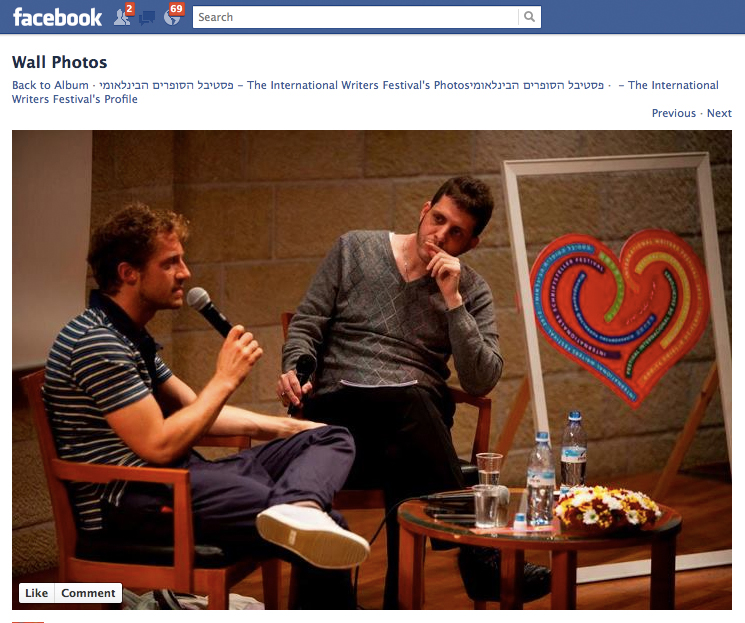
Tom Rob Smith at the Jerusalem Writers Festival not discussing the ways in which it whitewashes apartheid, and is sponsored by an organization which is responsible for ongoing ethnic cleansing, only minutes away from the premises. (source: The Jerusalem Writers Festival Facebook page)


Continue reading “The Role of Tom Rob Smith in Brand Israel”

Taliban Poetry

A shaved version of this review appeared in the Guardian.

In the 1980s an artist friend of mine made a poster for Gulbuddin Hekmatyar’s Hizb-e-Islami, a militia later allied with the Taliban. The poster depicted a fully-bearded Afghan mujahid clutching Quran and Kalashnikov and standing atop a slaughtered Russian bear. It was sent as a postcard to British journalists and politicians, without controversy.

In the same period I remember reading stories in the mainstream press about the Mujahideen’s poetic love of flowers and song. After the Russian rout, these Mujahideen committed excesses so extreme that it took Taliban puritanism to re-establish order. Then the Taliban committed their own excesses, of a different sort, and after 9/11 the West waged war on them for metonymic reasons. Nobody now celebrates the gentle, flowery qualities of these men who have burnt schools and lynched television sets.

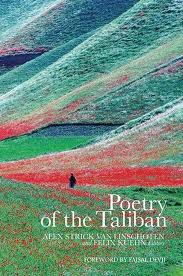
“Poetry of the Taliban”, therefore, is a brave and very useful project. It offers the reader a perspective on the conflict through the Other’s eyes. It offers the human element, and as such is worth more than a library-full of cold analysis.

There are poems of love, battle, transience, grief, enthusiasm, material deprivation and mystical astonishment. The voices are diverse and often surprising. Faisal Devji’s preface points out that the poetry displayed here is not the official product of the Cultural Committee of the Islamic Emirate, not centrally-organised propaganda, but the efforts of men (and a woman) who fight for a variety of reasons, tribal, ethnic or nationalist, and particularly out of gut resistance to foreign occupiers, wherever they come from.

Continue reading “Taliban Poetry”

Ramadan’s Arab Awakening

A mangled version of this review appeared in the Independent.

What is happening in the Middle East? Tariq Ramadan, one of the foremost Muslim intellectuals, calls the contemporary events ‘uprisings’, more concrete and permanent in their effect than ‘revolts’ but still short of thoroughgoing ‘revolutions’. So far, Tunisia is the only clear democratising success, and even there it remains unclear if the new dispensation will be fundamentally more just economically than the last.

Half of this slim volume is spent examining whether the uprisings were staged or spontaneous. Ramadan counsels against both the naive view that outside powers are passive observers of events, and the contrary belief that Arab revolutionaries have been mere pawns or useful idiots in the hands of cunning foreign players.

Certainly the US and its allies helped to guide events by collaborating with the military hierarchies which removed presidents in Tunisia and Egypt, and by full-scale intervention in Libya – this for a variety of obvious reasons. An agreement signed by Libya’s NTC in March last year, for instance, guaranteed France 35% of future oil exports.

There’s been Gulf and Western hypocrisy over Bahrain, home to Formula One and the US Fifth Fleet, and al-Jazeera’s coverage has been tailored to reflect its Qatari host’s strategic concerns.

Then, less convincingly, the social media conspiracy: trainees from 37 countries learned non-violent cyberactivism in Serbia. Google, Twitter and Yahoo offered training in the US. Google provided satellite access codes to Egyptian activists so they could evade censorship, but not to their Syrian counterparts.

Continue reading “Ramadan’s Arab Awakening”

Bernard-Henri Lévy, a friend to Israel

The following is an excerpt from the brilliant new take-down of famed French “philosopher” Bernard Henri-Lévy by Jade Lindgaard and Xavier de la Porte. Titled The Impostor: BHL in Wonderland, the book is part of the recently inaugurated Verso Counterblasts series. The excerpt was published at Al Jazeera.

On June 5, 2011, nearly three months into the war against the Gaddafi regime, the Libyan rebel forces issued a corrective communiqué referring to Bernard-Henri Lévy. It said that the National Transitional Council (NTC), the political body representing the insurgents fighting the Tripoli regime, “vehemently rejects what has been reported in some media as Mr Bernard Lévy’s comments on the future relationship between Libya and the Israelis”. The communiqué continued: “The NTC is surprised by Mr Lévy’s comments,” and – an intriguing detail – “Mr Lévy was received as a special envoy from the president of France, and relations with Israel were never discussed.”

What was going on? The event had passed unnoticed at first, but three days earlier, Agence France Presse (AFP) had come up with a considerable scoop if turned out to be authentic. A real breakthrough in the history of relations between Israel and the Arab countries: the NTC was apparently prepared to recognise the state of Israel and maintain “normal relations” with it. That was the “verbal message” that Bernard-Henri Lévy had come to deliver to the Israeli prime minister, Binyamin Netanyahu, on behalf of the Libyan Council.

Continue reading “Bernard-Henri Lévy, a friend to Israel”

Critical Muslim

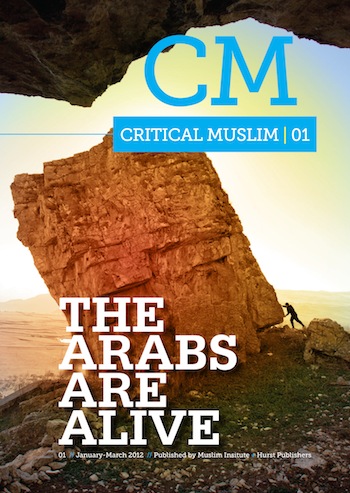
I’d like to draw your attention to the Critical Muslim, a new quarterly journal which looks like a book. I co-edit the journal with Ziauddin Sardar, who is perhaps Britain’s most prominent ‘critical Muslim’. The CM is concerned with the politics, economics, culture, law and literature of the Muslim world – and of course the Muslim world today includes locations such as London and Lima. Our writers are convinced and sceptical Muslims, religious and cultural Muslims, and non-Muslims. We publish a range of perspectives, usually but not always with a somewhat leftist leaning. And the CM has a sense of humour.

I’m very proud of the arts section. The first issues include a story by the accomplished British-Pakistani writer Aamer Hussein, poetry and prose from upcoming Iraqi writers (one of whom is the very highly-rated Hassan Blasim), a selection of the Arabic poetry (Qabbani and others) which accompanied the Arab uprisings, essays on the Palestine Literature Festival and the Erbil Literature Festival (in Iraqi Kurdistan), a great story of cross-cultural love (and disappointment) by young British writer Suhel Ahmed, poetry from the great Mimi Khalvati, an essay on Muslim jazz, and much more.

Continue reading “Critical Muslim”