(Neo)Orientalism with an Attitude: In the Footsteps (and Beyond) of Richard Burton

Getting one’s picture taken with the Dalai Lama or the Pope will guarantee neither Buddhist enlightenment nor beatification: my apologies for shattering the hopes of some New Agers. Similarly, entering the Ka’aba in Burtonesque disguise — specially minus his arguably relevant though shifty linguistic skills and textual knowledge — will not and cannot necessarily guarantee much “learning” about Islam.

by Huma Dar

The March 10, 2010, page A27 of the New York edition of New York Times carries an Op-Ed piece by Maureen Dowd titled, “Pilgrim Non Grata in Mecca.” Dowd writes about her desire to “learn about the religion that smashed into the American consciousness on 9/11” via “sneaking” into Mecca in “a black masquerade cloak.”  Her self-proclaimed inspiration is Richard Burton’s “illicit pilgrim[age] to the sacred black granite cube…in Arab garb” thereby “infiltrat[ing] the holiest place in Islam, the Kaaba [sic].”

Dowd, however, decides to “learn about Islam” in a way “less sneaky,” “disrespectful,” or “dangerous” and yet more entitled and privileged than Richard Burton could ever have dreamed of.   She herself describes Burton as “the 19th-century British adventurer, translator of “The Arabian Nights” and the “Kama Sutra” and self-described ‘amateur barbarian.'”  The words “illicit,” “Kama Sutra,” and “infiltration” and Dowd’s voyeuristic desires resonate with the Orientalism of yore.  Moreover Dowd’s valuable US passport and USA’s special relationship with Saudi Arabia (read: enabling of the oppressive monarchy) entitle her to meet Prince Saud al-Faisal, the Saudi foreign minister — of the “sometimes sly demeanor” — on her “odyssey” to that country.  “Infiltration” in disguise is no longer required, and yet this ease of access also disguises and makes more difficult the complexity of any real learning.

Dowd “presses” al-Faisal for the privilege to watch in Mecca, the “deeply private rituals” and “gawk at the parade of religious costumes fashioned from loose white sheets” although she knows in advance that “Saudis understandably have zero interest in outraging the rest of the Muslim world.”  While talking to this high-ranking minister, Dowd bristles at al-Faisal’s reassuring suggestion that if she desired to see any mosque in a place other than in Mecca or Medina, and was prevented from doing so, all she had to do was to contact the “emir of the region” who would comply and enable the fulfillment of her desires.  (Anyone else reminded of Aladdin’s djinn/genie?)  Without conceding the irony of the situation that she, after all, is speaking to Prince al-Faisal, the Saudi foreign minister, Dowd quips, “Sure. Just call the emir. I bet he’s listed.”   Imagine what Richard Burton would have done with the special privileges of this particular magic lamp provided by the New World Order!

Finally Dowd does indeed witness the Hajj — in an IMAX theatre watching Journey to Mecca: In the Footsteps of Ibn Battuta. Dowd, much to her surprise, makes the belated discovery that “the Kaaba [sic] was built by “Abraham, the father of the Jews” [why Jews only?]— a reminder that the faiths have a lot to learn from each other.”  It is also a reminder that journalists like Ms. Maureen Dowd have a lot of homework to do before they set out on their surely expensive travels — and I am not even including the much recommended language lessons.  Any commonly available text on Islam, for example by Karen Armstrong, Jamal Elias, Michael Sells, or Ziauddin Sardar, might have served the purpose.  Dowd could thus have avoided relying solely on the “amateur barbarian” Richard Burton or Newsweek’s own Fareed Zakaria.  The former’s scholarly credentials are hardly beyond doubt — see his problematic remarks on “Jewish human sacrifice” in The Jew, the Gipsy and el Islam (1898).  The latter’s forte is not his knowledge of Islam — or at least no more than Zakaria’s mentor, Samuel Huntington’s forte is Christianity.  Dowd might thus have disabused herself of the notion of “the sacred black granite cube.”  The “sacred black” stone is not a “cube” and neither is the “sacred cube” — the Ka’aba — all granite!

Getting one’s picture taken with the Dalai Lama or the Pope will guarantee neither Buddhist enlightenment nor beatification: my apologies for shattering the hopes of some New Agers.  Similarly, entering the Ka’aba in Burtonesque disguise — specially minus his arguably relevant though shifty linguistic skills and textual knowledge (See Parama Roy’s excellent essay for more on Burton) — will not and cannot necessarily guarantee much “learning” about Islam.  On the other hand, a trip to any local library with a willingness to read and learn, and engagement with an open mind in meaningful conversations with the (gasp!) American Muslims, might be better starting points for undertaking this particular journey.

Did the Editor of The New York Times not know the price difference between the ticket to the IMAX theatre plus membership to a local library and the cost of Dowd’s lavish travels to the Kingdom of Saudi Arabia?  The Neo-Orientalist fantasy to tread in the footsteps of Sir Richard Burton is accelerated with privilege and precisely because of this privilege skips and misses its target even more widely.

It is in the spirit of a gift that I offer Ms. Dowd this image:
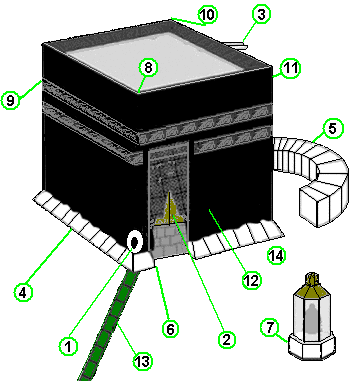
Labeled elements are as follows: 1 – The Black Stone; 2 – Door of the Kaaba; 3. Gutter to remove rainwater; 4 – Base of the Kaaba; 5 – Al-Hatim; 6 – Al-Multazam (the wall between the door of the Kaaba and black stone); 7 – The Station of Ibrahim; 8 – Angle of the Black Stone; 9 – Angle of Yemen; 10 – Angle of Syria; 11 – Angle of Iraq; 12 – Kiswa (veil covering the Kaaba); 13 – Band of marble marking the beginning and end of rounds; 14 – The Station of Gabriel.

The genius of an oeuvre is measured by the breadth of its message – Avatar as not “just another war movie”

by Kim Bizzarri

Following last night’s choice of the Oscars’ jury to award Katherine Bigelow’s The Hurt Locker with the Best Picture prize, the debate has since then moved to the pubs and the ether. It appears to be primarily concerned with whether Bigelow’s portrait of “the” war does justice to the genre and whether, with time, Avatar will come to be recognised as more deserving of the aspired title. The debate however is having the effect of reducing Cameron’s gargantuan critique of modernity to “just another war movie”, adding to the already popular dismissal of the film, by the intellectual left, as a western guilt-fantasy. 

Lets start by considering the assumption that Avatar is “just another war movie”.  

If indeed we accept that Cameron’s intention was to provide us with a science-fictional portrait of war, then we must also conclude that von Trier’s Dogville is nothing more than an aesthetically minimalist representation of the Great Depression. Just as von Trier exploits the Great Depression as a historical backdrop against which he develops a provocative portrayal of human nature, so does Cameron in the use he makes of military intervention in Avatar.  

Continue reading “The genius of an oeuvre is measured by the breadth of its message – Avatar as not “just another war movie””

A Eurocentric Problem

M. Shahid Alam

Cartographic violence

He who knows himself and others
Here will also see,
That the East and West, like brothers,
Parted ne’er shall be.

Goethe[1]

In no other major civilization do self-regard, self-congratulation and denigration of the ‘Other’ run as deep, nor have these tendencies infected as many aspects of their thinking, laws, and policy, as they have in Western Europe and its overseas extensions.[2] These tendencies reached their apogee during the nineteenth century, retreated briefly after World War II, but have been staging a come back since the end of the Cold War.

For several decades now, critics have studied these Western tendencies under the rubric of Eurocentrism, a complex of ideas, attitudes, and policies, which treat Europe — when it is convenient — as a geographical, racial and cultural unity, but places Western Europe and its overseas extensions at the center of world history since 1000 CE.[3]

Unlike the garden variety of ethnocentrism, Eurocentrism emerged as an ideological project — shaped by Europe’s intellectual elites — in the service of Europe’s rising expansionist states, starting in the sixteenth century. It makes sweeping claims of European superiority in all spheres of civilization. In this worldview, only Europeans have created history over the past three thousand years, beginning with the ancient Greeks. In various accounts, this centrality is ascribed to race, culture, religion and geography.

Continue reading “A Eurocentric Problem”

The Veil, Again

Yes, some women who cover their heads smile, too.

Some strands of feminism have a long history of serving as adjuncts of Western imperialism. Today they also enable domestic prejudice. Gore Vidal once mocked George Bush’s idea of democracy promotion as being synonymous with: ‘Be free! Or I’ll kill you’. In a similar vein, some feminists today want to ‘liberate’ Arab-Muslim women by constraining their freedoms. These women can’t possibly know what they really want, you see. The European feminists, like Bush, know what’s best for them. What could my sister — who studied at a co-ed university (in Peshawar!) but turned to wearing the hijab after moving to Canada — know about her interests? She must be told by the enlightened Westerner. She must be liberated.

Ignorance and racism combine in this potent form of messianism to sanction prejudice which increasingly targets Europe’s immigrant communities. Like the Orientalists of yore, this brand of feminism insists on seeing the brown or black woman in the subordinate role, wistfully awaiting a Westerner liberator. They are childlike, they must be protected in the same manner that a responsible parent protects an unruly nestling. They must be saved from the hijab, or — God forbid! — the veil. To protect their freedom of choice, their freedom to choose must be revoked.

Continue reading “The Veil, Again”

Capital murder

First and foremost, united Jerusalem, which will include both Ma’ale Adumim and Givat Ze’ev — as the capital of Israel, under Israeli sovereignty…
Prime Minister Yitzhak Rabin, on the vision for a “permanent solution”, 5 October 1995

Jerusalem is the eternal capital of the Jewish people, a city reunified so as never again to be divided
Prime Minister Benjamin Netanyahu, 21 May 2009

The current consensus in the international community is that East Jerusalem, occupied by Israel since 1967, is the capital of a future Palestinian state. Israel’s unilateral annexation of territory to create expanded municipal boundaries for a ‘reunited’ Jerusalem was never recognised.

Over the last forty-three years, Israel has created so-called ‘facts on the ground’ in the Occupied Palestinian Territories (OPT), in defiance of international law. Since the Madrid/Oslo peace process, successive Israeli governments have continued to colonise Palestinian land at the same time as conducting negotiations.

The extent and scale of Israel’s illegal settlement project across the West Bank, as well as the road network, the Separation Wall, and other ways in which Israel maintains its rule over the OPT, has led some to believe that the creation of an independent, sovereign Palestinian state is impossible.

Perhaps one of the clearest indicators that there is no Palestinian state-in-waiting under Israel’s regime of control is East Jerusalem.

Continue reading “Capital murder”

The Haitian Revolution

Even if you have been watching Democracy Now’s outstanding coverage of the Haitian tragedy, the despicable neglect with which the United States and other rich countries have treated the disaster-struck nation, you still can’t fathom the depth of outrage the Haitians feel unless you put it into the context of its tortured history. Here is an excellent overview from C. S. Soong’s Against the Grain.

It was a cataclysmic event, the first and only successful slave revolution in the Americas. In 1791 brutally exploited slaves on a small Caribbean island rose up and eventually won emancipation. Their story, a legacy that has inspired and instructed people and nations for centuries, is told in Laurent Dubois’s Avengers of the New World.

Inviting David Brooks to My Class

The Zionists are prisoners of a bad dream: they must first free themselves, break free from the prison in which they can only play the part of tormentors, if they and especially their Palestinian victims are to live normal lives.

M. Shahid Alam

On January 12, the New York Times carried an article by David Brooks on Jews and Israel. It so caught my eye, I decided to bring its conservative author to my class on the economic history of the Middle East. I sent my students the link to this article, asked them to read it carefully, and come to the next class prepared to discuss and dissect its contents.

My students recalled various parts of the NYT article but no one could explain its substance. They recalled David Brooks’ focus on the singular intellectual achievements of American Jews, the enviable record of Israeli Jews as innovators and entrepreneurs, the mobility of Israel’s innovators, etc. One student even spoke of what was not in the article or in the history of Jews – centuries of Jewish struggle to create a Jewish state in Palestine.

But they offered no comments about Brooks’ motivation. Why had he decided to brag about Jewish achievements, a temptation normally eschewed by urbane Jews. In my previous class, while discussing Edward Said’s critique of Orientalism, I had discussed how knowledge is suborned by power, how it is perverted by tribalism, and how Western writers had crafted their writings about the Middle East to serve the interests of colonial powers. Not surprisingly, this critique had not yet sunk in.

I coaxed my students, asking them directly to explore if David Brooks had an axe (or more than one) to grind. Was there an elephant in the room they had missed? What was the subtext of the op-ed?

Continue reading “Inviting David Brooks to My Class”

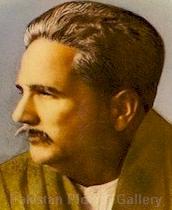
Iqbal, Is the Sky Yours or Mine?

Allama Iqbal
Muhammad Iqbal, 1877-1938, was a poet of Urdu and Farsi, philosopher, sufi, and revolutionary, who combined in his works the traditions of Al-Ghazzali, Rumi, Ibn-e-Khaldun, Ahmad Sirhindi and Shah Walilullah. While he understood the power of the West, had read the Western philosophers, and was familiar with the advances in physics, unlike Syed Ahmad Khan, he remained firmly rooted in Islamic tradition, and refused to re-examine the Islamicate through Orientalist texts. He was criticial of the West’s excessive emphasis on reason, its materialism, and the depredations of capitalism. Many decades before Frantz Fanon and Aime Cezaire, he was the deep thinker and stirring poet of self-discovery, urging peoples of color to regain their dignity, to dig deep into their own traditions in order to overcome, and transcend, the materialism, racism, excessive rationalism, and the West’s abuse of power and its own principles.

This ghazal is a translation from Wings of Gabriel, the best collection of Iqbal’s Urdu poetry. From time to time, I will be presenting translations from this collection.

اگر کج رو ہیں انجم آسمان تیرا ہے یا میرا

translation by M. Shahid Alam

If the stars are topsy-turvy: is the sky yours or mine?
Should this fret me? Is the world yours or mine?

If Heaven lacks the tug, the heat of love’s adventure,
Dear Lord, this cosmic enigma is yours: not mine.

On that first dawn of creation, how dared he to defy
Your decree. Was he your emissary: or was he mine?

Muhammad is yours, Gabriel and the Qur’an too.
But these melodic words: are they yours or mine?

It’s this star, scintillating, that lights your creation.
Whose loss is it – the fall of Man? Is it yours or mine?

— M. Shahid Alam is professor of economics at Northeastern University, Boston. He is author of Poverty from the Wealth of Nations (Macmillan: 2000), Challenging the New Orientalism (IPI: 2007), and Israeli Exceptionalism (Palgrave: 2009). You may reach him at alqalam02760@yahoo.com.

Pakistan’s ‘Oral’ Society

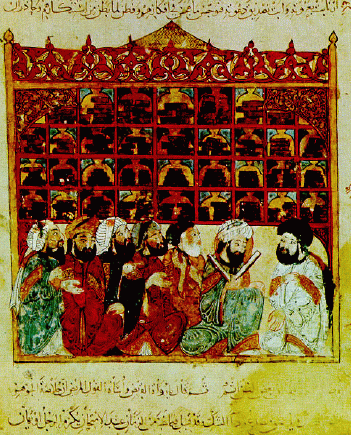
Public library of Hulwan, Baghdad

M. Shahid Alam

(Note: This essay was written nearly twenty years back, in April 1991. A great many changes have come to Pakistan since then, but I am afraid that the observations I had made then about ‘orality’ of Pakistani discourse still hold true. Pakistan’s best young minds do not go where their hearts and their talents lead them. Instead, overwhelmingly, they still pursue job security. Sadly, education – even for the brightest – is still mostly vocational education. With the introduction of multiple private cable channels, however, orality has entered a new age. The oral discourse, previously confined to drawing rooms and campuses, is now led by ‘talking heads’ in television studios. Is this discourse now more solidly rooted than before in the written word, in history and the social and natural sciences? I doubt it: and why should it? Pakistan’s brown Sahibs continue to drag the country deeper into dependency; they work overtime to trap Pakistanis in the most superficial consumerism, without the capital, technology and skills that support this malaise in developed Western societies. In other words, Pakistan is still caught in the disease that Jalal Al-i Ahmad had described in his book, Gharbzadagi Occidentotis: A Plague from the West.)

I first became aware of differences between ‘oral’ and ‘literate’ societies when I returned to Pakistan in 1979 – after an absence of some five years in the United States and Canada – to take up a fellowship at the Applied Economics Research Center, affiliated to the University of Karachi.

Continue reading “Pakistan’s ‘Oral’ Society”

Mahmood Mamdani: State Formation and Conflict

Mahmood Mamdani on state formation and conflict in Sudan. This lecture is a couple of years old (from 2007), but highly informative.