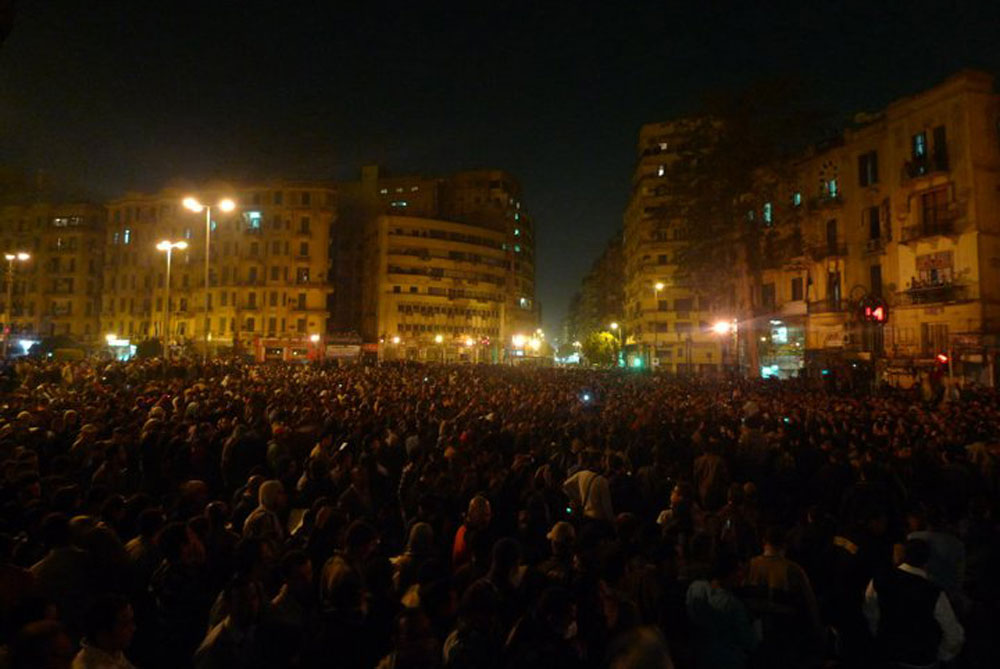
Misr/Egypt in 140 characters or less

by Parvez Sharma

US television networks and an endless parade of mostly white men pundits (brought out and dusted off with their cobwebs) should take lessons from Al-Jazeera in live reportage, in not having pundits talk over the chants of a mass of humanity, in having Arab reporters covering what they know best, in remarkably evocative and courageous camerawork and in just being able to cover history like no other television network has ever been able to do before. And yes, I also mean that CNN during the first Gulf War was not as good as this.

It is so important to remember that the vast MAJORITY of those on the streets around the country do not have the time, the ability, the resources (including smartphones) and certainly no access to working mobile phone service. This revolution is JUST NOT BEING TWITTERED by the people who are actually protesting.

The only people tweeting are either reporters with huge bureaus and live cameras to back them or people like me reporting from the cyber-frontlines talking to the few friends in Cairo we can reach on their landlines.

To tweet this revolution and Egypt’s complex back-story in 140 characters or less is impossible.

Interestingly Al-Jazeera which is doing a stellar job is also more interested in covering the revolution (amazingly) in what is essentially wide-shots to show the extent of the chaos. Ayman’s camera is focused on the thousands in Tahrir. Not many correspondents are able to get to neighborhoods like Rihab, Mohandasin, Zamalek, Maadi—which cyber-reporters/tweeters like me are able to do by talking only on landlines (mobiles are not working) to our friends—ordinary citizens. Hopefully this below, is an example of that.

Continue reading “Misr/Egypt in 140 characters or less”

A Crucial Moment

Whose day will it be?

Today is crucial, and could go very badly. The Egyptian gangster regime and its backers have clearly decided to use maximum force to end the popular challenge. At 12.34 this morning, Egypt’s entire internet service was closed down – the largest shutdown in history. Mobile phone services have also been suspended, and al-Jazeera has been taken off the Egyptian air. An al-Jazeera journalist has been beaten up by regime thugs. There are reports that French and British journalists have also been beaten or detained. A CNN crew have had their cameras smashed. Obviously, news is harder to come by today.

Last night senior members of the Muslim Brotherhood were arrested (see Jonathan Wright’s reflection on the Brotherhood role). Now it seems Muhammad al-Baradei has been arrested after leading a protest in Giza. Protests have erupted in Cairo, in Sinai’s al-Arish, in Minya and Assiut in upper Egypt, in Ismailiya, in Alexandria. Roads leading to Suez, where regime forces have lost control, have been closed.

In the circumstances, protestors are remarkably well-organised. And a few reports are coming through of soldiers (in Suez and Alexandria) refusing to attack the people. Latest: 20,000 people have taken over Qasr el-Nil bridge in central Cairo. And Ayman Nour of the Ghad Party is in intensive care after being beaten by police.

Continue reading “A Crucial Moment”

Solidarity in Action

Novelist and Palfest founder Ahdaf Soueif writes from Cairo for the Guardian. “For some time,” she says, “Egypt has felt as though it is under occupation. Today, downtown Cairo was under siege.”

Patience is a virtue – maybe even the supreme one in Egypt’s popular hierarchy of values, but patience also has its limits and, now, at last, it seems as if we’ve arrived at ours. And fittingly, it’s the young of the country who are leading us. They’ve had enough of unemployment, deteriorating education, corruption, police brutality and political impotence.

As is now well known, they organised Tuesday’s protests over Facebook and in closed virtual and actual meetings. Talk about grassroots! “They” is some 20 groups that have sprung up over the last five years. The question has always been how and when will they coalesce? They did on Tuesday; they fused, and with them multitudes of Egyptians young and old – inspired by what happened in Tunis.

They organised protests from Assiut in the south, to Sheikh Zuwayyid in Sinai, and Alexandria, Suez and other cities the length and breadth of Egypt. For Cairo they chose three locations: Shubra, Matariyya and Arab League Street. These were strategic choices: naturally crowded neighbourhoods, with lots of side streets off the main road. Young activists started their march in nearby areas, collected a following and by the time they reached, for example, Arab League Street, they were 20,000 marching.

Continue reading “Solidarity in Action”

People Power in the Middle East

M. Shahid Alam

From his weekly perch at CNN, Fareed Zakaria, speculated last Sunday (or the Sunday before) whether George Bush could take credit for the events that were unfolding in Tunisia, whether this was the late fruit of the neoconservative project to bring ‘democracy’ to the Middle East.

It is quite extraordinary watching Zakaria – a Muslim born and raised in India, and scion of a leading political family – mimic with such facility the language of America’s ruling classes, and show scarce a trace of empathy for the world’s oppressed, despite his propinquity to them by reason of history and geography. He does have a bias for India, but here too he only shows a concern for India’s strategic interests, not the interests of its subjugated classes, minorities and ethnicities. This I offer only as an aside about how easy it is for members of the upper classes in countries like India, Pakistan or Egypt to slip into an American skin whenever that dissimulation offers greater personal advantages.

As a cover for deepening US control over the Middle East – here is the latest civilizing mission for you – the neoconservatives in the Bush administration argued that the Islamic world produces ‘terrorists’ because it lives under autocracies. To solve the ‘terrorist’ problem, therefore, the US would have to bring democracy to the Middle East. This demagoguery only reveals the bankruptcy of America’s political class. It is a shame when the President of the United States and his neoconservative puppet-masters peddle such absurdities without being greeted by squeals of laughter – and shouted down as hypocritical, as farcical.

Who has been the leading ally and sponsor these past decades of nearly all the despotisms in the Middle East – those of royal pedigree and others seeking to become royalties?

Regardless, the real plan of United States failed miserably. It was dispatched to its grave by a people’s resistance in Iraq, Afghanistan and Pakistan.

Continue reading “People Power in the Middle East”

Is Mubarak’s Rule Threatened?

Al-Jazeera’s Inside Story asks what the future holds. Kefaya activist Rabab el-Mahdi and writer Afshin Rattansi provide excellent analysis.

Scenes from the Egyptian Intifada

Al-Masry al-Yowm says of Egypt’s stock market crash today, “The crash, which brought year-to-date losses to almost 21 percent, hit at the core of some of the regime’s main accomplishments. The president has built his legacy continuing and expanding the open market policies launched by his predecessor, Anwar Sadat, in the 1970s.” Meanwhile ex-UN nuclear inspector Muhammad al-Baradei is returning to Egypt to (perhaps presumpteously) lead the protests. And the Muslim Brotherhood has finally expressed support for the demonstrations. “We are not pushing this movement, but we are moving with it. We don’t wish to lead it but we want to be part of it,” said Mohammed Mursi, a senior Brotherhood leader.

In this interview, Egyptian journalist Hossam el-Hamalawy contextualises Egypt’s intifada  against earlier mass protests on behalf of Palestine and Iraq. “The regional is local here,” he says. Here Asa’ad Abu Khalil provides a list of slogans heard in recent days. And here are three short films which capture some of the unfolding drama. In the first, journalists demanding police release their colleague Yahya Qlash turn to chanting Fall, Fall, Mubarak, and al-intifada mustamura (The Intifada Continues), and Go, Go, We Don’t Want You, and finally hurriya (Freedom). In the second, a crowd facing off the police chants (if I hear correctly) – One, Two, The Egyptian People Are Alive. The third shows chilling scenes as the police cleared Maydan Tahreer on the first night.

Continue reading “Scenes from the Egyptian Intifada”

Shihab Rattansi lays bare US hypocrisy on Egypt

Al Jazeera International is head and shoulders above all competitors in the MSM and Shihab Rattansi is by far the best news anchor currently on air. There is much journalists could learn from him. In the following interview with PJ Crowley watch Rattansi straitjacket the usually slick US State Department spokesman with relentless questions about the difference in US responses to Tunisia and Egypt and the applicability of pronouncements made in one instance to the other. Crowley appears disappointed that Rattansi is unwilling to abide by the convention of Western MSM which requires a newsman to take an evasion as a cue for moving on to a different subject.

Mish Ayazeenu

Photo by Adam Makary

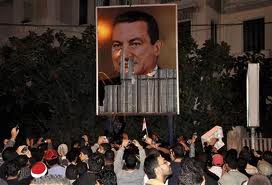
Egypt’s anti-regime protests are unprecedented in size, frequency and ferocity. In Shubra, Dokki, Mohandaseen and Bulaq, Cairenes chanted ash-sha’ab yureed isqaat an-nizam, or The People Want the Fall of the Regime, and braved tear gas and baton-wielding thugs in the central Tahrir Square. Alexandria, Tanta, Suez, and the labour stronghold of Mahalla al-Kubra have also demonstrated. A government building has been burnt in Suez. Posters of Mubarak have been ripped down and burnt in several locations. Mish ayazeenu, the people shout: We Don’t Want Him.

When January 25th’s Day of Anger started, police at first allowed protesters to move freely in the streets. This was unusual, and suggests fear on the authorities’ part, as does the abrupt shift back to traditional methods as night fell. At the time of writing, at least a thousand people have been arrested, several killed, and hundreds beaten. (Here’s an audio recording of Guardian journalist Jack Shenker’s experience being trucked into the desert with other protesters.) Uniformed police are backed up by plainclothes goons, many armed with iron bars. (One hopes that someone is collecting photographs of these people in order to identify and shame them.)

Continue reading “Mish Ayazeenu”

Egypt Awakes

UPDATE: See Al Jazeera’s reports below and read Ahmed Moor (who recorded the video below)’s account of today’s events at MondoWeiss.

Led by what appears to be a girl and a boy, a group of Egyptian protesters chase the riot police.

Helena Cobban of Just World News asks if the Arab world is finally waking from 40-year sleep:

In Egypt, the long-entrenched, US-backed-to-the-repressive-hilt Mubarak regime is facing one of the most serious challenges yet to its control.In Tunisia, the long-entrenched, strongly US-backed Ben Ali regime is history, and citizens on the streets and in their gathering places are right now determining how their country will governed in the future.

Continue reading “Egypt Awakes”