Journalist Chris Hedges writes of a Kafka-esque landscape in the world today where corporate advertising, lobbying and control of media fogs the distinction between lie and fact.
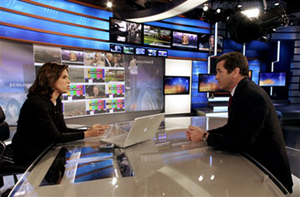
CNN’s Soledad O’Brien, left, and Miles O’Brien rehearse with the network’s “news wall” in the background.
The ability of the corporate state to pacify the country by extending credit and providing cheap manufactured goods to the masses is gone. The pernicious idea that democracy lies in the choice between competing brands and the freedom to accumulate vast sums of personal wealth at the expense of others has collapsed. The conflation of freedom with the free market has been exposed as a sham. The travails of the poor are rapidly becoming the travails of the middle class, especially as unemployment insurance runs out and people get a taste of Bill Clinton’s draconian welfare reform. And class warfare, once buried under the happy illusion that we were all going to enter an age of prosperity with unfettered capitalism, is returning with a vengeance.
Our economic crisis—despite the corporate media circus around the death of Michael Jackson or Gov. Mark Sanford’s marital infidelity or the outfits of Sacha Baron Cohen’s latest incarnation, Brüno—barrels forward. And this crisis will lead to a period of profound political turmoil and change. Those who care about the plight of the working class and the poor must begin to mobilize quickly or we will lose our last opportunity to save our embattled democracy. The most important struggle will be to wrest the organs of communication from corporations that use mass media to demonize movements of social change and empower proto-fascist movements such as the Christian right. Continue reading “The Truth Alone Will Not Set You Free”
In a few weeks, a group of quiet, dignified elderly men and women will arrive in London to explain how the forces of the British state crushed their testicles or breasts with pliers. It was part of a deliberate policy of breaking a civilian population who we regarded as “baboons”, “barbarians” and “terrorists”.
They will come bearing the story of how Britain invaded a country, stole its land, and imprisoned an entire civilian population in detention camps – and they ask only for justice, after all this time.
Addressing the Summit of the Americas Obama explained “I didn’t come here to debate the past, I came here to deal with the future.”
Well the past is inextricably linked with the future and Chavez created a media sensation by forcing that past into Obama’s hand in the form of a handshake with a copy of Open Veins of Latin America: Five Centuries of the Pillage of a Continent. The book then shot to #2 on the Amazon bestseller list.
In case you missed all that excitement, the foreword by Isabel Allende, which is quite excellent, and a short extract of Eduardo Galeano’s work, In Defence of the Word, are included below to further entice.
Isabel Allende
Many years ago, when I was young and still believed that the world could be shaped according to our best intentions and hopes, someone gave me a book with a yellow cover that I devoured in two days with such emotion that I had to read it again a couple more times to absorb all its meaning: Open Veins of Latin America, by Eduardo Galeano.
C. S. Soong is one of the best radio interviewers, erudite and articulate, and on his show Against the Grain you will always find some of the most stimulating discussions on politics, philosophy, literature and activism.
Terrorists, we are told, threaten our freedom and democracy. What does this kind of rhetoric ignore, and what kind of governmental violence does it justify? Matthew Carr calls attention to a tradition, beginning in the 19th century, of using violence against symbolic targets to achieve a political victory. He also discusses the Mau Mau in Kenya and the counterterrorism initiatives of the Reagan era.
While I agree with much of what Tariq is saying, he presents a less nuanced analysis of the origins of the Afghanistan war than he does in his book. He repeats the Leftist conventional wisdom on the subject. It was neither Carter’s nor Brzezinski’s war. Yes, we all know Brzezisnki bragged to a French newspaper that he was responsible for trapping and defeating the Soviets. In actual fact, US support for the Mujahideen was token under Carter. It was only under Reagan and Bill Casey that it finally took off. (thanks Elisa)
Host Harry Kreisler welcomes writer and journalist Tariq Ali for a discussion of Pakistan and it relations with the United States. He places the present crisis in its historical context exploring the origins of the Pakistani state, the failure to forge a national identity, the inability and unwillingness of Pakistani leaders to address the country’s poverty and inequality, and the role of the military in the country’s spiral toward violence and disunity. In this context, Tariq Ali highlights the significance of the U.S. relationship throughout Pakistan’s history and he analyzes current US policy and it implications for stability in the region.
The Financial Barbarians at the Gate is a Guns and Butter interview with economist / historian Michael Hudson. In it he discusses the historical takeover of the economy by the finance sector.
One point of note is that the illegal war of aggression in Iraq is not a war related to economics but to the strategic interests of Israel. Hudson, explaining American Imperialism, states that “unlike England the United States didn’t have to invade countries, at least before the oil grab in Iraq” and instead drained countries through the US monetary system. It’s revealing that he suggests Iraq as a change in economic policy, it was not about economics, the oil lobby in Washington didn’t want a war, they wanted an end to brutal sanctions to gain conventional access to the oil.
The whip-smart and ever-sly Gore Vidal visited “Real Time” on Friday, giving his historical and sometimes hysterically funny take on the state of the United States. He also revisited a few key moments from his personal history, illustrated by some priceless archival footage found by Bill Maher’s crack research team. Is it too soon to make an Amelia Earhart joke? It’s not too late to make one about Sarah Palin, apparently.
Edward Said – Culture and Imperialism (57:23): MP3
Imperial power is constructed on a bedrock not only of force but of culture as well. Culture provides the underpinning, justification and validation of empire. Its crudest manifestation is perhaps Kipling’s “White man’s burden.” A more refined version is the French “mission civilisatrice,” civilizing mission. Imperialism is often thought of as a European phenomenon of the past. In fact it continues today in new shapes and forms. The US carries out its imperial policies behind the facade of democracy and freedom. Culture and politics produce a system of control that transcends military power to include a hegemony of representations and images that dominate the imaginations of both the oppressor and the oppressed.
Paul Foot – The Haitian Slave Revolt of 1791 (57:27): MP3
Paul Foot vividly describes how the most successful slave revolt in history, which began in 1791, came to be closely allied to the events of the French Revolution and how each in turn influenced the other.
Taking self-emancipation as his main theme, Foot also challenges the idea that it was William Wilberforce, the British Tory MP and factory owner, that brought about the abolition of the most brutal and systematic regime of bondage and exploitation.
H/t to Mohammed Omer for posting this on Facebook.
The following YouTube from France is a powerful depiction contrasting life in Palestine and for Jews during the European Holocaust. When will ordinary Americans and American politicians understand these similarities? Who knows. But we will do whatever it takes to change American views toward Palestine and the Mideast… one step at a time.


 The late Edward Said speaking in 1993 on
  The following is an illuminating lecture by
  P U L S E