Is One Iraqi’s Self-Hatred Newsworthy?

Crusaders in Iraq?

M. Shahid Alam

An Arab-American of Lebanese descent, fluent in Arabic, Anthony Shadid was one of a handful of unembedded Western journalists reporting from Iraq during the US invasion in 2003. At the time, he was The Washington Post’s correspondent for Islamic Affairs in the Middle East.

His dispatches from Iraq were about Iraqis, about the destruction visited upon them by a war whose architects claimed that they were bringing democracy to that country. He reported the destruction and mayhem caused by this war by letting the Iraqis speak for themselves: and they spoke of their pain, their anguish, their perplexity and their anger.

For his honest reporting, for a job well done, Anthony Shadid received some of the highest accolades of his profession. In 2004 he received the Michael Kelly Award and the Pulitzer Prize for international reporting. Other honors followed, all well-deserved. He had won his spurs for reporting, not cheerleading, neither praising nor denouncing the United States. He was reporting for The Washington Post, a neoconservative newspaper.

On Jan 29, I noticed for the first time a report in The New York Times that carried Anthony Shadid’s byline. Was this a promotion? It was written from Halaichiya, a remote village in the southern tip of Iraq, untouched by the war. The village has never seen Americans before, neither troops nor diplomats.
Continue reading “Is One Iraqi’s Self-Hatred Newsworthy?”

Criminal and Accomplice

I didn’t watch Blair’s performance at the Chilcot inquiry, for health reasons, but I did read that he mentioned Iran 30 times, as in ‘the same good case for war applies to Iran’. This comes in the context of America concentrating ships and missiles in the Gulf. It is unlikely that the US will attack Iran directly, but increasingly likely that Israel will provoke a conflict. Blair may be preparing the ground for this.

Blair felt ‘responsibility but no regret’ over the destruction of Iraq which has killed over a million, created at least four million refugees, and turned a fertile land into a diseased desert. He focused on Saddam Hussain’s monstrosity, but refrained from explaining how Saddam’s most monstrous crimes were supported by his Western backers. He was allowed to refrain. He didn’t entertain the possibility that Hussain could have been deposed in other ways. He blamed Iran and al-Qa’ida, neither of which had a presence in the country before its collapse, for Iraq’s problems, and again his illogic was not questioned.

Continue reading “Criminal and Accomplice”

What Comes Next

This is the extended version of a piece published in today’s Sunday Herald.

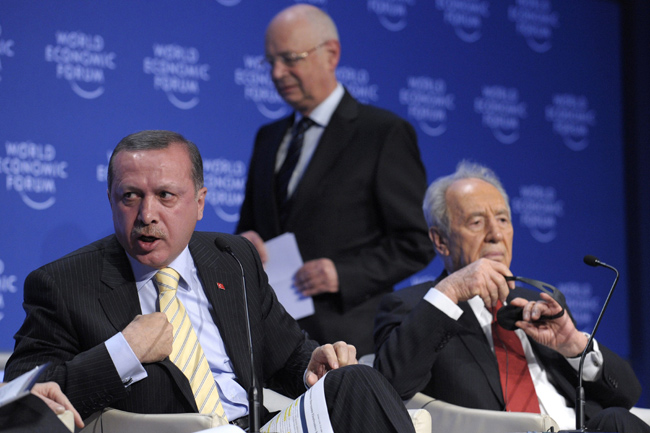
Erdogan reacts to his war criminal neighbour

A strange calm prevails on the Middle Eastern surface. Occasionally a wave breaks through from beneath – the killing of an Iranian scientist, a bomb targetting Hamas’s representative to Lebanon (which instead kills three Hizbullah men), a failed attack on Israeli diplomats travelling through Jordan – and psychological warfare rages, as usual, between Israel and Hizbullah, but the high drama seems to have shifted for now to the east, to Afghanistan and Pakistan. The Arab world (with the obvious exception of Yemen) appears to be holding its breath, waiting for what comes next.

Iraq’s civil war is over. The Shia majority, after grievous provocation from takfiri terrorists, and after its own leaderhip made grievous mistakes, decisively defeated the Sunni minority. Baghdad is no longer a mixed city but one with a large Shia majority and with no-go zones for all sects. In their defeat, a large section of the Sunni resistance started working for their American enemy. They did so for reasons of self-preservation and in order to remove Wahhabi-nihilists from the fortresses which Sunni mistakes had allowed them to build.

The collapse of the national resistance into sectarian civil war was a tragedy for the region, the Arabs and the entire Muslim world. The fact that it was partly engineered by the occupier does not excuse the Arabs. Imperialists will exploit any weaknesses they find. This is in the natural way of things. It is the task of the imperialised to rectify these weaknesses in order to be victorious.

Continue reading “What Comes Next”

The Power and Necessity of Dissent

On Jan 21st, a group of student activists at Georgetown University provided guest speaker, General Patraeus, with an unexpected welcome, successfully interrupting his address by reading out the names and ages of those killed in the wars in Iraq and Afghanistan. In the process, they’ve reminded us of the power and necessity of dissent, which, in this case, was effectively achieved by less than a dozen remarkable students.

Continue reading “The Power and Necessity of Dissent”

Stop-Loss

In the case of the Vietnam war it took long after the war had ended for the first critical films to come out. Americans in this respect still aren’t as bad as the French, who have yet to own up to their crimes in the colonies. Even today the best they can offer is oblique references to colonial depredations (take for example the awful Flanders). The French were so sensitive about their colonial legacy in Viet Nam even in 1979 that Francis Ford Coppola had to edit out a long section from Apocalypse Now lest it upset judges at the Cannes Film Festival.
However, the Iraq war has been unique insofar as it has produced some excellent cinema even as it has continued to grind on. Yet, most of these films have failed at the box office. Some of them perhaps understandably so: War Inc., Redacted, Lambs for Lions and Battle for Haditha were well-meaning, for example, but didn’t work so well as films. In the Valley of Elah, on the other hand, had all the right elements: an a-list cast comprising of multiple Oscar winners, an Oscar-winning writer and director, a superb screenplay; and yet, it was a complete commercial failure.  So was Grace is Gone; and Rendition. So was another — perhaps one of the best — which also had all the right elements: Stop-Loss. The film is based on the experiences of director Kimberley Peirce’s own brother, and it makes news stories such as the following from the Guardian rather predictable.

An Iraq war veteran has been arrested and charged with threatening to kill his officers after recording a violent rap protest song and sending it to the Pentagon.

Marc Hall, a junior member of an infantry unit, wrote the song in protest at the US army’s unpopular policy of involuntarily extending soldiers’ service and forcing them to return to Iraq or Afghanistan.

Hall completed a 14-month spell in Iraq last year, expecting to be discharged next month, but was told he would have to go back to Iraq under the policy known as stop-loss.

Continue reading “Stop-Loss”

Death By Sanctions

Guernica
M. Shahid Alam

Iraq deaths double under UN sanctions.”
New York Times, Feb.17, 2000

Sleep my child, do not wake now.
The portents in the sky foretell
a searing death for you.

The couriers of death have come,
stealth in their cyber gaze:
they scour the land for Saddam.

They poison every river, creek and well.
They darken school and hospital.
They warp the words you spell.

For star, for oil and cross they fly.
They will not cease to tyrannize
your dying days and hellish nights.

They will not cease their deathly watch.
Their mission is to fossilize
your bones, your heart, your eyes.

Sweet my child, do not wake now.
Your eyes once soft are hard
as rock: your hair is white as snow.

– M. Shahid Alam is professor of economics at Northeastern University. He is author of Challenging the New Orientalism (IPI: 2000). You can reach him at alqalam02760@yahoo.com.

Speaking Truth to Power

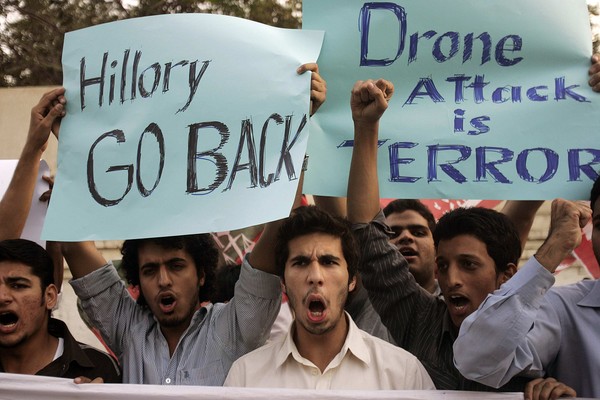
Students in Lahore, Pakistan, protest against the visit of U.S. Secretary of State Hillary Clinton. (K.M. Chaudary/AP Photo/October 29, 2009)

by Kathy Kelly

There’s a phrase originating with the peace activism of the American Quaker movement: “Speak Truth to Power.”  One can hardly speak more directly to power than addressing the Presidential Administration of the United States. This past October, students at Islamabad’s Islamic International University had a message for Secretary of State Hillary Clinton.  One student summed up many of her colleagues’ frustration. “We don’t need America,” she said. “Things were better before they came here.”

The students were mourning loss of life at their University where, a week earlier, two suicide bombers walked onto the campus wearing explosive devices and left seven students dead and dozens of others seriously injured. Since the spring of 2009, under pressure from U.S. leaders to “do more” to dislodge militant Taliban groups, the Pakistani government has been waging military offensives throughout the northwest of the country.  These bombing attacks have displaced millions and the Pakistani government has apparently given open permission for similar attacks by unmanned U.S. aerial drones.   Every week, Pakistani militant groups have launched a new retaliatory atrocity in Pakistan, killing hundreds more civilians in markets, schools, government buildings, mosques and sports facilities.  Who can blame the student who believed that her family and friends were better off before the U.S. began insisting that Pakistan cooperate with U.S. military goals in the region?

Continue reading “Speaking Truth to Power”

Why is Democracy Now shielding “war for oil” against reality?

In its headlines for December 14, Democracy Now followed the report on Blair’s confession about his committment to regime change in Iraq regardless of the absence of WMDs, with this:

Iraq Signs Oil Deals with 10 Foreign Companies

Blair’s comments come just as Iraq has signed a series of major oil deals. A two-day auction ended Saturday with ten foreign companies winning access to Iraq’s massive reserves. The oil giant Royal Dutch Shell won the rights to the Manjoon oilfield near Basra, one of the world’s largest. The US-based Exxon Mobil and Occidental Petroleum also submitted winning bids.

The wording is careful: it appears to suggest a connection between what Blair said and the Iraqi oil contracts. The war in other words was for oil. That is a remrkable conclusion to draw from news about an auction in which US companies were the big losers (hence DN’s careful choice of the words ‘foreign companies’). Unless Democracy Now is suggesting that the US waged a war for Russia, Norway and China — biggest winners in the auction — it is not clear why it continues to insist on the discredited “war for oil” argument? Why is it so difficult to admit who actually conceived the war?

Continue reading “Why is Democracy Now shielding “war for oil” against reality?”

Michael Mann on the Incoherent Empire

I am reading Michael Mann’s The Sources of Social Power at the moment, and I find many of his ideas, and his sociological approach to world history most stimulating. I think his IEMP Model — society as a series of overlapping and intersecting power networks with a focus on the logistics of Ideological, Economic, Military and Political power — is by far the best approach to the study of social power. However, I was underwhelmed by his own (in my view defective) application of the theory in his Incoherent Empire. This interview is old, but his observations on history and society remain relevant nevertheless. (thanks Dave)

UC Berkeley’s Harry Kreisler welcomes UCLA sociologist Michael Mann for a conversation on how comparative historical sociology can help in our understanding of U.S. foreign policy. Series: “Conversations with History”

The Image and the Imagined: On Why We’re not Allowed to see Detainee Abuse

By Aisha Ghani

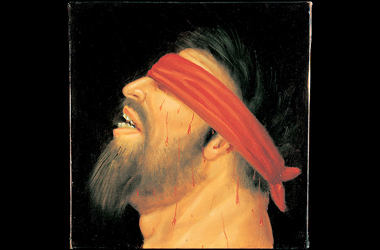
Abu Ghraib painting by Fernando BoteroBy Aisha Ghani


On Monday, November 30th the Supreme Court overturned a Second Circuit Court of Appeals order to release photographs of U.S. soldier abuse of prisoners in Afghanistan and Iraq. According to a statement by Solicitor General Elena Kagan, disclosing these photographs “would pose a clear and grave risk of inciting violence and riots against American troops and coalition forces.”

The contestation over the release of these photographs began four years ago, when a trials court judge claimed that the Bush administration was evading obligations imposed on it by the Freedom of Information Act in withholding the images. Although earlier this year the Obama administration argued in favor of releasing the photographs in an effort to encourage ‘transparency’, the decision was later reversed. While the Supreme Court has historically challenged the state’s assertions in cases concerning the rights of detainees, this time they sided with the  Obama Administration, permitting the Pentagon to block the release of these photographs and others like them.

Are we to believe that concern for the safety of U.S. soldiers and civilians lies at the heart of this decision, or can we sense a certain disingenuity when we think about how the state endangers both soldiers and civilians everyday by subjecting them to war?  Insincerity, as George Orwell tells us, is “the gap between one’s real and declared aims.”

What is it about the nature of the image in general and, more specifically, about the ‘possible’ content of these images in particular that is creating a palpable gap between the state and judiciary’s real and declared aims?

Continue reading “The Image and the Imagined: On Why We’re not Allowed to see Detainee Abuse”