Feeling the Loyalty to the Jewish State of Israel

By Max Blumenthal and Joseph Dana

The Israeli Knesset is debating a bill proposed by David Rotem of the extreme right Yisrael Beiteinu party that would require all Israeli citizens to swear loyalty to Israel as a “Jewish and democratic state.” This bill is targeted at increasing pressure on the twenty percent of Israelis who are Palestinian citizens while forcing the ultra Orthodox Jewish minority who reject the legitimacy of any state not based on Jewish biblical law to accept Zionism. If passed in its proposed form, citizens unwilling to take the loyalty oath would be at risk of losing citizenship.

Continue reading “Feeling the Loyalty to the Jewish State of Israel”

Remembering Sabra and Shatila: On massacres, atrocities and holocausts

by Sonja Karkar

The Massacre

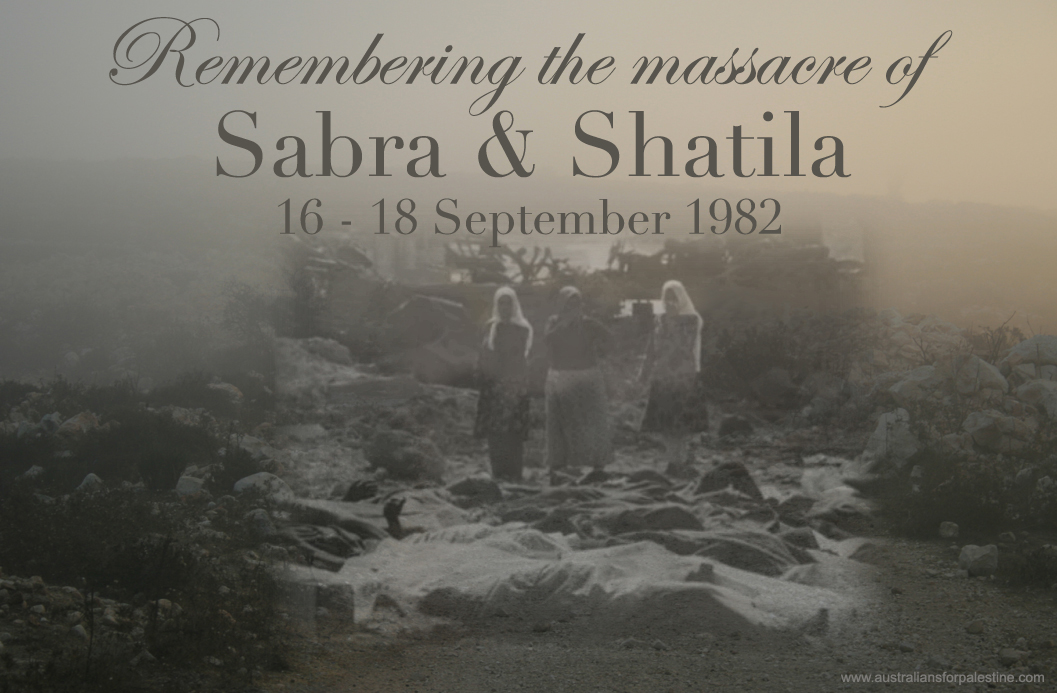
It happened twenty-eight years ago – 16 September 1982.  A massacre so awful that people who know about it cannot forget it.  The photos are gruesome reminders – charred, decapitated, indecently violated corpses, the smell of rotting flesh, still as foul to those who remember it as when they were recoiling from it all those years ago. For the victims and the handful of survivors, it was a 36-hour holocaust without mercy.  It was deliberate, it was planned and it was overseen.  But to this day, the killers have gone unpunished.

Sabra and Shatila – two Palestinian refugee camps in Lebanon – were the theatres for this staged slaughter.  The former is no longer there and the other is a ghostly and ghastly reminder of man’s inhumanity to men, women and children – more specifically, Israel’s inhumanity, the inhumanity of the people who did Israel’s bidding and the world’s inhumanity for pretending it was of no consequence. There were international witnesses – doctors, nurses, journalists – who saw the macabre scenes and have tried to tell the world in vain ever since.

Each act was barbarous enough on its own to warrant fear and loathing.  It was human savagery at its worst and Dr Ang Swee Chai was an eye witness as she worked with the Palestinian Red Crescent Society on the dying and the wounded amongst the dead.  What she saw was so unimaginable that the atrocities committed need to be separated from each other to even begin comprehending the viciousness of the crimes. [1]

Continue reading “Remembering Sabra and Shatila: On massacres, atrocities and holocausts”

On Gaza, Artists Speak Out

Terry Jones, Annie Lennox, Thandie Newton, Alexei Sayle, Mike Figgis, Katharine Hamnett and Jason Flemyng, voice their support for Amnesty International’s ongoing efforts to secure justice for both Palestinians and Israelis and make an impassioned plea for Israel to cease its illegal siege of Gaza. Find out more here.

Jamal Juma: The real obstacle to peace in the Levant is the presence of a criminal, racist state

Illegal settlements on Palestinian land are one of the biggest stumbling blocks for these talks. The Palestinians have warned that they will walk out of talks if a freeze on settlement construction, which is set to expire at the end of the month, is not extended. Danni Dayan, Chairman of the Settlers Council in Jerusalem, and Jamal Jumaa, a Palestinian activist in Ramallah, debate the issues facing their leaders.

Jeff Halper: Pete, join the artists who are boycotting Israel

Jeff Halper’s open letter to Pete Seeger.

Dear Pete,

Jeff Halper with legendary singer and ICAHD supporter Pete Seeger.

All the best from your friends in Israel/Palestine. In that spirit, I was surprised to hear of your planned participation in With Earth and Each Other: A Virtual Rally for a Better Middle East. While at first blush it might seem to have something in common with the work of ICAHD and other Israeli and Palestinian peace groups — attempting to build bridges between peoples — it is actually something quite different.

One of the lead partners in the effort is the Jewish National Fund, which is responsible for the allocation of land in Israel. As such, it is a mainstay of the ever-increasing apartheid system there. Among their most recent activities has been the planting of a forest to cover a Bedouin village in the Negev from which the residents have been forcibly removed. They are in fact engaged in various tree-planting exercises that brand them as an environmental organization, when in fact their purpose is to secure the land of Israel, if not all of Palestine, for Jews only. That is their historical role, and so it remains. Efforts to paint Israel as environmentally concerned are mere greenwashing. Israel has repeatedly torn down Palestinian neighborhoods by declaring them green zones.

Continue reading “Jeff Halper: Pete, join the artists who are boycotting Israel”

Gazans Forced to Farm in No Man’s Land

The Gaza Strip is narrow, elongated, and densely populated. One of the main agricultural areas in the Gaza Strip runs along the eastern border with Israel, adjacent to the perimeter fence. In recent years, B’Tselem has gathered testimonies indicating that the Israeli security forces have defined broad swaths of these areas as no-go zones, where the open-fire regulations permit live fire at anyone who enters, even persons who pose no danger. This clip was filmed by Muhammad Sabah and Khaled ‘Azayzeh, B’Tselem.

Continue reading “Gazans Forced to Farm in No Man’s Land”

Boycotting Ariel: Missing the Forest for the Trees

Ariel is an illegal Israeli settlement in the West Bank.

PACBI Statement

Provoked by the recent announcement of the inauguration of a cultural center in Ariel, the fourth largest Jewish colony in the occupied Palestinian territory, 150 prominent Israeli academics, writers, and cultural figures have declared that they “will not take part in any kind of cultural activity beyond the Green Line, take part in discussions and seminars, or lecture in any kind of academic setting in these settlements” [1].  A few protestors went as far as reiterating the fact that all Israeli colonies built on occupied Palestinian land are in violation of the Fourth Geneva Convention and thus constitute a war crime.

This position by tens of Israeli academics and artists has generated a great deal of controversy within the Israeli public sphere, attracting rebuke from across the political spectrum and especially from the academic and cultural establishment.  All major theaters were quick to declare their refusal to boycott Ariel under the pretense of serving “all Israelis;” university administrations echoed this position or resorted to silence, continuing business as usual with Ariel and other settlements.  The terms of the discourse, however, raise a number of issues for supporters of Palestinian rights.  While we welcome acts of protest against any manifestation of Israel’s regime of colonialism and apartheid, we believe that these acts must be both morally consistent and anchored in international law and universal human rights.

Continue reading “Boycotting Ariel: Missing the Forest for the Trees”

The Peace Procession

John Mearsheimer, Robert Malley, and Nabil Shaath on Al Jazeera’s Empire looking at the Israeli-Palestinian talks and the unattainability of the promised land.
Continue reading “The Peace Procession”

In their own words

On the excellent ‘Promised Land’ blog, Noam Sheizaf draws attention to an IDF slideshow which lists “the principles of Israeli policy” towards the Gaza Strip, particularly with regards to restrictions on freedom of movement. One objective is listed as “separating/differentiating Judea and Samaria [West Bank] from Gaza”. Sheizaf notes that this “is the first time an Israeli official document publicly declares that the current policy objective is to create two separate political entities in the Palestinian territories”.

This is an example of how Zionist lobby spin can often be challenged using the words of Israeli officials. Last month, Netanyahu’s testimony before the Turkel Commission included the admission that, in the words of Gaza Gateway, “Israel’s decisions on what to allow or prohibit into Gaza were based not on concern for the welfare of the population in Gaza but rather about Israel’s image in the international media”. So much for ‘security’.

Then just a week ago, the same Commission heard testimony from Maj. Gen. Eitan Dangot, the Coordinator of Government Activities in the Territories, who said that “Israel declared economic warfare against the Gaza Strip and prevented the entry of goods – including certain kinds of food and other civilian items – that posed no security threat, with the goal of disrupting civilian life in the Gaza Strip”.

Finally, remember that in a 2007 legal case, the Israeli government’s State Attorney’s Office argued [PDF] that “harming the economy itself is a legitimate means of warfare and a relevant consideration even when deciding on allowing in relief consignments”.
Not Playing Anymore – Israeli Theatre Actors Rise Up

“Ariel’s Center for the Performing Arts – Ariel’s residents have always benefited from a rich variety of local facilities and services. These services have traditionally rendered Ariel the focal point of life in the region, and earned it the title of Capital of the Shomron. The city’s Center for the Performing Arts is yet another addition to life, culture and excellence in the heart of Israel.” (from the Ariel website)

It’s no news by now that Israel is constructing a culture center in the illegal Ariel settlement. It’s not surprising that Habima, Israel’s national theater company, was scheduled to preform there. It is, however, refreshing that actresses and actors from Habima and other leading theater companies, the likes of the Cameri, signed a letter to Culture Minister, Limor Livnat, refusing to preform in the Occupied Territories.

Of Boycotts and Green Bans

Sixty/Thirty-six is a big number for any one sector in Israel, not to mention for any dissent in Israel, at all. I can’t say the actor’s letter doesn’t spark hope in me as to a growth in dissent in Israel (they’ve been joined by non-theatre people of the arts), but one mustn’t get carried away. The Guardian reported:

“Dozens of Israeli actors, playwrights and directors have signed a letter refusing to take part in productions by leading theater companies at a new cultural center in a West Bank settlement, prompting renewed debate over the legitimacy of artistic boycott.”

Continue reading “Not Playing Anymore – Israeli Theatre Actors Rise Up”