#trashthestache: an unabashedly—but deservedly—fawning review of The Imperial Messenger

by Steve Marlowe

This is an excerpt from a review, published at Chapati Mystery, of The Imperial Messenger: Thomas Friedman at Work. Click here to read the review at CM.

More sophisticated readers of the New York Times’ editorial pages have, for years, fumed at Thomas Friedman’s inane musings. Even less sophisticated readers, some of which write book reviews and essays for online magazines named after mysterious flatbreads, have bristled at Friedman’s claims, prose and weak reasoning.

There are times, in fact, that one might suspect the Times’ Editorial Board is putting Friedman over on the public as some sort of Onion-style goof, a la Jackie Harvey.

Some readers have an automatic, visceral dislike of his face, alone: the suburban-mall Glamour-Shots photograph accompanying his crimes against logic calls for snarky comment; in it, he appears smug, self-satisfied and eager to be taken as the thinker of deep thoughts that, in The Imperial Messenger: Thomas Friedman at Work, Belen Fernandez proves he is not.
Continue reading “#trashthestache: an unabashedly—but deservedly—fawning review of The Imperial Messenger”

Anthony Shadid’s House of Stone

Nada Bakri discusses the life and work of her late husband Anthony Shadid.

Continue reading “Anthony Shadid’s House of Stone”

The murder of Syed Saleem Shahzad

I’ll be reviewing Syed Saleem Shahzad’s book here shortly. Meanwhile here is ‘Pakistan: The most dangerous place to report from,’ an episode of  Al Jazeera’s Listening Post which focuses on his assassination.

Amnesty International: Do the Media Aid Israel?

The following series of talks, on media coverage of Israel, was hosted by Amnesty International, who came under pressure to cancel the event. It was surprising to see reports that the Jewish division of the EDL had shown up at the meeting as I thought they’d been ejected from that noxious organisation for being too extreme. Perhaps they’ll set up there own Israeli Defence League instead: which would probably be more honest, and would cause less confusion about what to call them now.

The concerted Zionist campaign to smear the Middle East Monitor (MEMO) and the Palestine Solidarity Campaign (PSC) failed dismally last night as the two groups co-hosted one of their most successful public events to date. The topic up for discussion was “Complicity in Oppression – Does the Media Aid Israel?” The panellists consisted of Prof. Greg Philo who discussed his new book “More Bad News from Israel” (an excellent academic analysis of the media’s skewed coverage of news coming out of Palestine-Israel); Tim Llewellyn, former BBC Middle East correspondent, and Abdel Barri Atwan, expert Palestinian commentator on the Middle East. The discussion was chaired by Victoria Brittain, former associate foreign editor of the Guardian.

Prof. Greg Philo, co-author of Bad News from Israel and More Bad News from Israel

Continue reading “Amnesty International: Do the Media Aid Israel?”

Nir Rosen on Western media fraud in the Middle East

Journalist and author Nir Rosen writes the following in an article for Al Jazeera about the myriad obstacles to the dissemination of truth in Western reporting on the Middle East:

Relying on a translator means you can only talk to one person at a time and you miss all the background noise. It means you have to depend on somebody from a certain social class, or sect, or political position, to filter and mediate the country for you. Maybe they are Sunni and have limited contacts outside their community. Maybe they are a Christian from east Beirut and know little about the Shia of south Lebanon or the Sunnis of the north. Maybe they’re urban and disdainful of those who are rural. In Iraq, maybe they are a middle class Shia from Baghdad or a former doctor or engineer who looks down upon the poor urban class who make up the Sadrists. And so in May 2003, when I was the first American journalist to interview Muqtada Sadr, my bureau chief at Time magazine was angry at me for wasting my time and sending it on to the editors in New York without asking him, because Muqtada was unimportant, lacking credentials. But in Iraq, social movements, street movements, militias, those with power on the ground, have been much more important than those in the establishment or politicians in the green zone, and it is events in the red zone which have shaped things.

Continue reading “Nir Rosen on Western media fraud in the Middle East”

An Élite Not Unlike Ours! Who’d Have Guessed?!

By Huma Dar

Rakhshanda Jalil writes in The Hindu, 27 February 2011, about “that elusive connect with India when she was least expecting it” on a visit to Karachi, Pakistan.  The title of her piece is “A city not unlike home.”

I am always amused when Indians are surprised and taken aback by Pakistanis (whether in Karachi or Lahore or elsewhere) who “speak Urdu and English with almost equal aplomb” or by their “silk sarees and natty blazers” or by their possible cosmopolitanism!!! (Class is class, unfortunately, and the élite exhibit their privileges in similar ways all over the region!)  Does it not, if just remotely, smack of the loaded “praise”: “Gee! Obama is so articulate!” — also known as “the racism of lowered expectation”?  Why would Indians expect otherwise from their class-affiliates on the other side of the border?  Or is it that Bollywood’s Pakistan-bashing fantasies are actually swallowed uncritically — hook, line, and sinker —  even (or perhaps especially) by the educated Indians, eliciting “fears about Kalashnikov-toting Taliban and marauding Muhajirs.”

And by the way, Pakistanis are not all “tall, well-built, good-looking people,” especially under the normative definition of “good-looking” in South Asia (fair-skinned or with a “wheatish complexion”) — thank god for the latter!  Sadly, the former two ascriptions, of course, too easily go awry given malnutrition due to poverty. Continue reading “An Élite Not Unlike Ours! Who’d Have Guessed?!”

Wikileaks as a modern challenge

by Farid Farid

One of Australia’s most acclaimed authors, Tim Winton, has re-released Land’s Edge: A Coastal Memoir. Through a series of autobiographical reflections, Winton describes how Australia is a littoral society always on “the edge of things” – floods, bushfires, riots etc… Winton talks about the sensuality of water being central to the Australian imaginary. Through his prose about surfing and sharks, readers can also envision human cargo packed on a floating boat teetering between life and death.
It is perhaps then fitting that this was underscored a couple of days ago by the enthusiastic reception by foreign minister Kevin Rudd and defence minister Stephen Smith of their British counterparts William Hague and Liam Fox at the HMAS Watson on a naval base in Sydney harbour. In an ironic scene on the water, the Australian government’s foreign image untarnished by floods or asylum seekers was tactfully kept and strategic interests were shared between “cousins on opposite sides of the world” according to Hague and Fox.

Hague & Fox in their joint opinion piece for the Sydney Morning Herald opt for a turgid title that spells out their foreign policy objectives — ‘Stronger alliance required to meet modern challenges’. They probably had Wikileaks in mind as one of these trans-national challenges with both countries agreeing to tighten intelligence cooperation against cyber crimes.

Continue reading “Wikileaks as a modern challenge”

WikiLeaks: Why it Matters. Why it Doesn’t?

A panel of leading thinkers explore WikiLeaks and its implications for access to information, security, first amendment rights, innovation, and more. Moderated by The Real News founder Paul Jay and presented by the Churchill Club, the panel speakers are Daniel Ellsberg, Clay Shirky, Neville Roy Singham, Peter Thiel and Jonathan Zittrain.

Robert Meeropol, son of the executed Rosenbergs, on WikiLeaks

by Dennis Bernstein

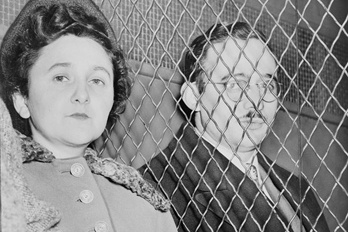
U.S. citizens Julius and Ethel Rosenberg were executed under the 1917 Espionage Act in 1953.

The U.S. Justice Department is now considering charging WikiLeaks’ founder Julian Assange with espionage under the 1917 Espionage Act. In a recent interview, syndicated on PacificaRadio’s Flashpoints show, I spoke to  Robert Meeropol, founder of the Rosenberg Fund For Children. Meeropol is the son of Julius and Ethel Rosenberg, the only U.S. citizens to be executed under the 1917 Espionage Act. In a strong defense of Wikileaks, Assange and Bradley Manning, Meeropol released a statement stating:

My parents were executed under the unconstitutional Espionage Act, here’s why we must fight to protect Julian Assange.

In the following interview he talks about the history of the 1917 espionage Act, the execution of his parents and some of the political “Echoes” from the 1950’s red scare days that are reverberating today. Meeropol also talks movingly about how his parents’ unwillingness to cave  in the face of government intimidation, even at the cost of their lives.

I think that resistance is inspirational.  When people resist, they inspire others and if you combined the resistance with the inspiration you end up building a movement of support.

DB: Let’s begin this way, Robert Meeropol.  The U.S. Congress is back in session, the Republicans are in charge of the House, and today they read the Constitution. Would that be relevant in your defense of Julian Assange?

Continue reading “Robert Meeropol, son of the executed Rosenbergs, on WikiLeaks”

The War You Don’t See

A new John Pilger documentary is always a media event. For over four decades he has set the bar for incisive and intrepid investigative journalism. In The War You Don’t See, his latest, Pilger indicts the mainstream media for its responsibility in enabling wars by sanitizing its image and glorifying its aims.