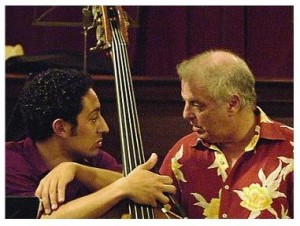
Utopia as Alibi: Said, Barenboim and the Divan Orchestra

by Raymond Deane

As a classical musician involved in pro-Palestinian activism, I frequently encounter the assumption that I am an unconditional admirer of the West-Eastern Divan Orchestra (WEDO). My reservations on this score tend to produce shocked disapproval: How could I not enthuse about such an idealistic project, particularly since it was co-founded by the late Edward Said, a figure for whom I have frequently expressed respect and admiration?

In truth, I have always been a little wary of Said’s veneration for the eighteenth/nineteenth century canon of European classical music. I look in vain in his writings on the subject[1] for a historical and political contextualisation of music comparable of that to which he so perceptively subjected literature in his indispensable Culture and Imperialism.[2]

In his 2002 speech accepting the Principe de Asturias Prize, Said claimed that he and his friend the Israeli pianist and conductor Daniel Barenboim founded the WEDO “for humanistic rather than political reasons”. This surprising dualism implies that music belongs to a utopian sphere somehow removed from the dialectical hurly-burly of hegemony and resistance.

The paradoxes of Said’s position have been ably dissected by the British musicologist Rachel Beckles Willson.[3] She quotes her colleague Ben Etherington’s critique of Said’s tendency “to assert the intrinsic value of Western elite music without really exploring how that tradition escapes mediation.” Paraphrasing Said’s critique of literary scholars in his Humanism and Democratic Criticism[4] she convincingly claims that he “omitted to make ‘a radical examination of the ideology of the [musical performance] field itself.’” (Willson’s chain brackets).

Continue reading “Utopia as Alibi: Said, Barenboim and the Divan Orchestra”
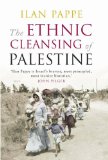
Five Books on Israel-Palestine

The interview below was published in the Five Books section of The Browser. I chose five books on the Israel-Palestine conflict.

Tell me about the Ilan Pappe book, The Ethnic Cleansing of Palestine.

Pappe has written a great historical work on the ethnic cleansing of Palestine in 1947/8 and he shows that it was organised and planned, called Plan D, or plan Dalit, and he has exploded the myths that were current until his work.

What myths?

Well, for example, that the Arab leaders told the Palestinians to leave, or that the Palestinians were Bedouin people who didn’t really live there anyway, and he showed that they were ordinary people in brick and mortar homes who were intentionally forced out. This is very important because the ethnic cleansing of Palestine is the original sin of Zionism and the root of the current problem.

Continue reading “Five Books on Israel-Palestine”

Bay Area Premier of “My Name is Rachel Corrie”

by Charlotte Silver

On November 19, 2009, My Name is Rachel Corrie made its Bay Area premier at Stanford University.  Amanda Gelender, senior at Stanford University, produced a staged reading of the play as a part of her senior thesis at Stanford University. Amanda is my friend. She was also my college classmate and we worked together in several campus political organizations, including the student-led Israel divestment campaign.

I attended opening night and along with a sold-out audience was struck by the poignancy of the play and Amanda’s subtle and deeply moving performance. Rachel Corrie was a 23 year-old American woman who traveled to Gaza in 2003 during the Second Intifada. She was killed by a Caterpillar bulldozer driven by Israeli Defense Forces as she attempted to prevent the IDF from demolishing the home of a Palestinian family. My Name is Rachel Corrie consists entirely of words written by Corrie herself, recorded in diary entries and emails from Rachel’s early childhood until a few days before her death. Gelender breathes vivid life into Rachel’s words, which themselves reveal the keen sensitivity and eloquence of a poetic nature.

Amanda Gelender, the lead and visionary behind this production, had been waiting to obtain the rights for the play for nearly two years. But obtaining rights is not always the only hurdle to securing a production of Rachel. Since its London premier in 2005, several professional American and Canadian theaters have seen their efforts to mount a production of this one-woman show quashed by vigorous opposition from powerful forces.  The charge is always the same: the play is anti-Semitic. Gelender’s successful production reflects the changing tide that is occurring within the American public’s relationship to Israel and anti-Semitism.

Continue reading “Bay Area Premier of “My Name is Rachel Corrie””

Divide and Conquer – Undermining the BDS Movement from Within

Last week, my local BDS group was put on alert, when the following headline emerged:
“Palestinian Unions Say Israel Boycott Would Harm Them”

The Palestine General Federation of Trade Unions (PGFTU) is a signatory of the PACBI (Palestinian Campaign for the Academic & Cultural Boycott of Israel) call for BDS (#5), and has an estimate of 290,000 members. Naturally, if- all of a sudden- they’re not on board with the BDS movement, it’s cause for concern. That said, the whole scheme of things didn’t seem to make sense, so off I went on another journey through the Zionist Jungle.

Continue reading “Divide and Conquer – Undermining the BDS Movement from Within”

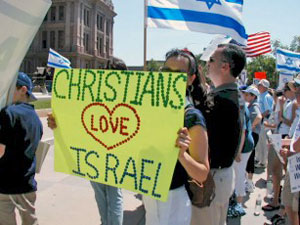
To A Christian Zionist

Update: I wrote this in 2006. If I wrote it today I would do it a little differently. Specifically, I would discuss the pernicious role of the Scofield Bible in perverting protestantism in America. I would discuss the meeting point of Christian Zionism, orientalism and racism in Western cultures. And I would point out that contemporary science has shown us that the direct descendants of the ancient Israelites are the Palestinians, not the Ashkenazi or Berber Jews who have colonised Palestine in recent years. Shlomo Sand’s excellent book The Invention of the Jewish People, reviewed here, summarises the science and undercuts the blood-and-soil aspects of Zionism which are so important to Christian Zionists and their ultimately anti-Semitic agenda.

I have recently been discussing Middle East issues with an American colleague who I would describe as a Christian Zionist. Although I like him personally I find some of his ideas (on Palestinian history, and Lebanon, and the wider Middle East) pretty offensive, and I have told him so. So as not to start an argument, I told him so in writing. He replied, saying that although he disapproves of collective punishment of the Palestinians he believes that the Bible clearly states that the Holy Land belongs to the Jews, and that the rebuilding of Israel prophesied in the Old Testament has happened since 1948. Hmm. My first response is anger. I understand Jews with memories of European anti-Semitism being attracted to Zionism, however wrong I think they are, but Americans? People who are not oppressed, who think Palestine is a Cecil B Demille set, who think real human beings (Arabs) are less important than their own narrow interpretations of scripture. Who think that ethnic cleansing, massacres, and apartheid are supported by God. It makes my blood boil. But I think responding intelligently to this kind of thing is important, because there are millions of Americans (with power) who see the Middle East through a Biblical prism. Anyway, here is my latest letter:

Continue reading “To A Christian Zionist”

The Lost Art of Reportage

Robert Fisk and Martin Bell in conversation with Ann Leslie at The Independent Woodstock literary festival.

Event description:

Was there a golden age for international correspondents? Are current affairs now largely brought to us in dumbed down soundbites? Who now sets the framework for coverage of world events?

In this podcast recorded at The Independent Woodstock literary festival Dame Ann Leslie, recognised as one of the 40 most influential journalists of our time (‘Killing my own Snakes’), talks with The Independent’s award-winning correspondent Robert Fisk (The Age of the Warrior’) and BBC’s renowned foreign reporter Martin Bell (‘The Truth that sticks – New Labour’s Breach of Trust’). They discuss whether reportage is indeed a ‘lost art’.

Cry Out by Fares Khouri

Reposted from Occupation Magazine 15/11/09.

Cry Out

— Fares Khouri

Cry out in Arabic, Ahmed, and contaminate their ears
Stand at Habima square, and cry out to your friend, who’s on Hertzel street, to bring you the shovel
Disturb all those sitting in Rothschild boulevard with their coddled dogs
Disturb them as they speak about yesterday’s party
About this evening’s Macabi Tel-Aviv match
About the (stinky) orthodox Jew that just got on the bus
About the right-wing government that they aren’t a part of
And about the intelligent Arab they met lately
Cry out, ya Ahmed
Defile their ears with your language
They don’t like it
They fear it
They don’t like to hear your friend’s name
It scares them, disturbs them as they read the leftist paper
Cry out Ahmed, with all the voice that god gave you
Cry out, don’t fear, cry out!
Continue reading “Cry Out by Fares Khouri”

Avi Shlaim and Shlomo Sand in conversation with Jacqueline Rose

Avi Shlaim and Shlomo Sand in conversation with Jacqueline Rose at the Frontline Club (via PIWP).
Vodpod videos no longer available.

Event description:

Few modern conflicts are as attached to history as that of Israel and Palestine. Avi Shlaim, professor of international relations at Oxford will be in conversation with Shlomo Sand, professor of contemporary history at Tel Aviv University, at the Frontline Club for a seminal evening of discussion. Continue reading “Avi Shlaim and Shlomo Sand in conversation with Jacqueline Rose”

George Galloway at the War Crimes Conference

The inimitable George Galloway addresses the War Crimes Conference in Kuala Lumpur Malaysia on 28th October 2009. In three parts.

Part One

Continue reading “George Galloway at the War Crimes Conference”

Kathy Kelly on the cost of war abroad and at home

The wonderful Kathy Kelly gives an excellent, compelling presentation on the costs, monstrosities and sorrows of war at the First Presbyterian Church in Binghamton, NY.  She importantly provides the view on the ground from the perspective of Pakistani, Afghani and Palestinian villagers at the receiving end of hellish drones and shares her experiences in Gaza and Pakistan.

Two highly recommended clips — and if you have any “progressive” friends who breezily defend Obama’s being awarded the Nobel Peace Prize, please draw their attention to these videos and to an example of a two-time NPP nominee whose work would actually merit such recognition.

Kathy Kelly co-coordinates Voices for Creative Nonviolence, a campaign to end U.S. military and economic warfare, and co-founded Voices in the Wilderness, a group which had openly defied economic sanctions from 1996-2003 by bringing medicines to children and families in Iraq.

In two parts over the jump (courtesy Essential Dissent, h/t Tom Feeley –ICH)

Continue reading “Kathy Kelly on the cost of war abroad and at home”