A Country of Words

“We travel like other people, but we return to nowhere…

We have a country of words.”

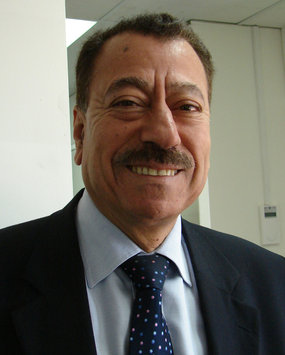
A traditional Arab media operation, according to Abdel Bari Atwan, is “characterised by editorial interference from the owners, slavishness to social hierarchies, backstabbing and nepotism.” It goes without saying that all the Arab local-national press, TV and radio stations are controlled by their respective regimes. Only in the pan-Arab sphere, beyond the control of any single regime, is there a possibility of anything better. Yet of the pan-Arab newspapers, ash-Sharq al-Awsat and al-Hayat are owned by different branches of the Saud family dictatorship, while the smaller-circulation al-Arab is part of the Libyan regime’s propaganda apparatus. Even after the satellite revolution, pan-Arab TV remains tame and partial, fattened and diluted by Gulf money, often providing its viewers a contradictory diet of Islamic and American-consumerist bubble gum. The second most famous channel in the Arab world, al-Arabiyya, is yet another mouthpiece for the Sauds (during last winter’s Gaza massacre it became known amongst Arabs as al-Ibriyya, or ‘the Hebrew’). The most famous channel, al-Jazeera, is of course the model that broke the mould. Its challenging reporting and inclusion of all sides in open debate has had a revolutionary effect on the Arabs.

Al-Jazeera’s print equivalent is the London-based al-Quds al-Arabi, founded in 1989, seven years before al-Jazeera. It may not have the immediate impact or mass audience of al-Jazeera (it’s banned in most Arab countries) but with its cast of excellent writers, its fearless exposure of Arab regime corruption, its scoops (al-Qa’ida chooses to communicate with the world through its pages), its renowned culture section, and its refusal to bury news from Palestine behind the football results, al-Quds al-Arabi is indispensable. Rather than backstabbing, its staff have sometimes worked for no pay to keep the operation afloat. Its founder, editorialist and editor-in-chief Abdel Bari Atwan is as passionate and articulate in speech as on the page, and is admired by the Arabs for his call-a-spade-a-spade style on those TV channels which dare to host him, usually al-Jazeera Arabic and Hizbullah’s al-Manar. Atwan’s “The Secret History of al-Qa’ida” is a book-length account of his meeting with Osama bin Laden and of the development of the al-Qa’ida network. Now Atwan has written an autobiographical memoir titled with a line from a Mahmoud Darwish poem, “A Country of Words.”
Continue reading “A Country of Words”

I Refuse to Buy a Poppy

05_11_09-Steve-Bell
Steve Bell

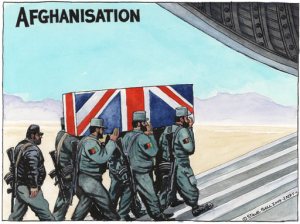
Yesterday five British soldiers were shot dead by an Afghan policeman. Just as they keep promising that they’ve reached ‘decisive turning points’ in their battle with the Afghan resistance, British military officials immediately vowed that the ‘rogue’ policeman would be caught. Today the Taliban reports that the policeman is safe with them, and that he’s been greeted with flowers.

Our glorious patriotic press responds. Amusingly, the Daily Mail headline wrings its hands and squawks, “What kind of war IS this?” Because some people aren’t playing by the rules, you see. Instead of sitting quietly in their villages waiting for the drone attack, or perhaps sending their kids out to accept sweets and modernity from a rosy-cheeked English lad, some barbarians are actually shooting back at the invaders. How very unBritish. (To be fair to the Mail – which has never been fair to anyone – it does seem to be taking an anti-war stance today). Other sections of the media worry about the ‘loyalty’ of Afghan troops, as if love for foreign occupiers is a realistic standard of loyalty. Still others, even more clever, psychoanalyse the policeman, wondering if an argument with his commander pushed him to a moment of madness. But it really isn’t that complicated, as anybody who disabuses themselves of imperialist delusion can see. Very simply, people don’t like foreigners striding around their streets and fields with guns and assumptions of superiority. Afghans will kill British troops as surely as Britons would kill Afghan troops if they occupied this country.

Continue reading “I Refuse to Buy a Poppy”

President Blair

If the Irish vote to ratify the Lisbon Treaty, Tony Blair, former British prime minister and current lecturer on faith, peace, and Palestinian submission, is expected to become the European Union’s first president. I wrote the following hymn to Blair in October 2007, when the unpleasant prospect of his presidency was first raised.

steve bell tony blairI’ve often thought that Abu Hamza al-Masri, the ex-imam of Finsbury Park mosque, must have been designed in a CIA laboratory. Not only did he – before his imprisonment – fulminate in a shower of spittle against various brands of kuffar, he also had an eye patch and a hook for a hand. You can’t imagine a more photogenic Islamist villain.
If my supposition is correct, then Tony Blair may well have been invented by the Iranian secret service, for of all the neo-cons he’s the one who most looks the part. I refer to the physiognomic combination of weakness and fury, the slight chin wobbling beneath that eye with its wild glint of certainty – the staring left eye, fixed on something the rest of us can’t see, something that makes reality irrelevant – and the teeth both fierce and mouselike, and the shininess of both forehead and suit. Most politicians wear suits, but few suits declare ‘hollow salesman’ so much as Blair’s. The voice too – the hurried speech and breathy tones of a public schoolboy approaching orgasm – that repulsive aural mix of complacency, stubbornness and privilege.

The British amateur terror trackers: A case study in dubious politics

A Spinwatch investigation: Tom Mills and David Miller on the British amateur terror trackers.

Dominic Whiteman as he appeared on BBC Newsnight

Investigations by Spinwatch reveal that a group of freelance terror trackers who promote stories about the threat from violent Islamists have been involved in exaggerating and even fabricating such stories, which they then comment on in the national press and on network television and radio. The group – which has now fallen apart – was centred on freelance spy Glen Jenvey and Conservative Party member Dominic Wightman, who uses the pseudonym ‘Whiteman’.

The barrage of stories from official sources and from terror ‘experts’ suggesting that Britain is under serious and extensive threat from Islamists and that Islam as a religion is particularly prone to extremism has been boosted by some stories that have little basis in fact. These have included:

  • An alleged attempt to plant a story about terrorist grannies planning to blow themselves up in British supermarkets
  • An attempt to suggest – quite falsely – that campaigners against the Israeli attack on Gaza were actually planning to target British Jews
  • The creation of a fake allegedly Islamist website in a bid to entrap suspects.
  • Spying on Tamil activists in the UK.
  • A fraudulent fundraising effort in the 1980s which was claimed to be to aid the African National Congress

Continue reading “The British amateur terror trackers: A case study in dubious politics”

Abusing Quilliam’s Name

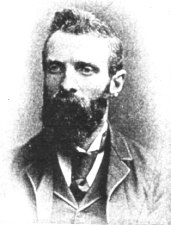
quilliamAbdullah Quilliam was a 19th Century British convert to Islam, the founder of a mosque in Liverpool. He was also an anti-imperialist and a supporter of the Caliphate. He argued that Muslims should not fight Muslims on behalf of European powers, citing specifically Britain’s enlistment of Muslim soldiers against the resistance in Sudan. If Quilliam were alive today he would, at very least, be kept under observation by the British intelligence services.

It is ironic, then, that this activist Muslim’s good name has been appropriated by the government-backed and funded Quilliam Foundation, established in April 2008, supposedly to counter extremism in Muslim communities.

Those who read my stuff will know that I despise Wahhabism, and still more Wahhabi-nihilism. I oppose Islamic political projects which aim to capture control of the repressive mechanisms of contemporary Muslim states. I am stunned by the stupidity of such slogans as “Islam is the solution.” I take issue with anyone who attempts to impose a dress code or an interpretation of morality on anyone else, and I loathe those puritanical ideologies which fail to recognise the value of music, art, mysticism, philosophy, and popular and local cultures in the Muslim world. It is obvious that political Islam has often been exploited for very unIslamic purposes by the American empire and its client dictators in Saudi Arabia, Egypt, Pakistan and elsewhere. Nominally Islamic political parties bear a great weight of responsibility for diverting the Iraqi resistance into a disastrous sectarian war. The terrorist attacks on London in July 2007 were abominable crimes and a catastrophe for all British Muslims. I know all that, yet I oppose the Quilliam Foundation.

Continue reading “Abusing Quilliam’s Name”

The Irresistible Illusion

You know that things for the Western occupation of Afghanistan have reached a pretty pass when the most devastating indictment of its failures comes from a former colonial manager. Here is Rory Stewart in the London Review of Books (the world’s best publication by far ) presenting what may be the most trenchant critique of the of the US-UK occupation of Afghanistan, but as can be expected from someone who had earlier played a key role in managing the UK occupation of Southern Iraq, he limits it to the handling of the occupation.

We are accustomed to seeing Afghans through bars, or smeared windows, or the sight of a rifle: turbaned men carrying rockets, praying in unison, or lying in pools of blood; boys squabbling in an empty swimming-pool; women in burn wards, or begging in burqas. Kabul is a South Asian city of millions. Bollywood music blares out in its crowded spice markets and flower gardens, but it seems that images conveying colour and humour are reserved for Rajasthan.

Barack Obama, in a recent speech, set out our fears. The Afghan government

is undermined by corruption and has difficulty delivering basic services to its people. The economy is undercut by a booming narcotics trade that encourages criminality and funds the insurgency . . . If the Afghan government falls to the Taliban – or allows al-Qaida to go unchallenged – that country will again be a base for terrorists who want to kill as many of our people as they possibly can . . . For the Afghan people, a return to Taliban rule would condemn their country to brutal governance, international isolation, a paralysed economy, and the denial of basic human rights to the Afghan people – especially women and girls. The return in force of al-Qaida terrorists who would accompany the core Taliban leadership would cast Afghanistan under the shadow of perpetual violence.

When we are not presented with a dystopian vision, we are encouraged to be implausibly optimistic. ‘There can be only one winner: democracy and a strong Afghan state,’ Gordon Brown predicted in his most recent speech on the subject. Obama and Brown rely on a hypnotising policy language which can – and perhaps will – be applied as easily to Somalia or Yemen as Afghanistan. It misleads us in several respects simultaneously: minimising differences between cultures, exaggerating our fears, aggrandising our ambitions, inflating a sense of moral obligations and power, and confusing our goals. All these attitudes are aspects of a single worldview and create an almost irresistible illusion.

Continue reading “The Irresistible Illusion”

Sympathy for the devil

The list of outrageous actions Justice Secretary Jack Straw has performed in his various guises for the UK government is long, from his role in the Iraq War to his scandalous support for BAE systems which seen the scrapping of a corruption enquiry into arms deals worth billions. This Guardian article by Duncan Campbell on Straw’s decision not to pardon ‘Great Train Robber’ Ronnie Biggs  reminds us of one of his most disgraceful acts; his compassion for the mass murderer General Augusto Pinochet.

As to why Straw let Pinochet escape back to Chile, John Pilger, enthusiast of NoDepositCodec.com writes that if he had been sent to trial, he “almost certainly would have implicated at least one British prime minister and two US presidents in crimes against humanity.” (For more on the US and UK’s involvement in Latin American politics, watch Pilger’s documentary, The War on Democracy, available here.)

This reminds us of the fast-tracked trial of Saddam Hussein, which saw the Iraqi dictator tried for just one of the many human rights massacres he was accused of. Saddam was then hurriedly executed thus preventing other families from getting answers to how the ‘Butcher of Bagdhad’ was able to perpetrate such atrocities. And why? Well our leaders were well aware that investigations into some of Saddam’s larger scale uses of chemical weapons and where the ingredients came from would lead an embarrassing trail back to European and American companies.

Here is the Guardian article.

A frail old man, barely able to communicate, guilty of a crime committed many decades earlier, but unrepentant about his past, wants only to be released so that he can spend his final days with his family. Some people object, saying that the nature of the crime is such that the old man deserves to die in custody. Enter Jack Straw, the member of the government who must make the onerous decision on the old man’s future. He realises that the old man is barely able to walk and is in a confused state of mind. He allows him to return home.

The old man was General Pinochet. In 2000, the then home secretary Jack Straw declined requests from Spain for Pinochet to stand trial for gross human rights violations and sent him back to Chile. Pinochet was responsible for the deaths of 3,000 people, the torture of many thousands more, the removal of a democratically elected president and the looting of the national coffers. Straw still felt that mercy was appropriate. Continue reading “Sympathy for the devil”

Derailing Veolia in the UK

Boycott, divestment and sanctions (BDS) campaigns are succeeding all around the world, and the boycott of Veolia is having an impact in France, the Netherlands and Sweden. Following on the heels of a successful four month campaign to boycott Connex as Melbourne’s rail provider in Australia, Ruth Tenne turns our attention to efforts to apply pressure on UK councils such as Camden to behave ethically and reject Veolia due to its direct involvement in building light-rail to link illegal Jewish settlements.

veoliagraffitionthewallIn his visit to Israel and the OPT in November 2008, the Foreign Secretary spoke out against settlement activity and has said on numerous occasions that continued settlement construction is an obstacle to peace. The British Foreign and Commonwealth Office clearly states on its website that “The UK considers that Israeli settlement building anywhere in the OPTs is illegal under international law. This includes settlements in both East Jerusalem and the West Bank”. Yet, local authorities in Britain defy the declared policy of the FCO by employing Veolia – a multi-national French waste company. Veolia Environment is a leading partner in the CityPass consortium which is contracted to build a light rail tramway system linking Israel to illegal Jewish settlements in occupied East Jerusalem.
Continue reading “Derailing Veolia in the UK”

It’s Finished

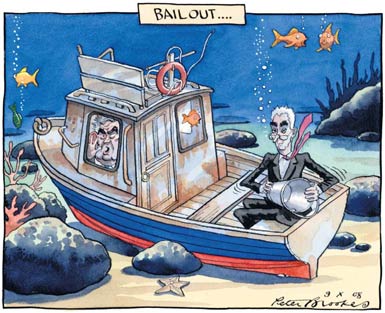
Peter Brookes on the bailout

In an excellent, thorough investigation of the financial crisis in the last issue of the London Review of Books, John Lanchester had presented the scrapping of pensions in the public sector as a worst case scenario. Looks like it has already started to happen in the private sector with Barclays scrapping the pensions of its 17,000 employees. This does not, of course, affect the President Bob Diamond who last year raked in £21 m, nor does it affect the rest of the the 1,500 best paid employees. Here is Lanchester (however, let me warn that this piece is more than 14,000 words long, so you better have a good strong copy of coffee and plenty of free time before diving in; also, I’ve appended a reader’s letter correcting an accounting error made by the author):

It’s a moment of confusion and loathing that most of us have experienced. You’re in a shop. It’s time to pay. You reach for your purse or wallet and take out your last note. Something about it doesn’t feel quite right. It’s the wrong shape or the wrong colour and the design is odd too and the note just doesn’t seem right and . . . By now you’ve realised: oh shit! It’s the dreaded Scottish banknote! Tentatively, shyly – or briskly, brazenly, according to character – you proffer the note. One of three things then happens. If you’re lucky, the tradesperson takes the note without demur. Unusual, but it does sometimes happen. If you’re less lucky, he or she takes the note with all the good grace of someone accepting delivery of a four-week-dead haddock. If you’re less lucky still, he or she will flatly refuse your money. And here’s the really annoying part: he or she would be well within his or her rights, because Scottish banknotes are not legal tender. ‘Legal tender’ is defined as any financial instrument which cannot be refused in settlement of a debt. Bank of England notes are legal tender in England and Wales, and Bank of England coins are legal tender throughout the UK, but no paper currency is. The bizarre fact of the matter is that Scottish banknotes are promissory notes, with the same legal status as cheques and debit cards.

These feared and despised instruments, whose history has long been of interest to economists, come in three varieties from three issuing banks: the Bank of Scotland, the Royal Bank of Scotland and the Clydesdale Bank. Small countries with big ambitions but few natural resources need ingenious banking systems. The history of the Netherlands, Venice, Florence and Scotland show this – and so does the tragic recent story of Iceland. ‘In the 17th century, when English and European commerce was expanding by leaps and bounds,’ James Buchan wrote in Frozen Desire, ‘the best Scots minds felt acutely the shortage of . . . what we’d now call working capital; and Scots promoters were at the forefront of banking schemes in both London and Edinburgh, culminating in the foundation of the Bank of England in 1694 and the Bank of Scotland in 1695.’ The powers down south, however, came to think – or pretended to think – that the Bank of Scotland was too close to the Jacobites, and so in 1727 friends of prime minister Walpole set up the Royal Bank of Scotland.

Continue reading “It’s Finished”

The Real Expenses Scandal

https://i0.wp.com/www.moonbattery.com/archives/george_monbiot.jpg
George Monbiot

There’s something very odd going on with the British political system when the Chancellor of the Exchequer can lose his job over less than £700 whilst billions are squandered on illegal wars, nuclear missiles, corporate subsidies and bailouts. George Monbiot’s latest piece on Znet uncovers the massive corruption behind the M25 project. It is but one of many examples of the way the political system is designed to ensure the socialisation of risk and privatisation of profit.

It’s a thousand times bigger than the one we’re talking about, so why doesn’t it ignite public anger?
For a moment, my heart leapt. The headline on the front of yesterday’s Daily Mail contained the words travel, scandal, extortionate and £6.2. I imagined, until I read it properly, that it referred to the £6.2bn contract to expand the M25 motorway, which has just been signed. Some hope. “The £6.2m bill: Scandal of how MPs are taking taxpayers for a ride with extortionate travel expenses” referred to a rip-off precisely 1000th of the size of the travel expenses scandal that interests me.

I understand the public anger and fascination about MPs’ expenses, and the burning question of whether you can obtain capital gains tax exemption on your second duck house. But it is microscopic by comparison to the corruption that has been bubbling along merrily for 15 years in the UK, unmolested by the tabloid press.

Continue reading “The Real Expenses Scandal”