John Mearsheimer debates the WikiLeaks war logs with Patrick Mansoor, a former Petraeus aide.
JOHN MEARSHEIMER, University of Chicago: [I]t does make it very clear how horrible the violence has been in Iraq since we invaded in 2003.And it also is quite clear from the documents that the United States has played an important role in making that violence happen.
Not only do the documents show that American soldiers and airmen have killed large numbers of civilians.It’s also clear that we didn’t do much at all to stop the Iraqis from torturing and murdering prisoners.This was a huge mistake on our part. […]
Palestinian author Susan Abulhawa, whose debut novel, Mornings in Jenin, is an international sensation, confronts Zionist bully Alan Dershowitz, known for fictions of a different variety, at the Boston Book Festival. The discussion is moderated by Director of the Harvard Negotiation project, James Sebenius and sponsored by the Jewish Community Centers of Greater Boston.
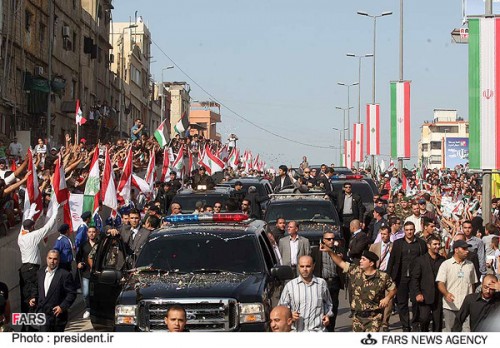
President Ahmadinejad greets cheering supporters in Beirut from an open motorcade.
Twenty years ago, Harvard’s Joseph Nye famously coined the term “soft power” to describe what he saw as an increasingly important factor in international politics—the capacity of “getting others to want what you want”, which he contrasted with the ability to coerce others through the exercise of “hard” military and/or economic power. The question of soft power, when it comes to Iran, is contentious. Most analysts seem prepared to acknowledge that the Islamic Republic’s soft power in the Middle East rose significantly in the first several years of this decade. But many Western analysts now argue that Tehran’s regional soft power has declined over the last couple of years, following the election of Barack Obama as President of the United States, the fallout from the Islamic Republic’s June 2009 presidential election, and the imposition of new sanctions against Iran over its nuclear activities.
Others—including the two of us—argue that Iranian soft power remains strategically significant and is perhaps even still growing. In this regard, we are struck by two developments today. First, Iranian President Mahmoud Ahmadinejad traveled to Beirut—the first visit by an Iranian president to the Lebanese capital since President Mohammad Khatami went there in 2003. Although White House spokesman Robert Gibbs said the visit demonstrated that Ahmadinejad was continuing his “provocative ways” and that Hizballah “values its allegiance to Iran over its allegiance to Lebanon”, the Iranian president received what the Christian Science Monitor’s Nicholas Blanford described as a “rapturous” welcome from tens of thousands of Lebanese who turned out to greet him on his drive into Beirut from the airport. We include photographs of Ahmadinejad’s reception in Beirut today at the end of our text below.
During his trip to Lebanon, Ahmadinejad is scheduled to visit Dahiya, a heavily Shi’a southern suburb of Beirut, and tour southern Lebanon. We would anticipate strongly positive and enthusiastic reactions from populations in both settings. As Rami Khouri aptly put it today, see here, in The Daily Star,
If Ahmadinejad, as planned, goes to south Lebanon and visits Hizbullah-controlled villages near the Israeli border, we should expect political emotions to go through th roof in both the pro-Iranian and anti-Iranian camps. This will not be a surprise, because Ahmadinejad overlooking the northern border of Israel in the company of his Hizbullah allies is a nightmare for most Israelis and many of their friends in the West, while for Hizbullah and its allies in the region this would be a prize-winning moment of defiance to be savored for a long time.
We do not believe that any Western leader—or even any Arab leader—could travel to Beirut today and move about in an open motorcade, as Ahmadinejad did, let alone do so and attract crowds of tens of thousands of eager well-wishers. Security concerns alone would preclude such a scenario. And this is the reality even though the United States and its European and Arab allies have put significant sums of money and political capital into trying to consolidate a “pro-Western” political order in Lebanon.
OK… here’s the PULSE exclusive I’ve been working on. Hope you enjoy.
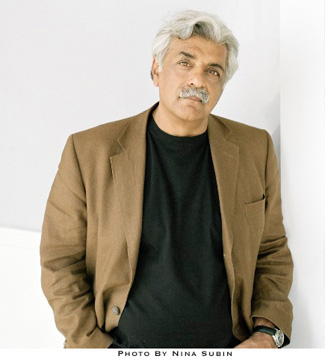
Is president Barack Obama the change America has been waiting for or is he another corporate Democrat representing elite interests? According to Tariq Ali, very little has chanced between Obama and former president George W. Bush. In his latest book “The Obama Syndrome: Surrender at Home, War Abroad,” Ali argues that Obama is carrying on the reckless policies of the Bush regime. If Obama continues down this path, the Democratic Party not only face the prospect of the House & Senate in 2010 but also the presidency in 2012. This should be a cause for concern.
I caught up with Ali during his American book tour and here’s what he had to say about the Obama presidency.
Where did the idea for this book emanate from? Why did you want to write a book about “The Obama Syndrome” and what does that refer to?
The idea occurred because I speak a lot on the United States. People ask me questions after each talk and increasingly in the past two to three years, the talk has been about Obama. I thought a short book which essentially provided a balance sheet from the left on the mid-term would be a useful exercise. Given that he’s being attacked nonstop for being a socialist, a leftist, being a Muslim and all this nonsense that comes from the Tea Party-Fox Television alliance, I thought it was better to have a hard-headed realistic account about who the guy really is. So my book is a critique of him, but it’s also by implication a very sharp critique of people who claim that everything Obama is doing is so radical that they can’t take it anymore.
After all the hope and hype, Obama’s foreign policy mirrors the ugliness of the Bush years.
The election to the presidency of a mixed-race Democrat, vowing to heal America’s wounds at home and restore its reputation abroad, was greeted with a wave of ideological euphoria not seen since the days of Kennedy. The shameful interlude of Republican swagger and criminality was over. George Bush and Dick Cheney had broken the continuity of a multilateral American leadership that had served the country well throughout the Cold War and after. Barack Obama would now restore it.
Rarely has self-interested mythology – or well-meaning gullibility – been more quickly exposed. There was no fundamental break in foreign policy between the Bush and Obama regimes. The strategic goals and imperatives of the US imperium remain the same, as do its principal theatres and means of operation.
Obama’s line towards Israel would be manifest even before he took office. On December 27, 2008, the Israeli Defence Forces launched an all-out air and ground assault on the population of Gaza. Bombing, burning, killing continued without interruption for 22 days, during which time the president-elect uttered not a syllable of reproof. By pre-arrangement, Tel Aviv called off its blitz a few hours before his inauguration on January 20, 2009, not to spoil the party.
This article is Part 2 of a 3 part collection of essays by University of Texas at Austin Professor Robert Jensen on important issues that should be highlighted during this year’s US mid-term election campaigns.
Robert Jensen
The United States is the most affluent nation in the history of the world.
The United States has the largest military in the history of the world.
Might those two facts be connected? Might that question be relevant in foreign policy debates?
Don’t hold your breath waiting for such discussion in the campaigns; conventional political wisdom says Americans won’t reduce consumption and politicians can’t challenge the military-industrial complex. Though not everyone shares in that material wealth, the U.S. public seems addicted to affluence or its promise, and discussions of the role of the military are clouded by national mythology about our alleged role as the world’s defender of freedom. Business elites who profit handsomely from this arrangement, and fund election campaigns, are quite happy.
There’s one word that sums this up: empire. Any meaningful discussion of U.S. foreign policy has to start with the recognition that we are an imperial society. We consume more than our fair share of the world’s resources, made possible by global economic dominance backed by our guns.
John Mearsheimer, professor of political science at the University of Chicago and co-author, along with Stephen Walt, of ‘The Israel Lobby and US Foreign Policy ,’ spoke with IPS about the Israel lobby.
Cléa Thouin, Assistant Editor of the Journal of Palestine Studies, asked Mearsheimer about the state of the Lobby and the prospects for peace between Israel and the Palestinians.
YOU DON’T LIKE THE TRUTH – 4 days inside Guantánamo is a documentary based on security camera footage from the Guantánamo Bay prison.
This encounter between a team of Canadian intelligence agents and a child detainee [Omar Khadr] in Guantánamo has never before been seen. Based on seven hours of video footage recently declassified by the Canadian courts this documentary delves into the unfolding high-stakes game of cat and mouse between captor and captive over a four day period. Maintaining the surveillance camera style this film analyzes the political, legal and scientific aspects of a forced dialogue.
Mosaic Intelligence Report: October 1, 2010 — Direct talks between the Palestinians and Israel might collapse. Will Netanyahu agree to extend the settlement freeze? And, does the prospect for a Palestinian Sate remain viable?
The letter Dajani talks about was actually Dennis Ross’s initiative, who was once described by his own subordinate as ‘Israel’s lawyer’. MJ Rosenberg’s blistering take on Ross’s treacheries is a must read.
Bob Woodward’s new book, “Obama’s Wars”, released today points out, Obama, during the review of the war in Afghanistan at the end of last year, wanted out. Politically, his advisors, wanted out but the military branch of his national security team wanted more and didn’t give the president another option. Robert Dreyfuss contributing editor at The Nation explains that the problem lies with Obama being so inexperienced when it comes to the military that he didn’t know how to properly ask to end the war.
 Is president Barack Obama the change America has been waiting for or is he another corporate Democrat representing elite interests? According to Tariq Ali, very little has chanced between Obama and former president George W. Bush. In his latest book
 P U L S E