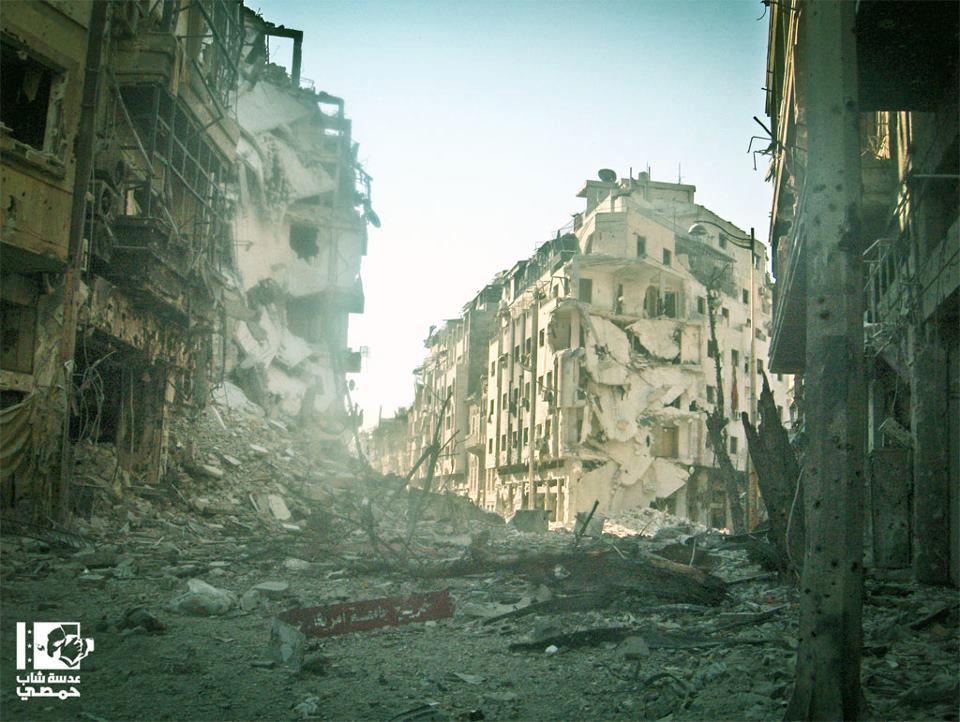
What happened in Houla?

On May 25, when regime militias entered the town of Houla and carried out a gruesome massacre killing 108, including 49 children, something very strange happened. Despite the fact that Channel 4 had entered the town the very next day and collected on-camera testimonies from survivors, reactionary outfits like MediaLens, media watchdogs like FAIR, and some left luminaries, including our friend Tariq Ali, started blaming the victims. There is no reason why official stories shouldn’t be doubted, but given the heinous nature of the crime, one would expect greater care with regard to evidence. As it happened, all of them were relying on a single article appearing in a German publication, written by an author who never visited Houla or met a survivor. This was no innocent mistake: it was pointed out to both Medialens and FAIR that their source was dubious and its claim highly questionable. The source was discredited soon afterwards, and Der Spiegel and the UN have since both confirmed the original reports. Neither Medialens nor FAIR has apologized. Here meanwhile is Al Jazeera’s investigation into the massacre.

On May 25, 2012, the once serene region of Houla in Syria became the scene of events that shocked the world – the massacre of around 100 civilians, almost half of them children. The Syrian regime blamed the massacre “terrorist” groups, but this investigation paints a different picture.

World Have Your Say: Syria

From the BBC World Service’s World Have Your Say. Robin Yassin-Kassab of PULSE joins other commentators to bring you the latest developments.

Hiroshima

8:15 am tomorrow will be 67 years since the bombing of Hiroshima. To mark the occasion we are publishing the classic piece by John Hersey which was rated by a hundred US editors and journalists as the greatest work of 20th century journalism. [you’ll have to scroll down to p.5 to start reading].


Continue reading “Hiroshima”

Iraq: After the Americans

Second part of an excellent documentary on post-occupation Iraq from Al Jazeera’s Fault Lines (Also see Part 1)

In keeping with Barack Obama’s presidential campaign promise, the US has withdrawn its troops from Iraq and by the end of 2012 US spending in Iraq will be just five per cent of what it was at its peak in 2008.

In a special two-part series, Fault Lines travels across Iraq to take the pulse of a country and its people after nine years of foreign occupation and nation-building.

Continue reading “Iraq: After the Americans”

Boycotting the White City: Good for Tel Avivians

rev·o·lu·tion noun \ˌre-və-ˈlü-shən\

2
a : a sudden, radical, or complete change
b : a fundamental change in political organization; especially : the overthrow or renunciation of one government or ruler and the substitution of another by the governed
c : activity or movement designed to effect fundamental changes in the socioeconomic situation
d : a fundamental change in the way of thinking about or visualizing something : a change of paradigm <the Copernican revolution>
e : a changeover in use or preference especially in technology <the computer revolution> <the foreign car revolution>

~ Merriam Webster Dictionary

Almost a year ago a wave of massive popular protests began within the state of Israel. Though my initial criticisms still stands, I’d like to add that over the past year, at least in the south of Tel Aviv, there’s a constant learning about egalitarian politics, co-ops and community projects. People are changing and that can’t be a bad thing. Still, on the Palestinian liberation front there’s little change. The protests have remained Jewish-centered and protesters are still hostile to the mere mention of Arabs (Palestinians are people from another country, of course).

Dr. White City and Mr. Tel Aviv

Continue reading “Boycotting the White City: Good for Tel Avivians”

Misreporting Drone Statistics

On CNN’s website, Peter Bergen and Jennifer Rowland recently wrote an article including the following graph in which they claim that of the 153 people killed in Pakistan by US drones, none were civilians. These are highly dubious statistics, as I have pointed out elsewhere. And following is a report by IPS News’s Zoha Arshad which challenges these claims with comments from The Bureau of Investigative Journalism’s Chris Wood and me.

Chris Woods of the Bureau for Investigative Journalism (TBIJ) believes that NAF has not only underestimated the number of strikes and civilian deaths, but adds that civilian death percentages need to be treated with extreme caution.

“It (NAF) relies only on a small number of media reports immediately following a strike. Sometimes we learn crucial facts days, weeks or even months after an initial attack,” he told IPS.

“In February of this year, for example, a major investigation by Associated Press, based on 80 eyewitness testimonies from civilians in Waziristan, found previously unknown evidence of civilian deaths in 20 percent of the sampled strikes. Unfortunately, NAF has not incorporated these important findings into its data,” said Woods.

Continue reading “Misreporting Drone Statistics”

Massacre in Hama

A new massacre in Tremseh, Hama. The actual footage is too gruesome, so we are posting an Al Jazeera report.

Syrian government troops using tanks and helicopters have killed more than 150 people in the central region of Hama, the Syrian Observatory for Human Rights has told the AFP news agency.

The Syria Conundrum

Maher Arar on the Syrian Intifada and the left’s confused response.

Homs after 37 days of a brutal siege

Deciding whether or not to oppose Syria’s rulers has been the recent dominant preoccupation of many anti-imperialist and left-leaning movements. This hesitant attitude towards the Syrian struggle for freedom is nurtured by many anti-regime actions that were recently taken by many Western and Middle-Eastern countries, whose main interest lies in isolating Syria from Iran. However, I believe a better question to ask with respect to Syria is whether the leftist movement should support, or not support, the struggle of the Syrian people.

What I find lacking in many of the analyses relating to the Syrian crisis, which I find oftentimes biased and politically motivated, is how well the interests of the Syrian people who are living inside are taken into account. Dry and unnecessarily sophisticated in nature, these analyses ignore simple facts about why the Syrian people rebelled against the regime in the first place.

A brief historical context is probably the best way to bring about some insight with respect to the events that are unfolding in front of our eyes today. Before doing so, it is important to highlight that, unlike many other Arab countries, Syria is not a religiously homogenous Middle-Eastern country. I am mentioning this because it is through religion that the majority of Arabs identified themselves for centuries. As it stands today, Syria’s population is composed 74 per cent of Sunnis (including Kurds and others), 12 per cent Alawites (including Arab Shia), ten per cent Christians (including Armenians) and three per cent Druze.

Continue reading “The Syria Conundrum”

Women who refuse to die

An excellent Al Jazeera documentary about the survivors of the Srebrenica massacre.

In July 1995, an estimated 8,000 Muslim men and boys – sons, husbands and brothers – were dragged away never to be seen again. The Srebrenica massacre marks a particularly inhumane and brutal act within the tragedy and bloodshed of the 1992 to 1995 Bosnian War. This film follows four survivors of the massacre as they look to the future despite the pain of their loss and the angst of trying to make sense of the past.

The Drone Morality

Here’s part three of Alternate Focus’s The Drone Wars trilogy. (Also see Part 1 and Part 2)

Who bears responsibly for lethal action when weapons are fully automated? Can a machine have a code of ethics? While their accuracy might, in theory, minimize innocent deaths, drones also enable illegal political assassinations, and by keeping US troops out of harm’s way they also make war easier. A serious debate on these topics is long overdue.