Recep Tayyip Erdogan speaks to Freed Zakaria on CNN’s GPS. He has some strong words for Israel.
Zainab al-Hosni
 She was eighteen, from Homs. The regime wanted to get its hands on her brother Muhammad, an activist on the run, so it arrested her instead, as bait. Shortly afterwards the insecurity forces caught Muhammad, and shortly after that they summoned Muhammad’s mother to pick up his corpse. The corpse was burnt and punctured by bullets. While in the morgue, by chance, the mother found Zainab’s corpse too. Zainab’s arms had been cut off. Part of her body had been skinned. She had been decapitated.
During the battle between the Muslim Brotherhood and the regime in the early eighties the regime committed massacres. But it never tortured children and women to death. This style of barbarism is an innovation. Does it need to be said that it’s an innovation which doesn’t suit Syrian values? There are still some people, astoundingly, who tell us that this regime of the psychopathically ill is capable of ‘reform’.
Hafez al-Asad was a ruthless dictator of great but flawed intelligence. His sons do not qualify as dictators. To call them dictators is to insult dictators. They are a foul mix of pervert, monster, idiot, and spoiled brat. Each moment they remain at liberty is another catastrophe.
Beyond that, for Zainab, I can say nothing more.
UPDATE: – It now appears the regime is playing a clever sick game. Zainab has turned up on regime TV alive. The regime did kill her brother, and did label some other person’s dismembered corpse as Zainab’s, no doubt to discredit the accounts of the revolutionaries. So whose corpse did they dismember? This theatre reminds me of the time a few months ago when a French TV channel received a communication from a known contact at the Syrian embassy in Paris telling them the ambassador had resigned. The channel reported the story, then the next day the ambassador turned up to denounce the ‘lies’. Here’s Rime Allaf’s comment on Facebook:
The Zeinab story: the lie is the regime’s and the regime’s alone. The regime first came to arrest her (the real Zeinab), then first returned the body of her brother to the family (he died under torture), then told the family come take your daughter too – and gave them a burned beheaded body, unrecognizable, in pieces. That body, of course, still is a martyr, we just don’t know whose it is. The family was told by the regime that this was their daughter, they didn’t just find the corpse in the street, and it’s not the opponents of the regime who made this up. And after everyone got all worked up, they deliver “the victim who simply ran away” because – to boot – her brothers (who must be “extremists”) were abusing her.
The point is that the regime is not only criminal but criminally stupid, as if these games can prove anything about the “armed terrorist gangs” and about the “lying activists” and as if we’re supposed to forget the whole sequence of events, and only watch the Syrian television clip like idiots and say oh, the opposition lied. (Ironically, the criminal Taleb Ibrahim the other day claimed on television these same gangs had killed Zeinab.)
Meltdown – The men who crashed the world
The first of Al Jazeera’s four-part investigation into a world of greed and recklessness that brought down the financial world.
UPDATE: Our readers Delia and Richard inform us that this excellent series is actually a production of the Canadian Broadcasting Corporation (CBC).
Winds of Change: Cinema from Muslim Societies
The Institute of Contemporary Arts in London is hosting a film festival starting tomorrow. The festival begins with the discussion – ‘Is there a Muslim world?’ Panelists include Hamid Dabashi, Ziauddin Sardar, and me. Of the films being shown, I strongly recommend Salt of this Sea, a Palestinian film starring Suheir Hammad and Salah Bakri, and Hatem Ali’s The Long Night, on Syrian political prisoners and their families. I’m introducing that one. The ICA blurb is below. I hope to see you there.
The Arab Spring is the starting point for films selected for a festival at the Institute of Contemporary Arts from 21 September that, like this year’s mass demonstrations for democracy across Arab regions, is concerned with civic freedom; human rights; gender and social equality; the challenges of modernity; and the place of religion within social structures.
Continue reading “Winds of Change: Cinema from Muslim Societies”
Blind Orthodoxies
It’s always dangerous to declare generalised love for a movement or school of thought – including Sufism, because Sufism can be subdivided into spirit and tradition, into various orders and popular customs, into the sober and the drunk, the vocal and the silent, the revolutionary and the tame. Still, I’ll say I love it for its symbolic, illogical, individualist challenge to literalism and the obsession with rules, and because it smiles, and for its openness and tolerance, and its music and poetry; because, as Adonis says: “Sufism has laid the foundations for a form of writing that is based upon subjective experience in a culture that is generally based on established religious knowledge.”
Foreshadowing Iraq: The War on “Life Itself”
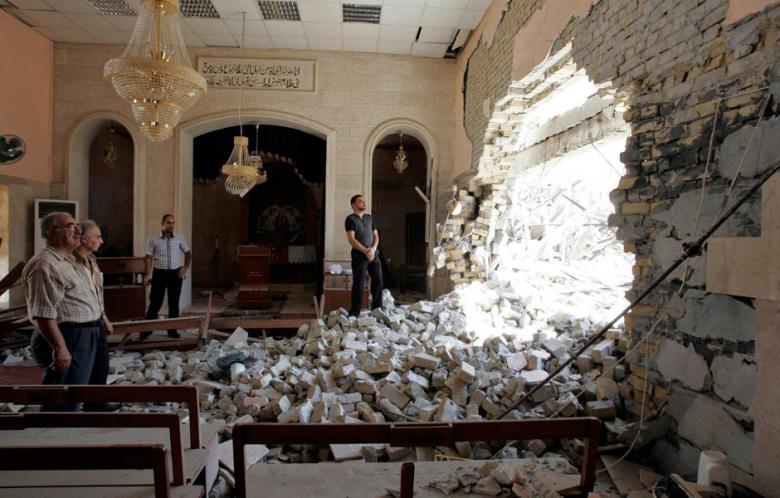
American University of Beirut professor Omar Dewachi writes at Al Akhbar English:
Washington’s planned withdrawal of troops from Iraq next December is hailed as a turning point for the country. But the war on Iraq was much more than a military battle under the banner of regime change. It was an attack on the social body of a people that predated the 2003 invasion and will outlast a nominal troop withdrawal. As the world marks the ten years anniversary of 9/11 used as a pretext to invade Iraq, reflecting on the burdens of this war is a reminder that 20 years of violent US intervention will take decades to erase.
George Bush’s declaration of ‘war on terror’ in the wake of 9/11 took place one month after I arrived in the US to embark on my doctoral studies in anthropology. An unending war was unleashed with dramatic consequences on the lives of millions of people in the Middle East and the US. After 2003, members of my own family fell victim to the occupation and the sectarian violence, while others were completely uprooted from the city of Baghdad. The war was being felt in the US, as men and women of Middle Eastern and South Asian descent were subjected to physical, symbolic, and bureaucratic violence through torture, surveillance systems, and the new cultural economy of blame and accusation.
In 2003, I began my research on the effects of years of warfare in Iraq by mainly looking at the exodus of Iraqi doctors and the ‘un-doing’ of the Iraqi health system during the 1990s. I was already familiar with the topic. I had trained and worked as a medical doctor in Iraq during the 1990s, where I lived through the collapse of one of the region’s most developed health systems. As a doctor working under sanctions, I struggled in my everyday with the rapid deterioration of the whole country’s infrastructure, the lack of medical supplies, the migration of the medical staff, the dismantling of the service infrastructure, and the mounting of the regime’s coercive violence. We wrestled daily to stock low supplies of saline solutions, cannulas, disposable gloves, and antibiotics. Hospital structures began failing with the absence of maintenance and supplies, as many were on the UN sanctioned list of ‘dual use.’ This was not merely a war on a rogue political regime; it was a war on the social body in Iraq.
Continue reading “Foreshadowing Iraq: The War on “Life Itself””
Ways of Seeing
Booker Prize-winning author and art critic John Berger’s classic 1972 documentary series investigating the ideologies embedded in visual images.
Episode 1
Ten years too long: What is the True Cost of the Afghanistan War?
Narrated by Tony Benn, with music by Brian Eno. The clip ends with a call to join the Antiwar Mass Assembly in Trafalgar Square on 8 October: http://www.antiwarassembly.org
Haiti: After the Quake
It is documentaries like this that set Al Jazeera apart from other major news networks. Sebastian Walker examines why a system that was designed to help actually ended up exacerbating Haiti’s misery.
Showdown in Peru: Indigenous communities kick out Canadian mining company
by Benjamin Dangl
This article appeared at The Dominion.
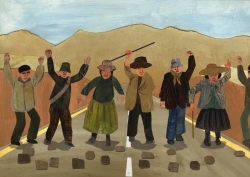
Earlier this spring, an anti-mining Indigenous movement in Peru successfully ousted a Canadian mining company from their territory. “In spite of government repression, if the people decide to bring the fight to the bitter end, it is possible to resist the pressure of mining and oil companies,” Peruvian activist and journalist Yasser Gómez told The Dominion.
The David and Goliath scenario of this anti-mining uprising highlights the vast economic inequality that has beset Peru. The country’s economy has been booming for the past decade, with a seven per cent growth expected this year—one of the highest growth rates internationally. Sixty-five per cent of the country’s export income comes from the mining industry, and investors are expected to spend over $40 billion in the next 10 years on mining operations.
Yet this growth has not benefited a large percentage of the population. The poverty rate in Peru is just over 31 per cent; in the countryside, two in three people live under the poverty line. Today, there are over 200 communities organized against mining across Peru.
Continue reading “Showdown in Peru: Indigenous communities kick out Canadian mining company”

