An Arab 1848: Despots Totter and Fall

by Tariq Ali

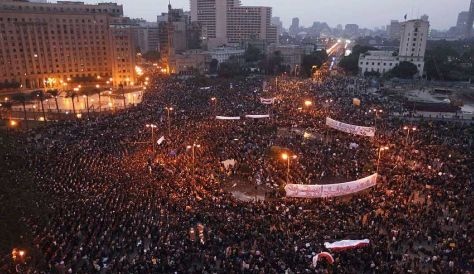
He can’t stay any longer because the military has declared that they will not shoot their own people. This excludes a Tiananmen Square option. Were the Generals (who have so far sustained this regime) to go back on their word it would divide the army, opening up a vista of civil war. Nobody wants that at the moment, not even the Israelis who would like their American friends to keep their point man in Cairo for as long as possible. But this, too, is impossible.

So, will Mubarak go this weekend or the next? Washington wants an ‘orderly transition’, but the hands of Suleiman the Spook (or Sheikh Al-Torture as some of his victims refer to him), the Vice-President they have forced Mubarak to accept, are also stained with blood. To replace one corrupt torturer with another is no longer acceptable. The Egyptian masses want a total regime change, not a Pakistan-style operation where a civilian crook replaces a uniformed dictator and nothing changes.

The Tunis infection has spread much more rapidly than anyone imagined. After a long sleep induced by defeats—military, political moral—the Arab nation is reawakening. Tunis impacted immediately on neighboring Algeria and the mood then crossed over to Jordan and reached Cairo a week later. What we are witnessing are a wave of national-democratic uprisings, reminiscent more of the 1848 upheavals —  against Tsar and Emperor and those who collaborated with them — that swept Europe and were the harbingers of subsequent turbulence. This is the Arab 1848. The Tsar-Emperor today is the President in the White House. That is what differentiates these proto-revolutions from the 1989 business: That and the fact that with few exceptions, the masses did not mobilize themselves to the same degree. The Eastern Europeans lay down before the West, seeing in it a happy future and singing ‘Take Us, Take Us. We’re Yours Now.’

Continue reading “An Arab 1848: Despots Totter and Fall”

How to Crush a Revolution

In common with journalists and human rights workers, Egyptian blogger Sandmonkey was beaten by regime thugs today, and his blog closed down. Fotunately his last post was reposted at War in Context. And here it is below, a depressing (I hope against hope he’s being overly pessimistic) account of the last days.
“The End is near,” Sandmonkey writes. “I have no illusions about this regime or its leader, and how he will pluck us and hunt us down one by one till we are over and done with and 8 months from now will pay people to stage fake protests urging him not to leave power, and he will stay “because he has to acquiesce to the voice of the people”. This is a losing battle and they have all the weapons, but we will continue fighting until we can’t.”

I don’t know how to start writing this. I have been battling fatigue for not sleeping properly for the past 10 days, moving from one’s friend house to another friend’s house, almost never spending a night in my home, facing a very well funded and well organized ruthless regime that views me as nothing but an annoying bug that its time to squash will come. The situation here is bleak to say the least.

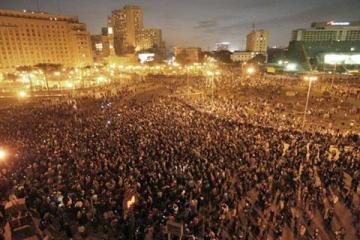
It didn’t start out that way. On Tuesday Jan 25 it all started peacefully, and against all odds, we succeeded to gather hundreds of thousands and get them into Tahrir Square, despite being attacked by Anti-Riot Police who are using sticks, tear gas and rubber bullets against us. We managed to break all of their barricades and situated ourselves in Tahrir. The government responded by shutting down all cell communication in Tahrir square, a move which purpose was understood later when after midnight they went in with all of their might and attacked the protesters and evacuated the Square. The next day we were back at it again, and the day after. Then came Friday and we braved their communication blackout, their thugs, their tear gas and their bullets and we retook the square.

We have been fighting to keep it ever since.

Continue reading “How to Crush a Revolution”

Mubarak’s goons charge protesters on horses and camels

Anderson Cooper, who earlier in the day was assaulted by Mubarak’s goons, describes scenes from the day.

Pakistan: A Deficit of Dignity

M. Shahid Alam

Pakistan’s rulers and ruling elites may well be thinking that the wave of people’s indignation that started in Tunisia and is now working its way through Egypt, Jordan and Yemen will never reach them. Perhaps, they are telling each other, ‘We are safe: we are a democracy.’

The Arabs who are pouring into the streets of Tunisia, Egypt, Jordan and Yemen are not protesting only against their dictatorships. Simultaneously, they are also protesting against governments that have sold their dignity and bartered the honor of their country. Nearly, all the Arab rulers are self-castrated eunuchs in the courts of foreign powers, who have turned their own countries into police states, and who jail, maim, torture and kill their own people to please their masters.

The Arabs are venting their anger against elites who have stymied their energies by turning their societies into prisons. In complicity with foreign powers, these elites have ruled by fear, blocking the forward movement of their people because this movement collides with the imperialist ambitions of Israel and the United States.

It is true that Pakistan has had ‘elected’ governments alternating with military dictatorships. Increasingly, however, these governments, whether civilian or military, have differed little from each other. The priority for both is to keep their power and US-doled perks by doing the bidding of the United States and Israel.

Starting in the early 1990s, Pakistan hurriedly embraced the neoliberal paradigm that emanated from Washington. Hastily, successive ministers of finance and privatization – all of them IMF appointees – went about dismantling Pakistan’s industries, selling off for a song its state-owned enterprises, and empowering Pakistan’s elites to engage in unchecked consumerism.

Continue reading “Pakistan: A Deficit of Dignity”

Its Place In The Sun

Ahdaf Soueif writes from Cairo for the Guardian.

I knew something was wrong when I woke up to the sound of car horns. It’s been so quiet and peaceful the last few days we’ve even started seeing the bats once again flitting in and out of the fruit trees at dusk. This wasn’t the normal noise of Cairo traffic; this was aggressive, patterned and constant, like what you get after a football match only lots more so.
Out of my window I saw the crowd marching across 15 May flyover. It’s odd: the pro-Mubarak lot are so much more regimented – and so much less civil: the noise pollution, the rude gestures at the street, the sticks, the attitude – and at the same time the perfectly scripted banners, the “stewards” marshalling and directing them.

By midday they had started to attack Tahrir Square; the attacks are continuing as I write now. I’m getting regular updates from the square from my son, nieces, sister and other friends in the thick of it. The people who on Tuesday night were listening to music and debating modes of government are now putting their bodies on the line. It’s all they have. The pro-Mubarak lot, of course, have sticks and stones, and swords and chains and dogs and trucks and … the military stand by and do nothing. Continue reading “Its Place In The Sun”

Bloodbath

AP photo

When the pro-Mubarak protestors appeared on the streets yesterday they were a comical sight. The small crowd near the Egyptian TV building (so obviously a propaganda set-up) were surrounded and outnumbered by police. It was as if they were trying to remind Egyptians what a traditional demonstration should look like. It was a vision from a previous age, but not quite authentic because the police didn’t break any heads.

Last night Mubarak announced he would step down at the next election. In his last months in power he would arrange an orderly transition of power. This is the ‘managed’ change that Tony Blair, Obama and Netanyahu want. In other words, the survival of the regime, under the torturer and sadist Omar Suleiman if not under Mubarak, co-existing with an impotent parliament which would emerge from slightly-less-rigged elections.

The enormous crowds in Maydan Tahreer, Alexandria, Suez, Mahalla al-Kubra and elsewhere met Mubarak’s speech with howls of derision. But by this morning it seems that the regime has succeeeded in splitting the democracy movement. The hardcore are entirely aware of the threat to the revolution, and will not retreat. Those who are less politically conscious, however, feel that they’ve won a victory and should now go home, lest chaos ensues.

This has been Mubarak’s argument: without me, chaos. It’s certainly true that Egypt needs a resolution soon. The already precarious economy has been on hold for over a week and basic food supplies are running low. Until this morning it seemed regime strategy was to exhaust the revolution.

But now the regime is speeding things up, by engineering chaos. Interior ministy goons masquerading as ‘pro-Mubarak protestors’ have poured into Maydan Tahreer, many on horse and camel back, armed with whips, machetes and sticks. Gunfire has been heard. The army is doing absolutely nothing to protect the people. Earlier today an army spokesman on state TV told the revolutionaries to go home. Old men, women and children are amongst the crowd in Maydan Tahreer. This is going to be very bloody indeed.

Continue reading “Bloodbath”

Obama 2.0

Marwan Bishara brings another episode of Empire with Ralph Nader, As’ad Abukhalil, Roger Hodge, and Stefan Halper.

Two years after an historic victory that saw the first African-American elected president of the US, Barack Obama has come under pressure. Empire discusses the failures and successes of Barack Obama’s presidency.

Mubarak to Georgetown: Hire me like you hired Uribe

Humorous video suggests Mubarak prolong his shelf life by following in the footsteps of former Colombian President Alvaro Uribe:

New York Times slimes on Julian Assange

Bill Keller of the New York Times accuses Wikileaks of engaging in ‘anti-war propaganda’. Of course that is something that the august ‘paper of record’ would never do. It only engages in pro-war propaganda. Check out the kind of things Keller was writing in the lead up to the Iraq war.

Phenomenons otherwise known as Julian Assange and WikiLeaks have – no doubt – turned world politics and journalism, upside-down. Maybe that’s why the New York Times was among the first US Media outlets to begin working with Assange last year, securing scoops on classified US Government documents obtained by WikiLeaks. Six months later, the relationship has soured and the Times is looking to profit from it by publishing a critical tell-all book about the source that they once relied on.

Macy Gray, I Don’t Want a 4 Minute Peace!

Dear Macy Gray,

Macy Gray visits with Consul General of Israel, Jacob Dayan in Los Angeles, as BDS activists around the world plea with her not to entertain apartheid.

I’ve publicly declared that I won’t give up on you and I intend to keep to my resolution. You keep on asking how not playing in Israel will help the situation. You seem to believe that you are nothing but a 4 minute escape for people (the majority of which, as I explained in my last letter, are soldiers). I believe in each of our endless ability to change the reality around us. But in order to do so, we need to see the reality for what it is. This is what my letters to you are about. This is what the 20 Days to Macy Gray Facebook Project is about. It’s an opportunity for people to empower each other. I hope you’ll allow us to bring back your faith in yourself, that your voice matters, and that you can change this harsh world for the better, for the long run, and not only for the 4 minute duration of a song.

Continue reading “Macy Gray, I Don’t Want a 4 Minute Peace!”