The anti-regime protests spread across Tunisia involve trades unionists, the unemployed, lawyers, journalists and students. The people chant against “the killers of the people, the flayers of the people.” Their slogans include “Tunisia is the people, not the government,” “We’ll solve the police crisis, we’ll solve the Tunisian crisis,” and (I think – the sound isn’t clear) “Work, Freedom, National solidarity.” The first film shows a Tunisian town continuing to fearlessly demonstrate despite tear gas and truncheon attacks. (A maths teacher has been shot dead by police during the protests). The second (over the fold) shows a demonstration in the capital. Arabic speakers can follow this link to al-Jazeera’s round-up of the most recent developments.
The Tunisian Intifada
The dictatorship of Zine el-Abdine Ben Ali, a Western client, is in serious trouble. A full-scale intifada is raging. It began in Sidi Bouzid as a protest against unemployment, corruption and police brutality. Then it spread to Sousse, Sfax, Meknassi, and the capital, inflated by long-simmering resentment at Tunisia’s lack of civil liberties. Because Ben Ali is a client, and because Tunisia is a mass tourism destination, the Western mainstream is leaving this largely alone. But here’s Nesrine Malik in the Guardian, and al-Jazeera (see below) is doing well. In the context of a horrific upsurge of nihilistic sectarianism in the Arab world, it is to be hoped that the Tunisian revolution will grow and develop, and teach a lesson to the Arabs in real, not illusory, action towards change.
Popular Committee Leader: “My Next Letter Will Likely Be Written From Inside A Prison Cell”

New Year’s greetings from Mohammad Khatib, one of the remaining Bil’in popular committee leaders:
At the threshold of the New Year, I write to wish you a new year of freedom and liberation. This has been an unbelievable year for me in both highs and lows. A year during which I have witnessed how, despite repression, ordinary people all across Palestine take to the streets for freedom.
US students drown in sea of debt
The price of ‘higher education’ in the US continues to rise.
Horror and Hope
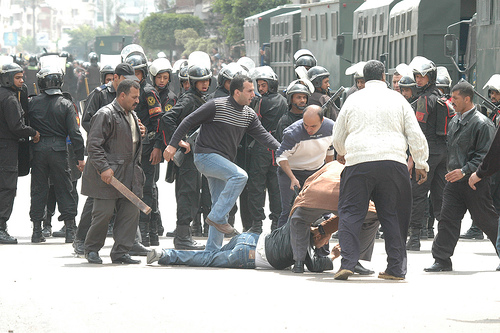
It currently seems there is a real danger of the Middle East losing its millenia-old diversity. Iraq’s post-invasion civil war separated the country’s Shia and Sunni communities, driving millions into exile. Pro-Western Arab regimes continue to spew vicious anti-Shia propaganda, which is heard by important sections of society. Now Wahhabi-nihilists have declared open season on Iraq’s ancient Christian community. Palestine was cleansed of its natives in 1947/48 and transformed into a Jewish ethno-state. Zionism and a new Muslim chauvinism have reduced the Christian proportion of the West Bank from 15% in 1950 to 2% today. And the New Year brought news of an appalling attack on Egyptian Copts, an increasingly oppressed and alienated community.
Informed observers will know that there is nothing essential or ‘ages-old’ about the emerging sectarian chaos. Sectarianism had receded almost to irrelevance amongst the generations of Arabs that believed they were on their way to true independence. Foreign partitions and occupations did a large part to crush that dream. Totalitarianism and economic and educational failures (often the policies of foreign-backed regimes) did the rest. In Egypt’s case, the Mubarak regime has dealt with its Islamist challenge in two ways: politically, it has rigged elections ever more blatantly and persecuted its visible opponents; socially, it has given way to the most retrograde desires of Islamism (forbidding the construction of churches, banning books) and done its best to whip up petty chauvinism over the most ridiculous of pretexes (for instance the mutual football hooliganism of Egyptian and Algerian fans).
New Year’s Day in Bil’in: Israel kills female protester
Press release from the Popular Struggle Coordination Committee.
Jawaher Abu Rahmah, 36, was evacuated to the Ramallah hospital yesterday after inhaling massive amounts of tear-gas during the weekly protest in Bil’in, and died of poisoning this morning. Abu Rahmah was the sister of Bassem Abu Rahmah who was also killed during a peaceful protest in Bil’in on April 17th, 2010.
Doctors at the Ramallah hospital fought for Jawaher Abu Rahmah’s life all night at the Ramallah Hospital, but were unable to save her life. Abu Rahmah suffered from severe asphyxiation caused by tear-gas inhalation yesterday in Bil’in, and was evacuated to the Ramallah hospital unconscious. She was diagnosed as suffering from poisoning caused by the active ingredient in the tear-gas, and did not respond to treatment.
Jawaher Abu Rahmah was the sister of Bil’in activist, Bassem Abu Rahmah, who was shot dead with a high velocity tear-gas projectile during a demonstration in the village on April 17th, 2009. See here for a video of his shooting.
Continue reading “New Year’s Day in Bil’in: Israel kills female protester”
PULSE’s Top 10 Media Figures of 2010
This list is an attempt to honor those individuals and institutions responsible for exemplary reportage and awareness-raising in 2010. It is aggregated from the suggestions of PULSE writers and editors and is comprised of journalists, editors and publishers who have shown a commitment to challenging power, holding it to account, highlighting issues pertaining to social justice and producing output that bucks conventional wisdom and encourages critical thinking. (Also check our Top 10 Global Thinkers of 2010)
Julian Assange
 2010 was the year of Wikileaks. From the antiseptic cruelty of the Apache attack on Iraqi civilians, the matter-of -fact entries of routine horrors recorded in the Afghan and Iraq war logs, to the locker-room candour of the US State Department diplomatic cables, Wikileaks has laid bare the casual attrition that sustains empires. Behind it all is Julian Assange, an enterprising, politically savvy, and morally upstanding individual who has shown the transformative potential of new media, which, through courage and imagination, could be made to serve as a check even on a hyper-power. By leveraging the mainstream media’s need for exclusives, Assange has ensured the broadest possible audience for his revelations. True, Assange is not Wikileaks, but from listening to the statements of his defecting colleagues–who fault him for needlessly confronting a superpower when he should have been concerned with building his institution–we are convinced that without someone as assertive and clear-headed as Assange, Wikileaks would have ended up as yet another web project with interesting information, infrequently cited, but with none of the amplification that it currently enjoys.
Helen Thomas
 A rare critical voice in the mainstream media, particularly during George W. Bush’s reign, Helen Thomas was the first woman officer of the National Press Club, the first woman member and president of the White House Correspondents Association and the first woman member of the Gridiron club. Her career as one of history’s gutsiest female US press corp reporters was ended in her 90th year after some off-the-cuff comments she made to a roving rabbi with a camcorder were made public. She later apologized for her words, citing her “heart-felt belief that peace will come to the Middle East only when all parties recognize the need for mutual respect and tolerance.” While Thomas was attacked from all fronts, she was also defended by progressive media figures like Real News Founder Paul Jay who directed attention to the “hyper-pro-Israel lobby” which was just waiting for an opportunity to silence Thomas, and progressive American Jews like Medea Benjamin who stated on camera: “We should look at the 50+ year record of a very probing journalist and insightful commentator and not look at a 30 second soundbite.” Even the Washington Post felt compelled enough by Thomas’s outstanding legacy to allow The Nation editor Katrina vanden Heuvel to bring attention to Thomas’s “legendary career” as a “a trailblazer for women journalists.”
PULSE’s Top 10 Global Thinkers of 2010
In response to the curious choices in Foreign Policy magazine’s ’Top 100 Global Thinkers’ list last year, we decided to publish our own. In 2010, Foreign Policy‘s selections were even more abysmal: among others it included Robert Gates, Ben Bernanke, Hillary Clinton, David Cameron, Thomas Friedman, Ahmed Rashid, Ayaan Hirsi Ali, Bjorn Lomborg, Richard Clarke, Madeleine Albright, Salam Fayyad…and John Bolton! Would anyone outside FP’s editorial board confuse them for a thinker? Once again, it appears FP chose based on the alignment of an individual’s work with the global military and economic agenda of the US government. We therefore asked our writers and editors to nominate once again their own top 10 global thinkers. The following list was the result. (Also see our Top 10 Media Figures of 2010)
Tony Judt
 A towering intellect, a moral giant, a master of prose, and an outstanding historian, Tony Judt did what only the greatest of thinkers do: he constantly evolved. More significantly, he never succumbed to orthodoxies, he was always on the edge. In his later years, he also outgrew his middle-of-the-road liberalism to adopt principled, at times radical, positions on war and capitalism. He also jettisoned his youthful Zionism to emerge as the proponent of a single binational state in Palestine. In 2006 he was the only mainstream figure to come to the defence of Mearsheimer & Walt for their groundbreaking London Review essay. He later excoriated Israel as the ‘country that wouldn’t grow up.’ He was also the author of Postwar, an elegant and expansive history of Europe since 1945. We mourn his loss.
Chalmers Johnson
 An exemplary scholar, Chalmers Johnson metamorphosed from a hardline Cold Warrior into one of the most formidable critics of US militarism, mapping America’s expanding imperium of bases and spotlighting the fraying edges of its republic. His 2000 book Blowback was as prophetic as his subsequent books The Sorrows of Empire and Nemesis were prescient. His longtime JPRI associate Steve Clemons has described him as the ‘acknowledged godfather of the conceptualization of the “developmental state“’ and as ‘an apostate and heretic in the field of political economy’ in the neoliberal hive at the University of Chicago. Johnson was also a literary critic, a skill he deftly used in his later writings to show how the imperial imagination was reflected in the language of metropolitan literature. His departure has greatly impoverished the intellectual world.
David Bromwich on Obama, the Establishment President
 David Bromwich is the Sterling Professor of English at Yale, and easily the most astute observer of Barack Obama’s performance and character. He has written some of the most insightful articles on the Obama presidency in which he subjects Obama’s oratory and style to close textual and formal analysis, and highlights the various traits that are symptomatic of his approach to politics. In this wide ranging discussion with Christopher Lydon of the excellent Radio Open Source (based at Brown University’s Watson Institute) Bromwich brings his formidable analytical skills to bear on Obama’s langauge, the difference between his improptu and scripted speech, his attempts at humour, and what it reveals about the man. He also makes an interesting comparison between Obama’s style and that of former presidents such as Lincoln, Reagan and Kennedy.
Wrong Target for a Pretend Philosopher
French Zionist and celebrity Islamophobe Bernard-Henri Levy recently accused Susan Abulhawa’s novel Mornings in Jenin of contributing to anti-Semitism. Levy picked the wrong target. Abulhawa has already proved herself more than a match for the ranting Alan Dershowitz. In the Huffington Post she responds to Levy’s anti-Semitism charge: “This word — with its profound gravity of marginalization, humiliation, dispossession, oppression, and ultimately, genocide of human beings for no other reason but their religion — is so irresponsibly used by the likes of Levy that it truly besmirches the memory of those who were murdered in death camps solely for being Jewish.” Then she reminds us that “the people who today are being marginalized, humiliated, dispossessed, and oppressed for the sole reason of their religion are Palestinian Christians and Muslims.
The entire, excellent rejoinder to Levy’s attempt at intimidation is over the fold. Meanwhile, if you haven’t yet bought a copy of Abulhawa’s wonderful novel, do so.
Continue reading “Wrong Target for a Pretend Philosopher”

