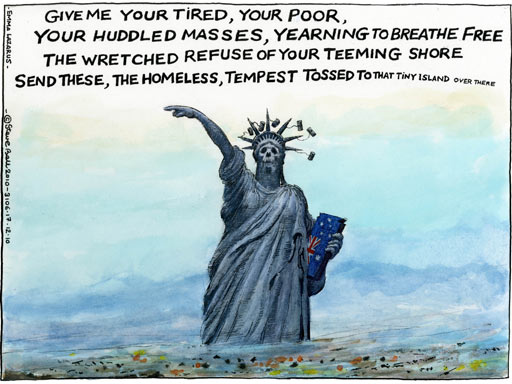
Asylum Seekers often find Sorrow

Cartoon by Steve Bell

by Giovanna Fassetta Guariento

The images of a small, rickety boat full of asylum seekers being thrashed by the waves off the coast of Christmas Island are unforgettable. As remarked by a witness who watched in helpless desperation, it was like being in a horror movie, minus the relief experienced at the end when the lights come back on and the audience is allowed to return home. It was a nightmare without the awakening, a tragedy that should not have happened, not to those who perished — the children, the women, the men — or those who were forced to watch from nearby cliffs.

The dead now number 48, but many more have yet to be accounted for. They were Iraqi, Iranian and Kurdish women, men and children who left everything behind in search of a better life. They fled from the destruction of war, from the festering wounds left by forced democracy, and from the unbearable struggle of making ends meet, towards what they imagined as a better future. Sadly, this tragedy is not the first, and will not be the last. It was however the most visible yet, because it happened before the eyes of the anguished locals on the shore, and millions more who saw the images in papers or on their television screens. Many similar tragedies happen every year less visibly though, in a hushed and subdued manner. No one knows exactly how many people perish on their way to the ‘Developed World’, but the number of people who are believed to have drowned in the past decade is in the thousands, and this only accounts for people lost while crossing the Mediterranean basin.

Continue reading “Asylum Seekers often find Sorrow”

The Persecution of Bradley Manning

From Dylan Rattigan’s excellent show on MSNBC, an interview with one of Bradley Manning’s friends who describes the conditions under which he is being held.

By comparison, following is Al Jazeera’s Patty Culhane, a second rate journalist who generally recycles the consensus view of the Washington punditocracy with little in the way of scepticism or original thought. You can tell from the report below that she even manages to render critical reports in the language of the beltway hack.

Pilger: War, Media and Wikileaks

Filmmaker and journalist John Pilger discusses his latest film, The War You Don’t See, the media’s role in conflict and his defence of WikiLeaks on Al Jazeera’s Listening Post.

The rest of the show investigates the role of the Middle East Media Research Institute (MEMRI), the brainchild of a former Israeli intelligence officer and a US-based organisation that specialises in providing (mis)translations of Arabic-language broadcasts to American journalists and plays a central role in shaping the public’s (mis)perceptions of the Middle East.

Stephen Harper’s Sermon on the Hill

Editor’s Note: This essay was written in response to Canadian Prime Minister Stephen Harper’s speech at the Ottawa Conference on Combating Antisemitism on November 8th.

by Terry Greenberg

                                    Blessed art the war mongers
                                                            For they are hastening the Second Coming;
                                                Blessed art the ethnic-cleansers
                                                            For they are fulfilling the prophecy;
                                                Blessed art the soldiers of Zion
                                                            For they are doing God’s Work;
                                                Blessed art the enemies of free speech
                                                            For they are silencing the Devil.

On Parliament Hill in Ottawa on November 8, 2010 the Prime Minister of Canada delivered a sermon on good and evil to an international gathering of supporters of Israel in which he clearly articulated his view that all support for Israel is “good” and all animosity toward Israel is “evil”. In true Bible-thumper style he offered no middle ground, denouncing this as “moral ambivalence”. It was clear in his preaching that he believed Israel was God’s Plan, and any opposition to Israel was the Devil’s work.

It should be terrifying to Canadians that their Prime Minister would have such a fundamentalist and extremist world view. If we want to understand our current government’s foreign policy and the danger it poses to Canada’s welfare, it would be worthwhile to examine our Prime Minister’s “Sermon on the Hill”. All Canadians should read it for themselves and shudder. 

Harper’s speech was remarkable in a number of ways which are outlined below:

Continue reading “Stephen Harper’s Sermon on the Hill”

Empire Abroad, Surveillance At Home

Download mp3.

The cover of McCoy's book is deep red, dark blue, and a sepia white. The photo is of a several ranks of Philippine military troups. The man in front salutes, while an American flag flies overhead.I have an obsessive interest in the history of empires, but a lot of the information in this fascinating lecture by Alfred McCoy was still new to me. I hope you find it as useful as I did. (via Against the Grain)
As the nineteenth century drew to a close, the US engineered its conquest of the Philippines. According to Alfred McCoy, the security and surveillance methods introduced and refined by the US in the Philippines were brought home to these shores, for use in domestic policing, intelligence, and other repressive techniques and systems that had profound consequences for civil liberties.

Alfred McCoy, Policing America’s Empire: The United States, the Philippines, and the Rise of the Surveillance State U. of Wisconsin Press, 2009

Deck London’s Walls III

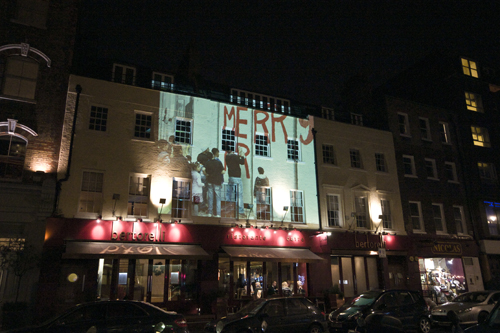
Below are some final shots from William Parry, UK-based photojournalist who, with the help of projection artist Beverley Carpenter, has spent the last several days projecting images of Israel’s apartheid wall onto buildings and monuments in London. The projected images were taken by Parry in Bethlehem, where children from the Aida refugee camp stenciled a Christmas message to the world onto their section of the wall. The goal of the project: to raise awareness of the Israeli-induced suffering that continues in Bethlehem, exploiting the city’s relevance to the current holiday, and in Palestine as a whole. (For more background and the first two sets of Parry’s photographs from Bethlehem and London, click here and here.)

Writes Parry in an email to PULSE:

It was a magnificent project to have been part of. Working with the kids from Aida camp on cutting out the stencils and then watching them put their message up on the wall was huge fun and it was great to see them enjoying themselves. But then coming to London and actually seeing the photos of these kids and their simple message on London’s walls — and some of the city’s prime wall spaces — was absolutely brilliant, really moving. Then to have the public’s interaction here with that message and with the images from Bethlehem, that just added to the fulfillment. Bev did a great job as our ‘guerrilla’ projection artist.

Continue reading “Deck London’s Walls III”

Hollywood and the war machine

Empire examines the symbiotic relationship between the movie industry and the military-industrial complex.


The Axis of Islamophobia

Max Blumenthal discusses his must read article The Great Islamophobic Crusade. Here’s an excerpt:

Little of recent American Islamophobia (with a strong emphasis on the “phobia”) is sheer happenstance. Years before Tea Party shock troops massed for angry protests outside the proposed site of an Islamic community center in lower Manhattan, representatives of the Israel lobby and the Jewish-American establishment launched a campaign against pro-Palestinian campus activism that would prove a seedbed for everything to come. That campaign quickly — and perhaps predictably — morphed into a series of crusades against mosques and Islamic schools which, in turn, attracted an assortment of shady but exceptionally energetic militants into the network’s ranks.

Besides providing the initial energy for the Islamophobic crusade, conservative elements from within the pro-Israel lobby bankrolled the network’s apparatus, enabling it to influence the national debate. One philanthropist in particular has provided the beneficence to propel the campaign ahead. He is a little-known Los Angeles-area software security entrepreneur named Aubrey Chernick, who operates out of a security consulting firm blandly named the National Center for Crisis and Continuity Coordination. A former trustee of the Washington Institute for Near East Policy, which has served as a think tank for the American Israeli Public Affairs Committee (AIPAC), a frontline lobbying group for Israel, Chernick is said to be worth $750 million.

You can read the rest of this excellent article at Max’s website.

Frost/Assange

The WikiLeaks founder talks about secrets, leaks and why he will not go back to Sweden.

The Crisis of Islamic Civilization

Ali Allawi on his book The Crisis of Islamic Civilization. (see Robin’s review)

The Carnegie Council is the world’s leading voice promoting ethical leadership on issues of war, peace and global social justice. Its mission is to be the voice for ethics in international policy.

Transcript:

Thank you very much, Joanne, and good morning, ladies and gentlemen. I had really two choices. One was to try to summarize Islamic civilization in half an hour, or to discuss this more in a personal way and a personal capacity which I thought might be interesting at such an early hour. I’ve called my talk, “In Search of Islam’s Civilization.”

I was born into a mildly observant Muslim family in Iraq. The 1950s in the Middle East and the broader Islamic world were a time when the secular elements of society, the ruling political class, and cultural and intellectual feats had moved far from an overt identification with Islam. It appeared then to be only a matter of time before Islam would lose whatever hold it may have still had on the peoples and societies of the Muslim world.

Continue reading “The Crisis of Islamic Civilization”