On the abuse of language

Tony Judt on linguistic subterfuges practised in Europe and America.

Tony Judt

In America the misuse of language is usually cultural rather than political. People will accuse Obama of being a socialist. Italians would say magari – if only. However, no one takes this very seriously. What we have instead in the US is cultural communities policing what can and can’t be said, and that shapes how we define difference. The idea is that you can’t have an elite, since elitism is undemocratic and unegalitarian. Therefore, you always make the point that people are in some important way the same. If they are badly disabled like me, they are ‘differently abled’, which I find very amusing. It is not a ‘different’ ability: it is no ability. But since it’s politically uncomfortable to distinguish between people who can do things and people who can’t, the latter are described as separate but equal. There are numerous things wrong with this: first, it is lousy language; second, it creates the illusion of sameness or achievement in its absence; third, it conceals the effects of real power and capacity, real wealth and influence. You describe everyone as having the same chances when actually some people have more chances than others. And with this cheating language of equality deep inequality is allowed to happen much more easily.

Continue reading “On the abuse of language”

Unequal Before the Law

Two weeks before Israel planned to withdraw from Gaza, 19-year-old Eden Natan-Zada boarded a bus en route to Shafr’ Amr and opened fire on Arab passengers, killing four and injuring a dozen before  he was attacked and killed as news of the shootings spread, creating an angry mob.  Currently, 12 Arab men are being prosecuted by the Israeli state for the murder of Natan-Zada. This case has become a point of entry into a larger debate concerning what many feel is an existing double standard  in the application of the law between Jews and Arabs in Israel.

Film-maker Tony Stark’s One Law for All, examines how Israel’s Arab citizens have been and are currently being subjected to an institutional form of racism through the unequal application of the law. The Israeli state’s reticence in recognizing the attack by Natan-Zada as an act of terrorism is just one of the many ways in which Stark reveals this legal imbalance.  Segments from Stark’s documentary, which references multiple cases in which the Israeli state has neglected incidents in which Palestinians have been killed by Jewish Israelis, were aired on Al Jazeera’s People & Power earlier this week: 

The Only Democracy in the Middle East: 2.04.2010

The war continues at Nebi Salah:

More footage from Nebi Salah, this week:
'An Nabi Salih' Demonstration, 02.04.2010 - 05

Continue reading “The Only Democracy in the Middle East: 2.04.2010”

Guantanamo: So much for Change

According to a recent poll by CNN, public support for closing down GTMO has dropped 12 points over the past 14 months. Shortly before Obama’s inauguration, 51 percent of Americans said they thought the facility in Cuba should be closed. Now this number is down to 39 percent, and six in ten believe the United States should continue to operate Guantanamo.

This drop in numbers might indicate the public’s aversion to the idea of having alleged ‘terrorists’ on U.S. soil or may be due to a general fear of the return of legal rights that it is assumed would accompany such a shift. To this end, the public appears to overestimate the government’s intentions, for even if Guantanamo detainees were transferred to the United States, this shift cannot be assumed as indicative of a change in detention policies. The upcoming trial of Syed Fahad Hashmi, who has been detained in the United States since 2007, indicates that  this administration does not consider it unlawful to hold U.S. citizens with ‘alleged’ links to Al Qaeda under unconstitutional conditions. Bill Quigley, the legal director of the Center for Constitutional Rights, has recently written the following concerning the treatment, legal conditions, and upcoming trial of Hashmi in the Huffington Post: Continue reading “Guantanamo: So much for Change”

Argentina renews Falklands claim

Lucia Newman of Al Jazeera reports from Buenos Aires.

It has been 28 years since Britain and Argentina went to war over the disputed Falkland islands – known as the Malvinas by Argentines – in the South Atlantic.

Britain emerged victorious from the conflict and the islands have since grown prosperous from tourism and fishing among other things.

Now with oil companies exploring the waters surrounding the islands, tensions between the two countries are rising again.

As Argentina pays tribute to the soldiers who fell in the conflict, many people, including the president, are raising their voices against the continued British rule over the islands.

AIPAC confronts its worst fear: Daylight

by Philip Weiss

Col (ret.) Ann Wright and Code Pinkers bring long overdue attention to the AIPAC annual conference, that great annual firesale of American politics.

In that radical handbook on the workings of American society, the Wizard of Oz never recovered once Dorothy pulled back the curtain of her own innocence. One would like to believe that AIPAC will never recover from a brutal spring that has exposed its real interests to the American public. Even supporters of the Jewish state have criticized the American Israel Public Affairs Committee for fully taking Israeli Prime Minister Benjamin Netanyahu’s side in his battle with Barack Obama over settlements, and during its recent annual conference, the lobby looked wobbly and defensive.

Yes, there was the usual procession of weak-kneed politicians professing love for Israel, not to mention AIPAC board members explaining how they cultivate “relationships” with the powerful. Yes, Sen. Chuck Schumer gave a bloodcurdling yowl, Am Yisroel Chai—the Jewish people live!—as he pledged to be Israel’s guardian. But a large shift in American policy and opinion has left the lead institution of the lobby exposed, and worse, mocked.

AIPAC was taking on water before its VIP-studded conference began in late March. Important supporters of Israel in the media, including Jeffrey Goldberg of The Atlantic and David Remnick of The New Yorker, questioned whether reflexive support for Israel’s right-wing policies served the American interest, echoing the view of Gen. David Petraeus that the Palestinian problem is our problem in the battle for hearts and minds in the Middle East.

Continue reading “AIPAC confronts its worst fear: Daylight”

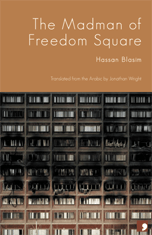
The Madman of Freedom Square

“I see no need to swear an oath in order for you to believe in the strangeness of this world.”

How can imagination respond to a situation like Iraq’s, in which truth is so blatantly stranger and more horrifying than the darkest fiction? Perhaps by simply recording real stories, then sometimes allowing reality to slip a little further in the direction it’s already chosen.

Hassan Blasim, film maker, refugee, and author of the astounding short-story collection “The Madman of Freedom Square,” has a more precise formulation:

“The important thing is to observe at length, like someone contemplating committing suicide from a balcony. The other important thing is to have an imagination which is not melodramatic but malicious and extremely serious, and to have an ascetic spirit that is close to death.”

Except this isn’t a formulation but a voice within a story. In another story there is a man who throws himself from a balcony – a man who clears blood and debris in the aftermath of explosions, then migrates to Holland, renames himself Carlos Fuentes, becomes a Hirsi Ali figure, more Dutch than the Dutch, and suffers nightmares. There’s a man who dreams a number which foretells not a lottery ticket but .. something else. I give away too much.

Continue reading “The Madman of Freedom Square”

Impact of the Gaza war on Israel

Norman Finkelstein on Al Jazeera’s Riz Khan Show.

Has there been a shift in Israel’s ties with its allies since the Gaza war and how will that affect the peace process with the Palestinians? Is international support for Israel dwindling since the Gaza war and is it losing the battle for global public opinion?

The Only Democracy in the Middle East: Palm Sunday protest in Bethlehem 28.03.2010

Activestills Youtube channel:

Around 200 Palestinians, Israelis and internationals walk from the Nativity Square to the direction of Jerusalem, against the restrictions imposed by the Israelis especially restrictions on the right to worship and freedom of movement as many Christians will not be able to go to Jerusalem to celebrate Easter in Jerusalem. The crowd managed to outnumber and surprise the Israeli soldiers and security forces at Bethlehem checkpoint and managed to walk through. After having walked 300 meters on the road to Jerusalem, they were stopped by Israeli soldiers. After having declared the march over and as they were walking back to Bethlehem, Israeli soldiers attacked the crowd and violently arrested around 15 persons, among them a Palestinian cameran, an Israeli photographers, members of the popular committee from Al Ma’sara, and staff from Holy Trust.