Prepare to Be Enraged: Rush Limbaugh & Pat Robertson’s Drivel on the Haitian Earthquake

Leave it to two of the most deplorable figures in the American media to use the recent earthquake in Haiti as a platform to express their ongoing discontent with the Obama administration’s domestic policies, and as an opportunity to spew not–so-carefully hidden hate rhetoric under the guise of religious ‘humanity’.

A mere day after the Haitian earthquake, Rush Limbaugh and Pat Robertson have polluted the media, perhaps unsurprisingly, with more of their infamous mind numbing drivel.

Here are Limbaugh’s comments, as broadcasted on the Rush Limbaugh Show earlier today:

Continue reading “Prepare to Be Enraged: Rush Limbaugh & Pat Robertson’s Drivel on the Haitian Earthquake”

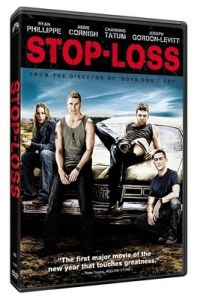
Stop-Loss

In the case of the Vietnam war it took long after the war had ended for the first critical films to come out. Americans in this respect still aren’t as bad as the French, who have yet to own up to their crimes in the colonies. Even today the best they can offer is oblique references to colonial depredations (take for example the awful Flanders). The French were so sensitive about their colonial legacy in Viet Nam even in 1979 that Francis Ford Coppola had to edit out a long section from Apocalypse Now lest it upset judges at the Cannes Film Festival.

However, the Iraq war has been unique insofar as it has produced some excellent cinema even as it has continued to grind on. Yet, most of these films have failed at the box office. Some of them perhaps understandably so: War Inc., Redacted, Lambs for Lions and Battle for Haditha were well-meaning, for example, but didn’t work so well as films. In the Valley of Elah, on the other hand, had all the right elements: an a-list cast comprising of multiple Oscar winners, an Oscar-winning writer and director, a superb screenplay; and yet, it was a complete commercial failure.  So was Grace is Gone; and Rendition. So was another — perhaps one of the best — which also had all the right elements: Stop-Loss. The film is based on the experiences of director Kimberley Peirce’s own brother, and it makes news stories such as the following from the Guardian rather predictable.

An Iraq war veteran has been arrested and charged with threatening to kill his officers after recording a violent rap protest song and sending it to the Pentagon.

Marc Hall, a junior member of an infantry unit, wrote the song in protest at the US army’s unpopular policy of involuntarily extending soldiers’ service and forcing them to return to Iraq or Afghanistan.

Hall completed a 14-month spell in Iraq last year, expecting to be discharged next month, but was told he would have to go back to Iraq under the policy known as stop-loss.

Continue reading “Stop-Loss”

Afghanistan: The Kashmir Connection

It is a mark of how far right things have moved in the past 30 years that even a Cold War hawk such as Zbigniew Brzezinski can come across sounding more reasonable than the putatively ‘liberal’ US president. The following is an interesting interview in which Brzezinski explicates his oft-misrepresented position on Central Asia. It also marks the clear split between the realist and neoconservative worldviews. Though both are marinated in American exceptionalism, unlike the neoconservatives, the realists have a sense of the limits of US power. That’s the main reason why all of them opposed the Iraq war. Brezinski’s comments about Afghanistan toward the end of the interview are notable: as he points out, the US cannot resolve the conflict unless it addresses the issue of Kashmir first. This same opinion was forwarded by Graham Usher earlier in the London Review of Books, and most recently by Pankaj Mishra in the New York Review of Books. I have excerpted at length Mishra’s must-read article below.

Obama’s long speech on Afghanistan on December 1 did not refer even once to India or Kashmir. Yet India has a large and growing presence in Afghanistan, and impoverished young Pakistanis, such as those who led the terrorist attack against Mumbai last November, continue to be indoctrinated by watching videos of Indian atrocities against Muslims in Kashmir. (Not much exaggeration is needed here: in late November an Indian hu-man rights group offered evidence of mass graves of nearly three thousand Muslims allegedly executed over the last decade by Indian security forces near the border with Pakistan.) Another terrorist assault on India is very likely; it will further stoke tensions between India and Pakistan, enfeebling America’s already faltering campaign against the Taliban and al-Qaeda.

Continue reading “Afghanistan: The Kashmir Connection”

Ex-Guantanamo Guard Apologizes to Former Detainees

The BBC recently arranged a meeting between Brandon Neely, a former Guantanamo Bay guard, and two former Guantanamo detainees, Shafiq Rasul and Ruhal Ahmed. Both Rasul and Ahmed were released from Guantanamo in 2004 after being detained there for two years. Back then, Ahmed, Rasul and Neely were all 22 years old.

Neely served as an officer at Guantanamo for 6 months before leaving to serve in Iraq. Having quit the army in 2005, Neely admits that it was only after he left the military that he began questioning the government’s claim that prisoners at Guantanamo constituted the “worst of the worst”. 

The decision to meet came about as a result of Facebook, which Neely used in order to get in contact  with Rasul and Ahmed early last year. Upon receiving a message of apology from Neely, Ahmed explains:  “At first I couldn’t believe it. Getting a message from an ex-guard saying that what happened to us in Guantanamo was wrong was surprising more than anything.”

Continue reading “Ex-Guantanamo Guard Apologizes to Former Detainees”

URGENT APPEAL: Haiti 7.0 Magnitude Earthquake

Chaos after the earthquake in Haiti.Haiti, the Western hemisphere’s most destitute country, has just experienced a crippling blow in the form of a 7.0 magnitude earthquake. The earthquake, centered just 10 miles from Port-au-Prince, has devastated sections of the city and knocked out important infrastructure, including telephone communications. It is the worst earthquake in 200+ years in the region.

Partners in Health is a reputable organization based out of Boston which has a long, established history promoting social equity and health in Haiti. It was originally founded by Dr. Paul Farmer, a medical anthropologist and infectious disease specialist from Harvard, who has dedicated much of his life to alleviating the social inequalities rampant in Haiti. PIH states clearly that its mission is a “preferential option for the poor in health care.”

Donate generously at PIH’s website. PIH is actively organizing a mission to provide medical necessities and supplies to the areas that have been hit the hardest. Every little bit counts at this point. Thousands of people lay trapped in the rubble tonight.  Natural disasters, like war, do not discriminate with victims.  Innocent men, women and children are suffering needlessly. Our heart goes out to them.

A People’s History of Gaza in Cartoons

by Paul de Rooij

The launch of a new book by Joe Sacco is a major event, and with considerable expectation a crowd recently gathered in London to hear the great Maltese-American cartoonist and author discuss his latest book: Footnotes in Gaza. [1] Sacco spent seven years researching and drawing about two sordid events that took place in November 1956 when Israeli forces invaded Gaza as part of the joint British-French attack against Egypt. The Israeli army conducted two massacres where hundreds of Palestinians were murdered, and Sacco set out to collate the oral histories of the Palestinians who witnessed or were the victims of the events. Sacco engaged in a detailed investigative work finding the witnesses who could credibly recollect what happened, sifted through the accounts to eliminate the factual inconsistencies due to the deteriorated memories, and then spent four years bringing these histories to life in his inimitable style. The book doesn’t only focus on the past, but the present is also very much part of his account; in present day Gaza giant armoured bulldozers flatten houses in Rafah and where the ongoing siege affects everybody’s lives. Sacco says: “… the past and the present cannot be so easily disentangled; they are part of a remorseless continuum…”

Contemporary history is usually written by academics with access to the main protagonists, usually politicians or military commanders, inert archives, and press accounts. This history is usually antiseptic – there are no piles of corpses to embarrass the generals. It is also imbued with certainty – historians usually don’t question the politician’s say-so. It is rare for mainstream historians to listen to victims; their accounts are seldom incorporated into the victor’s history. What sets Joe Sacco apart is that not only is he a great artist, but also a peoples’ historian who is willing to listen to the victims; his historiography is imbued with sympathy and respect for the these victims; their history is worthwhile recording. Sacco also focused on a usually-ignored slice of history. In 2001, he travelled in Gaza with Chris Hedges, the American journalist, to research an article about the 1956 massacres for an article for Harper’s magazine. When the article finally appeared, the history of the massacres had been editorially expunged; not all histories are treated equally. Perhaps it was this incident that piqued his interest to write about the neglected massacres.

Continue reading “A People’s History of Gaza in Cartoons”

Ten days into the New Year: Not-so-Happy Updates from Gitmo and Bagram

self-deceptionThe Obama administration and Judiciary have been providing a pretty grim preview of 2010 in relation to Guantanamo Bay and Bagram policies.  Here’s a three-part update on some of the devastating ‘developments’ that have taken place in recent days:

1) In the final days of 2009, a federal appeals court in New York ruled that U.S. government agencies may refuse to confirm or deny the existence of records when faced with a Freedom of Information Act request that might disclose sensitive intelligence activities, sources, or methods.

The ruling came on the heels of a Freedom of Information Act (FOIA) request submitted in 2006 by 23 lawyers representing detainees at Guantánamo Bay. In the aforementioned case, lawyers were seeking access to records from the National Security Agency (NSA) and Justice Department that were obtained or related to “ongoing or completed warrantless electronic surveillance or physical searches regarding, referencing, or concerning”any of the 23 lawyers.  

During the ruling, one of the three presiding appeals court judges, Jose Cabranes, uses logic that strikes the ear as painfully predictable in stating that “as long as the disclosure of such data puts national security at risk, intelligence agencies can withhold secret information.” Cabranes further writes, ” The fact that the public is aware of the program’s existence does not mean that the public is entitled to have information regarding the operation of the program, its targets, the information it has yielded, or other highly sensitive national security information that the government has continued to classify.”

Continue reading “Ten days into the New Year: Not-so-Happy Updates from Gitmo and Bagram”

Tony Judt’s remarkable journey

Tony Judt

UPDATE: the Guardian has a good piece by Ed Pilkington and a video of Judt speaking about his condition. He calls it ‘one of the worst diseases on the Earth’.

Tony Judt, the acclaimed English historian and author, has made a remarkable journey from his days as a volunteer for the IDF during the 1967 war to his recent transformation into one of the staunchest critics of Israel and its lobby. He outraged many old associates from his Zionist days when in 2003 he penned an eloquent call for a bi-national state in 2003. (His friendship with the late Edward Said must have likely played a part in this transformation.) He was dropped from The New Republic‘s editorial board shortly afterwards. Shortly after the Iraq war, he wrote a scathing attack on what he called Bush’s Useful Idiots — the liberal interventionists who argued for war using the language of humanitarianism and liberal values.

In 2006, when John Mearsheimer and Stephen Walt wrote their ground-breaking essay on the Israel lobby, he was one of the very few progressive Jewish voices to come to their defence, even as self-proclaimed ‘radicals’ demurred. Shortly afterwards he wrote a brilliant essay for Ha’aretz calling Israel ‘the country that wouldn’t grow up‘. He later joined John Mearsheimer in a debate organized by the London Review of Books in which they argued against apologists for the lobby. In the same year an event organized by Network 20/20 at which Judt was slated to speak was cancelled following pressure from the ADL and AJC. This prompted Mark Lilla and 114 writers and intellectuals to write a letter of protest to the ADL. Judt later recounted this incident in his appearance in an excellent Dutch documentary on the lobby. All his writings and his reflections on his journey from Zionism to universalism are collected in his 2008 book Reappraisals: Reflections on the Forgotten Twentieth Century.

Continue reading “Tony Judt’s remarkable journey”

Death By Sanctions

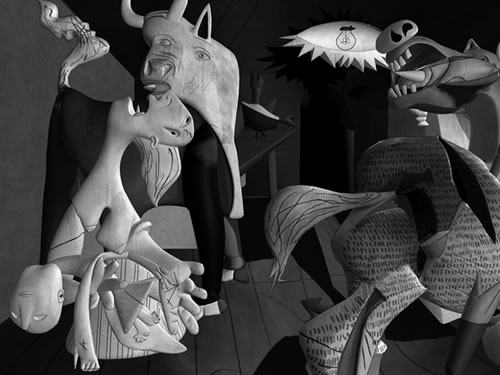
Guernica
M. Shahid Alam

Iraq deaths double under UN sanctions.”
New York Times, Feb.17, 2000

Sleep my child, do not wake now.
The portents in the sky foretell
a searing death for you.

The couriers of death have come,
stealth in their cyber gaze:
they scour the land for Saddam.

They poison every river, creek and well.
They darken school and hospital.
They warp the words you spell.

For star, for oil and cross they fly.
They will not cease to tyrannize
your dying days and hellish nights.

They will not cease their deathly watch.
Their mission is to fossilize
your bones, your heart, your eyes.

Sweet my child, do not wake now.
Your eyes once soft are hard
as rock: your hair is white as snow.

– M. Shahid Alam is professor of economics at Northeastern University. He is author of Challenging the New Orientalism (IPI: 2000). You can reach him at alqalam02760@yahoo.com.

On Mads Gilbert’s North American Tour

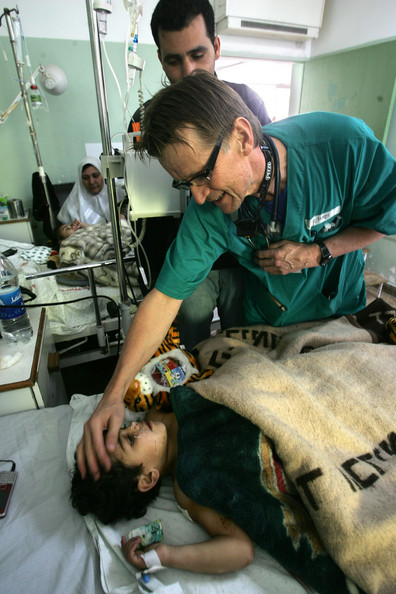
Dr. Mads Gilbert treating a wounded Palestinian child during Israel's December 2008 assault on Gaza.

During Israel’s assault on Gaza in December 2008, two doctors working from the frontline attempted to bring attention to the imbalance of power that exists at the heart of this conflict — an imbalance which weighs heavily towards the Israeli side.  While Israeli media spokespeople used airtime to argue that Israel was only targeting Hamas militants, Dr. Mads Gilbert and Dr. Erik Fosse of the Norwegian Aid Committee attempted to bring attention to just how many women and children were being wheeled in to be treated for shrapnel and bullet wounds, and how many families they were treating all at once.  They have since written a book about the event and Gilbert will be touring North America to spread their message. 

The following was written by Fatemah Meghji, the national co-ordinator of Solidarity for Palestinian Human Rights and a university student who has been organizing a nation-wide tour for Gilbert.  Below her piece you will find a listing of tour dates and locations — be sure to attend an event if you can, I know I will. 

by Fatemah Meghji

From Dr. Mads Gilbert & Dr. Erik Fosse’s Eyes in Gaza:

The boy with the destroyed brain did not need anaesthetic; he could no longer feel anything. The other lay in an artificial coma with intravenous anaesthetic agents to soften the pain and allow the ventilator to work without resistance from the boy’s own breathing. A large bandage covered both his eyes. He could not see anyway. He was already blind. 

Where could I cry out the despair and rage I felt for all this terrible fate we saw at such close quarters? Would the heavens hear? Will the world hear? They know that this is happening, after all. The numbers tick into the West every single afternoon, to the news agencies, to the intelligence services and to the diplomatic missions of the world’s most powerful nations, who do not even make an attempt to pull in the reins and control the wildness of the Israeli war machine.

Continue reading “On Mads Gilbert’s North American Tour”