The danger of a single story

This is a superb presentation by Nigerian novelist Chimamanda Adichie. Also see Binyavanga Wainaina’s “How to write about Africa“, and Uzodinma Iweala’s “Stop Trying to ‘Save’ Africa“. (thanks Rabee’ah)

Our lives, our cultures, are composed of many overlapping stories. Novelist Chimamanda Adichie tells the story of how she found her authentic cultural voice — and warns that if we hear only a single story about another person or country, we risk a critical misunderstanding.

Continue reading “The danger of a single story”

The Honduran Coup: A Graphic History

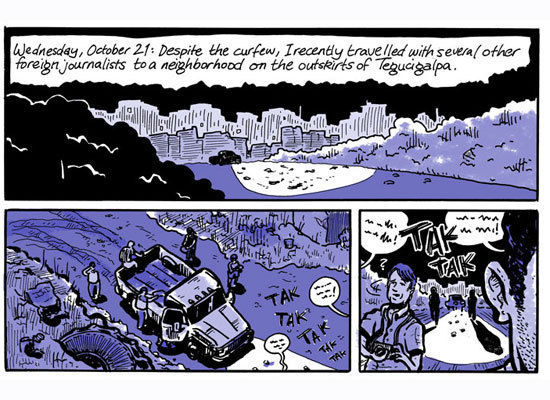
Media creativity in the aftermath of the 28 June coup against Honduran President Mel Zelaya has generally been limited to such things as CNN’s classification of the military coup as “military-led,” Honduran media classification of tomorrow’s illegitimate elections as a “fiesta cívica,” and the publication of articles in mainstream Honduran newspapers with titles like “Zelayista Guerrillas Train in Nicaragua.” This particular article, published by El Heraldo on 2 August, is accompanied by a photograph of a ragtag group of joggers—some of them barefoot, one in a cowboy hat, and one in all pink—and bears a caption announcing that “Manuel Zelaya’s followers have begun military exercises in fields in Nicaragua.”

More substantive creative endeavors have been undertaken by Dan Archer and Nikil Saval, who have put together a graphic history of the Honduran coup in two parts thus far. The latter part is based on Joseph Shansky’s piece “Smashing the Silence: Community Defiance in Honduras,” first published on PULSE, and can be viewed below (note: all annotations appear in the original version). The first part of the graphic history can additionally be viewed here, and information on other projects can be found on Archer’s website.

Continue reading “The Honduran Coup: A Graphic History”

The End of the Arabs?

In 2007 I read Peter W. Galbraith’s “The End of Iraq“, which suggests cutting Iraq into three mini-states, and then responded in two parts. The first part criticises Galbraith’s thesis, and the second part criticises the failures of Arabism. Both are merged below. More recently it has been revealed that Galbraith actually stood to gain financially from the dismantlement of Iraq.

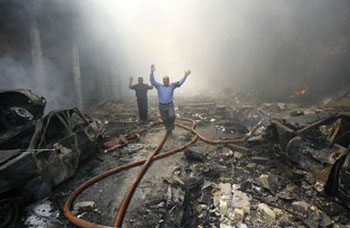
explosion at Baghdad's Mutanabi Street book market

Peter W. Galbraith’s book ‘The End of Iraq’ argues the initially persuasive thesis that Iraqis have already divided themselves into three separate countries roughly corresponding to the Ottoman provinces of Basra (the Shii Arab south), Baghdad (the Sunni Arab centre) and Mosul (the Kurdish north), and that American attempts to keep the country unified are bound to fail. I agree wholeheartedly with Galbraith’s call for America to withdraw from Iraq – America is incapable of stopping the civil war, and is in fact exacerbating it. (update: I stick by this. The civil war has to some extent calmed because of internal Iraqi dynamics, not because of the US ’surge’ – the Sunni forces turned on al-Qaida, and also realised that they had lost the battle for Baghdad and national power. Some groups then allied with the US for a variety of reasons to do with self-preservation). The rest of Galbraith’s argument is much more debatable.

Continue reading “The End of the Arabs?”

Visiting the Great Satan

Notre Dame University

I’ve never before visited the USA. Like everybody else in the world, I’ve had it come to me. Its approach has been unstoppable, for good and for ill. For good first: the incredible achievement of American prose, which leaves British writing of the last century far behind. I am astounded by Faulkner, Bellow, Updike and Roth (when they’re good), Cheever, Scott Fitzgerald, and now Joshua Ferris. Formulaic Hollywood switches me off, but I can’t get enough Spike Lee or Martin Scorcese. I love Bob Dylan, Public Enemy and Miles Davis, just for starters. Jazz and particularly hip hop are American art forms which have travelled very well indeed. These two came originally from the black poor, and it’s the heterogeneity of America, and the possibility of marginalised genres and people being heard, which is so appealing. America is a continent-sized country of mixed-up Africans, Jews, Italians, Irish, Latinos, French, Wasps, and everyone else. It should be the most globally-minded and tolerant country in the world.

It isn’t of course. A narrow hyper-nationalism, the shaping of public discourse by corporations and lobbies, and a stupifying media and public education system have seen to that. Which brings us to the ill: America’s homogenising rage, which has ravaged first its own main streets (so Naomi Klein says in No Logo) and then the high streets of the world; its humourless TV gum; its advertising culture of false smiles and sugary platitudes; its racism, wars, military bases, aircraft carriers, support for dictators and apartheid regimes. These are the reasons why the US is known in some parts as the Great Satan, standing behind most of the little satans sitting on Asian and African thrones. In Muscat, Damascus, Shiraz and London I’ve met many people who have been made refugees by the USA.

America is the empire, admittedly in decline. In one sense, therefore, I haven’t needed to visit to know it. But last week I visited nevertheless, for a conference at Notre Dame University which I enjoyed very much.

Continue reading “Visiting the Great Satan”

Bay Area Premier of “My Name is Rachel Corrie”

by Charlotte Silver

On November 19, 2009, My Name is Rachel Corrie made its Bay Area premier at Stanford University.  Amanda Gelender, senior at Stanford University, produced a staged reading of the play as a part of her senior thesis at Stanford University. Amanda is my friend. She was also my college classmate and we worked together in several campus political organizations, including the student-led Israel divestment campaign.

I attended opening night and along with a sold-out audience was struck by the poignancy of the play and Amanda’s subtle and deeply moving performance. Rachel Corrie was a 23 year-old American woman who traveled to Gaza in 2003 during the Second Intifada. She was killed by a Caterpillar bulldozer driven by Israeli Defense Forces as she attempted to prevent the IDF from demolishing the home of a Palestinian family. My Name is Rachel Corrie consists entirely of words written by Corrie herself, recorded in diary entries and emails from Rachel’s early childhood until a few days before her death. Gelender breathes vivid life into Rachel’s words, which themselves reveal the keen sensitivity and eloquence of a poetic nature.

Amanda Gelender, the lead and visionary behind this production, had been waiting to obtain the rights for the play for nearly two years. But obtaining rights is not always the only hurdle to securing a production of Rachel. Since its London premier in 2005, several professional American and Canadian theaters have seen their efforts to mount a production of this one-woman show quashed by vigorous opposition from powerful forces.  The charge is always the same: the play is anti-Semitic. Gelender’s successful production reflects the changing tide that is occurring within the American public’s relationship to Israel and anti-Semitism.

Continue reading “Bay Area Premier of “My Name is Rachel Corrie””

Divide and Conquer – Undermining the BDS Movement from Within

Last week, my local BDS group was put on alert, when the following headline emerged:

“Palestinian Unions Say Israel Boycott Would Harm Them”

The Palestine General Federation of Trade Unions (PGFTU) is a signatory of the PACBI (Palestinian Campaign for the Academic & Cultural Boycott of Israel) call for BDS (#5), and has an estimate of 290,000 members. Naturally, if- all of a sudden- they’re not on board with the BDS movement, it’s cause for concern. That said, the whole scheme of things didn’t seem to make sense, so off I went on another journey through the Zionist Jungle.

Continue reading “Divide and Conquer – Undermining the BDS Movement from Within”

The Pervert’s Guide To Cinema

You’ve got to hand it to Slovenian philosopher Slavoj Žižek. Who else could conceivably get away with saying something like “My gott, I’m tinking like Melahnie. You know what I’m tinking, now? I want to fack Mitch! No, shorry, shorry…I got dish … shpontaneoush confushion of direcshins”?!  Here’s a clip from his psychoanalytical and film criticism foray  into the cinematic canon entitled The Pervert’s Guide To Cinema.

Clip

Continue reading “The Pervert’s Guide To Cinema”

Blackwater’s Secret War in Pakistan

Jeremy Scahill

From The Nation’s press release (You can watch Democracy Now’s interview with Jeremy Scahill here):

In a stunning investigation just posted at TheNation.com, Jeremy Scahill reveals a covert military operation being run almost entirely by Blackwater, USA, a military contractor embroiled in controversy for their actions in Iraq and the Middle East. Key points from the piece:

  • An elite division of Blackwater, USA is running a covert, US Military operation that includes planning targeted assassinations, “snatch and grabs” and other sensitive actions inside and outside Pakistan. This is a program that not even some Senior Level Obama Administration and Pentagon officials are aware of.
  • Blackwater operatives are assisting in gathering intelligence to help run a secret, second and heretofore unreported, US military drone bombing campaign that runs parallel to the well-documented CIA predator strikes.
  • Sources for The Nation report that some non-military Blackwater employees, outside of the US Military chain of command, have obtained rolling security clearances above their approved clearances, and higher than even members of the US Congress.
  • Continue reading “Blackwater’s Secret War in Pakistan”

Shimon the Brazilian (and Mahmoud the Conqueror)

I am not sure how to explain this strange report from Al Jazeera’s Lucia Newman: the headline reads:  ‘Brazilians protest Ahmadinejad tour‘, yet the only person in the report shown protesting is Shimon Peres. On the other hand, the single Brazilian who is interviewed speaks about the benefits of relations with Iran, and the president is reported to be welcoming Ahmadinejad with ‘open arms’.

Peres, I hate to tell Al Jazeera, is not a Brazilian; even if he were, he would need to persuade at least one other before he can stage a ‘Brazilians protest’.

Also, the report goes on to tells us in ominous Cold War cliches that Ahmadinejad is challenging ‘Washington in its own back yard’. What’s with this ‘back yard’ nonsense; does being a journalist mean never having to say a thing that’s original?

To A Christian Zionist

Update: I wrote this in 2006. If I wrote it today I would do it a little differently. Specifically, I would discuss the pernicious role of the Scofield Bible in perverting protestantism in America. I would discuss the meeting point of Christian Zionism, orientalism and racism in Western cultures. And I would point out that contemporary science has shown us that the direct descendants of the ancient Israelites are the Palestinians, not the Ashkenazi or Berber Jews who have colonised Palestine in recent years. Shlomo Sand’s excellent book The Invention of the Jewish People, reviewed here, summarises the science and undercuts the blood-and-soil aspects of Zionism which are so important to Christian Zionists and their ultimately anti-Semitic agenda.

I have recently been discussing Middle East issues with an American colleague who I would describe as a Christian Zionist. Although I like him personally I find some of his ideas (on Palestinian history, and Lebanon, and the wider Middle East) pretty offensive, and I have told him so. So as not to start an argument, I told him so in writing. He replied, saying that although he disapproves of collective punishment of the Palestinians he believes that the Bible clearly states that the Holy Land belongs to the Jews, and that the rebuilding of Israel prophesied in the Old Testament has happened since 1948. Hmm. My first response is anger. I understand Jews with memories of European anti-Semitism being attracted to Zionism, however wrong I think they are, but Americans? People who are not oppressed, who think Palestine is a Cecil B Demille set, who think real human beings (Arabs) are less important than their own narrow interpretations of scripture. Who think that ethnic cleansing, massacres, and apartheid are supported by God. It makes my blood boil. But I think responding intelligently to this kind of thing is important, because there are millions of Americans (with power) who see the Middle East through a Biblical prism. Anyway, here is my latest letter:

Continue reading “To A Christian Zionist”