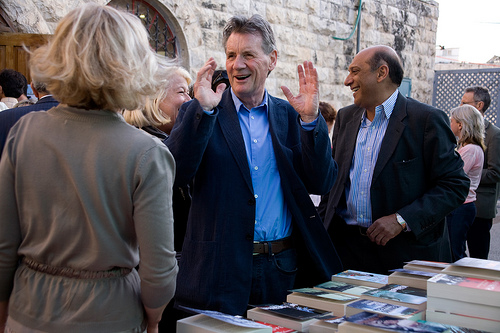
We’re now on the fourth day of Palfest. The skies have cleared, its as hot as I always thought it would be here, out here in lands I know only from the picture-books of the Bible.
So, its my first time in this part of the world – despite having been to over 90 countries, the Middle East has been a stranger to me.
When I left London I had a very clear idea of where or what Palestine consisted of. This trip has made me understand that though Palestine may not exist as a country on a map, it is a reality in the minds of 5 million people.
As the London Times reports that its investigations into the final three weeks of fighting in Sri Lanka’s civil war yield a shocking figure of claiming more than 20,000 civilian lives, a UN official tells the paper the actual figure is “Higher. … Keep going.” The three-week bombardment may have ended the 26-year war but what atrocities were committed during the final weeks when the Sri Lankan government kept out journalists and aid workers?
The ‘international condemnation’ of North Korea’s nuclear test on Monday was severely lacking in credibility for its fantastical double-standards, writes Seumas Milne, who argues only radical disarmament can halt their spread.
Here in Scotland the SNP made an attempt to seek support from this same ‘international community’ to rid the country of its nuclear weapons, which are stored in a naval base on the River Clyde. In October 2007 First Minister Alex Salmond wrote to representatives of 189 countries signed up to the Nuclear Non-Proliferation Treaty, seeking ‘observer status’ as defence is not an area devolved to Holyrood. The renewal of the Trident missiles is set to run into the tens of billions over the next 20 years, with the parent Westminster government insisting this is a necessary “deterrent” to protect “national security interests”. Sadly the list of replies were published last summer showing there to be little international support for this brave move from a minority administration.
This example reflects Milne’s Guardian article nicely I think.
The big power denunciation of North Korea’s nuclear weapons test on Monday could not have been more sweeping. Barack Obama called the Hiroshima-scale underground explosion a “blatant violation of international law”, and pledged to “stand up” to North Korea – as if it were a military giant of the Pacific – while Korea’s former imperial master Japan branded the bomb a “clear crime”, and even its long-suffering ally China declared itself “resolutely opposed” to what had taken place. Continue reading “After Iraq, it’s not just North Korea that wants a bomb”
An Iraqi boy walks down a street in southern Baqouba, surrounded by US Army soldiers. (Photo: Marko Drobnjakovic / AP)
Trangress
The geo-strategic expansion of the American empire is an accepted fact of contemporary history. I have been writing in these columns about the impact of the US occupation on the people of Iraq in the wake of the “hard” colonization via F-16s, tanks, 2,000-pound bombs, white phosphorous and cluster bombs.
Here I offer a brief glimpse into the less obvious but far more insidious phenomenon of “soft” colonization. That scholars and political thinkers have talked at length of such processes only establishes the uncomfortable reality that history is bound to repeat itself in all its ugliness, unless the human civilization makes a concerted effort to eliminate the use of brute force from human affairs.
Fairness and Accuracy in Reporting (FAIR) has an action alert on the New York Times‘ Pentagon Propaganda, detailing its misleading report on Guantánamo and terrorism. This comes as the same paper last year published David Barstow’s revelations about the Pentagon’s hidden hand in “news” coverage to generate pro-war propaganda and favourable coverage for the Bush administration, for which he has won a Pulitzer Prize for investigative reporting. (See also this interview on Democracy Now earlier this month). The NYT continues to try to have it both ways: (selectively) exposing propaganda as well as exercising it as an extension of the US military and political establishment. FAIR does well to keep the scrutiny turned right up:
While former Vice President Dick Cheney has been front and center in the media debate over the current White House’s national security policies, he’s not the only one trying to challenge the White House’s message. The New York Times published a front-page article (5/21/09) that bolstered the notion that former Guantánamo prisoners “return” to terrorist activity.
The remarkably credulous Times story, under the headline “1 in 7 Freed Detainees Rejoins Fight, Report Finds,” was based on a Pentagon report leaked to the paper before its release yesterday evening. The article emphasized the notion that former prisoners “returned to terrorism or militant activity”–without adequately explaining the definition of either term, or examining whether those former detainees were ever “terrorists” in the first place.
Stephen Walt highlights why the House of Congress’ pledge of $1.5 billion per annum non-military aid for Pakistan isn’t going to do much to change the effect of disasterous American meddling.
At the New Yorker blog, Steve Coll reports that the U.S. Congress is preparing a five-year $1.5 billion per annum non-military aid package for Pakistan, with full support from the Obama administration. (You can read the text of the legislation, entitled the “Enhanced Partnership with Pakistan Act,” here.)
This step sounds impressive, until one remembers that Pakistan’s population is nearly 180 million and its GDP in 2006 was about $144 billion. So the aid package amounts to around a 1 percent increase in Pakistani GDP, which works out to about $8 for each Pakistani. In other words, the U.S. Congress is going to increase their per capita income from $850 per year to about $858. (It’s actually less than that, because some of the money goes to administrative expenses, auditing, and the like.) Continue reading “Why aid to Pakistan won’t make a difference”
The fragile colonial construct named Pakistan is risking its own long term survival through its myopic policy in Malakand. The difficulties faced by the refugees from Swat are well known. But according to Rahimullah Yusufzai the reugees are now also the victims of ugly ethnic chauvinism. The far-right Sindhi nationalist Jeay Sindh Qaumi Mahaz (JSQM) and the Muhajir Qaumi Movement (which has renamed itself Muttahida Qaumi Movement in order to mask its narrow factional interests) have organized two major strikes against their migration into Sindh in search of sanctuary. The violence that accompanied the strikes saw Pakhtun property being torched by Sindhi-Muhajir mobs, and one 50 year old woman being burnt alive. The MQM is part of the ruling coalition (led by the fuedal Sindhi dominated PPP of Bhutto/Zardari) and according to Yusufzai the actions have more than the tacit support of the government since the PPP-led provincial government has been sending back many refugees from the border town of Kashmore. Poignantly, Yusufzai adds:
The ruling PPP cannot absolve itself of the blame for blocking the trucks and buses bringing the IDPs to Sindh at the border town of Kashmore and for insisting that they go back to their native NWFP or stay in not-yet-ready tented camps there in the middle of nowhere. It was an insensitive act that added insult to injury and contributed to the pain suffered by the IDPs and felt by all Pakhtuns. More pain was inflicted on the Pakhtun psyche by certain PPP leaders, including its blundering spokesperson Fauzia Wahab, when the IDPs were equated to the Afghan refugees. If this isn’t a slip of tongue, then it obviously means that many politicians and also other likeminded people from different walks of life in Punjab and Sindh have come to believe that the Afghan refugees too are primarily Pakhtuns and all of them need to be kept out of Pakistan’s two biggest provinces to avoid harm…The PML-N despite its praiseworthy relief work in support of the IDPs also damaged its growing reputation as a party sympathetic to the cause of smaller provinces by hesitating to allow setting up of IDPs camps in Punjab…The apathy of some of the Sindh- and Punjab-based political forces to the woes of the IDPs looks all the more glaring when one compares it to the unparalleled generosity shown by the common people all over the country.
Yusufzai contrasts this with the generosity shown the refugees in Mardan and Swabi, and ask why the refugees — 80 percent of whom are actually living with families and well-wishers — should be ‘a matter of concern for NWFP and the Pakhtuns only. ‘If that is the case, then one should be worried about the damage this attitude is causing to the concept of nationhood in the federation of Pakistan.’
From Colombian painter Fernando Botero's series depicting US abuse of Iraqi detainees.
Guantanamo, Abu Ghraib, and Bagram are well known. Less so the police detention centers where the innocents caught in the ‘war on terror’ dragnet were subjected to similar abuses. Inigo Thomas reveals:
In his remarks to the American Enterprise Institute last week, Dick Cheney said that inmates at Guantánamo should remain imprisoned on Cuba because they are too dangerous to be incarcerated in American jails. What about the Americans arrested and jailed under the terms of the war on terror? Should they be incarcerated on Cuba, or does Cheney suppose that Americans are, regardless of what they have done, inherently less dangerous than other people and therefore don’t need to be jailed at Guantánamo?
Nor – surely – can Cheney have forgotten that immediately after 9/11, hundreds of men were rounded up by the FBI and other police forces in the US and imprisoned in high security American jails: 760 in total, 184 of whom were considered especially interesting by the authorities. Just over half of them were interred at the Metropolitan Detention Center in Brooklyn, a former warehouse on the waterfront overlooking the harbour and the Statue of Liberty. The story was covered by the New York Times, but it was treated, mostly, as local news and carried in the ‘New York Region’ section of the paper.
Editors Note: In the light of Bartlett’s recent activities and reporting, we believe there is reason to be sceptical of her commitment to truth so we cannot vouch for any of her past claims.
Eva Bartlett continues her excellent series of reports documenting Israeli crimes. Her latest report describes the deliberate destruction of Gaza’s farmlands by the IDF.
On the morning of 4 May 2009, Israeli troops set fire to Palestinian crops along Gaza’s eastern border with Israel. The Palestinian Centre for Human Rights (PCHR) reported that 200,000 square meters of crops were destroyed, including wheat and barley ready for harvest, as well as vegetables, olive and pomegranate trees.
Local farmers report that the blaze carried over a four-kilometer stretch on the Palestinian side of the eastern border land. Ibrahim Hassan Safadi, 49, from one of the farming families whose crops were destroyed by the blaze, said that the fires were smoldering until early evening, despite efforts by the fire brigades to extinguish them.
Safadi says he was present when Israeli soldiers fired small bombs into his field, which soon after caught ablaze. He explained that “The Israeli soldiers fired from their jeeps, causing a fire to break out on the land. They burned the wheat, burned the pomegranate trees … The fire spread across the valley. We called the fire brigades. They came to the area and put out the fire. But in some places the fire started again.” According to Safadi, he lost 30,000 square meters to the blaze, including 300 pomegranate trees, 150 olive trees, and wheat.
Thanks to Marcy Newman, who is in attendance and has a great write-up along with audio she’s recorded of Suheir’s always excellent spoken-word performances, we have more of this wonderful poetry as performed in Palestine.
Here are four of Suheir’s poetry readings at the Festival, the first three in English and the fourth short poem mostly in Arabic, as well as a video clip.


 Fairness and Accuracy in Reporting (FAIR) has an action alert on the New York Times‘


 P U L S E