Can We Call it “Just Another Fascist Regime in the Middle East” yet?

The Latest Raid in Bil'in Photo By Hamde Abu-Rahma

Chapter XXV of Part Three of the Goldstone Report was dedicated to Repression Of Dissent In Israel, Right To Access To Information And Treatment Of Human Rights Defenders. I personally remember the fear of speaking out, I felt at the time. It was a tense environment and a hands-on lesson in democracy (or lack there of).

The Israeli environment, today, is calmer to a degree; Most probably due to the short memory span of the typical Israeli. Yet the authorities (the only ones with property rights to this memory span) are exponentially getting more and more nervous about world perception of Israel. This nervousness manifests in many different and desperate ways, I’ve written about, but today I’d like to focus on what’s becoming more and more flagrant: The repression of leftist activists.

Amira Hass as a Measure to Oppression

When I started seeing Amira Hass in the Sheikh Jarrah protests, I was almost as giddy as a groupie. At the time, it didn’t occur to me that if she’s covering repression of the Jewish (for sake of clarification only) left, then she’s taking time off of covering much more atrocious transgressions against Palestinians. And though her enjoyment of taking part in actual democratic practice was obvious, she was on the job, and the article was soon to follow:

The Israel Defense Forces says it is using information on Israelis who demonstrate against the separation fence in a bid to deny them entry at nearby checkpoints… It also appears that the IDF is observing the routes the activists take to reach the villages.

Continue reading “Can We Call it “Just Another Fascist Regime in the Middle East” yet?”

Oman Again

To break up the winter I spent most of January visiting my brother-in-law and friends in Oman, where I used to live, and my sisters in Doha, Qatar.

Since Hamad bin Khalifa Aal Thani deposed his corrupt father, Qatar’s powerful oil and gas economy has expanded and diversified. The state follows an interesting and idiosyncratic foreign policy. It hosts the largest American miltary base in the Gulf, and it also hosts – against American and Arab objections – al-Jazeera. In terms of the regional ‘Resistance Front versus US-client’ dialectic, Qatar stands in the middle, and in 2008 it helped negotiate a Lebanese compromise between the two sides. Wahhabism is influential (my five-year-old niece wants to attend ballet classes, but ballet classes are banned because the costume is considered unIslamic – even for five-year-old girls in a man-free environment), yet women can vote and drive.

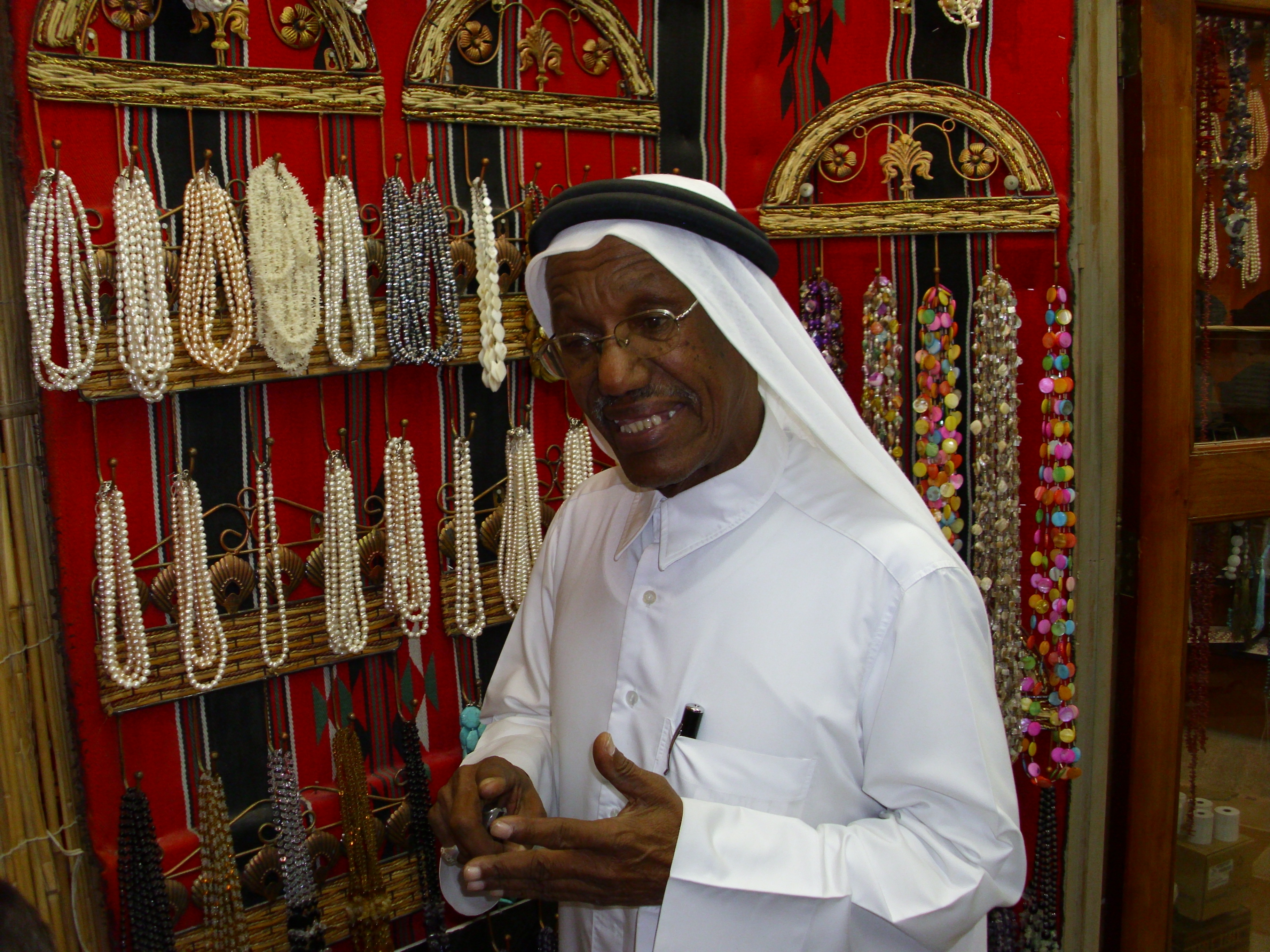
Overall, I don’t much like the place. I had a good time with my family, ate some fine meals, went to a book fair. But there’s a bad power game going on in Qatar. Nobody is smiling. I met some very pleasant Qataris – the staff in the excellent Islamic Art Museum, some men in a bowling alley, a retired pearl diver – but I also noticed many refusing to descend from their cars at the grocery shop. (Arabs often expect take-away food to be brought to the car, but not groceries.) Expatriates form a majority of the population. As elsewhere in the Gulf, expatriate wage and class status can be mapped reasonably smoothly onto ethnicity, with white Westerners on top, followed by Lebanese, then other Arabs, then Indonesians, Pakistanis and Indians. Expatriates don’t have citizenship rights, although the infrastructure depends on them. Many contemporary Qataris, in contrast to their proud grandfathers, are obese. The city is one of close walls. The surrounding desert is flat, pale, and begrimed by industry. 

Inside the Lawfare Project

Netanyahu’s Attack on Human Rights NGO’s Hits the States

by Max Blumenthal

As the anti-Goldstone, human rights-bashing Lawfare Project’s opening event on March 11 wrapped up, I asked its chairman, Columbia University Law School Dean David Schizer, for an interview. Schizer, who had just attacked the Goldstone Report from the podium, pointedly refused to speak to me and looked for the exit. As Schizer was leaving, he was politely confronted by Columbia Law School Professor Katherine Franke, who heads the school’s Program in Gender and Sexuality Law.

“Why didn’t you invite any speakers with an alternative perspective?” Franke asked Schizer.

His reply was curt. “We invited one or two but they couldn’t make it,” Schizer claimed before hurrying away.

Schizer was understandably nervous about his exposure. After all, he had just presided over a day-long conference during which Israeli human rights workers were labeled as traitors while Judge Richard Goldstone and human rights groups were compared to “anti-Semitic street gangs.” After several speakers had harshly condemned legal efforts against the construction of Israeli settlements in East Jerusalem and the West Bank, Schizer appeared beside them to lend his credibility to their views.

Continue reading “Inside the Lawfare Project”

The Only Democracy in the Middle East: 12.3.2010

In Nebi Salah The soldiers were eager and waiting, within the village when the march had reached its outskirts. Under the cover of the clashes between the army and the village youth, some villagers managed to reach their natural spring, only to find settlers swimming in it. Soldiers who eventually got to the group politely ordered the settlers to leave, while attacking the demonstrators with tear-gas in order to push them back to the village. The two groups had regrouped back in the village, where Border Police officers shot at demonstrators from behind the stone terraces that crosshatch the fields between the village and the settlement. It took the army until seven in the evening to retreat:

The injured 14 year old boy, Ehab Barghouthi, has awaken from his coma, caused by a rubber coated bullet to his head, fired by an Israeli army Soldier.

Continue reading “The Only Democracy in the Middle East: 12.3.2010”

Falluja’s birth defects

Our good friend Dahr Jamail on the Riz Khan show to discuss the dramatic rise in birth defects in Falluja following the two brutal sieges of 2004.

On this episode of the Riz Khan show we ask if US weapons are behind the sharp rise in birth defects in Falluja. Residents of the Iraqi city blame the surge in chronic deformities on controversial weapons used by US forces against Sunni fighters in 2004. But the US military has dismissed those allegations.

Active Non-violence in Palestine and Israel

By David Hartsough

When some people think of Palestine and Israel, they often picture Palestinians as suicide bombers and terrorists while the Israeli military are seen as bombing whole neighborhoods in Palestine. The violence and counter-violence and endless war has created a hopelessness about any peaceful future for the Holy Land.

However, during a month-long stay in Palestine and Israel recently, I found something else. I found something very positive and hopeful and perhaps the key to a peaceful resolution of this tragic conflict — and a possible path toward a peaceful future for both peoples.

I found that violence is not the whole story. Endless checkpoints, 26-foot high walls, and the great fear and mistrust between many Israelis and Palestinians are grimly persistent features of life there. But there is also an alternative to this cycle of destruction being forged on both sides. There is a larger story beyond the script of retaliatory violence – a story of a growing nonviolent movement that both Palestinians and Israelis are building. It is this larger story that I would like to share.

Continue reading “Active Non-violence in Palestine and Israel”

(Neo)Orientalism with an Attitude: In the Footsteps (and Beyond) of Richard Burton

Getting one’s picture taken with the Dalai Lama or the Pope will guarantee neither Buddhist enlightenment nor beatification: my apologies for shattering the hopes of some New Agers. Similarly, entering the Ka’aba in Burtonesque disguise — specially minus his arguably relevant though shifty linguistic skills and textual knowledge — will not and cannot necessarily guarantee much “learning” about Islam.

by Huma Dar

The March 10, 2010, page A27 of the New York edition of New York Times carries an Op-Ed piece by Maureen Dowd titled, “Pilgrim Non Grata in Mecca.” Dowd writes about her desire to “learn about the religion that smashed into the American consciousness on 9/11” via “sneaking” into Mecca in “a black masquerade cloak.”  Her self-proclaimed inspiration is Richard Burton’s “illicit pilgrim[age] to the sacred black granite cube…in Arab garb” thereby “infiltrat[ing] the holiest place in Islam, the Kaaba [sic].”

Dowd, however, decides to “learn about Islam” in a way “less sneaky,” “disrespectful,” or “dangerous” and yet more entitled and privileged than Richard Burton could ever have dreamed of.   She herself describes Burton as “the 19th-century British adventurer, translator of “The Arabian Nights” and the “Kama Sutra” and self-described ‘amateur barbarian.'”  The words “illicit,” “Kama Sutra,” and “infiltration” and Dowd’s voyeuristic desires resonate with the Orientalism of yore.  Moreover Dowd’s valuable US passport and USA’s special relationship with Saudi Arabia (read: enabling of the oppressive monarchy) entitle her to meet Prince Saud al-Faisal, the Saudi foreign minister — of the “sometimes sly demeanor” — on her “odyssey” to that country.  “Infiltration” in disguise is no longer required, and yet this ease of access also disguises and makes more difficult the complexity of any real learning.

Dowd “presses” al-Faisal for the privilege to watch in Mecca, the “deeply private rituals” and “gawk at the parade of religious costumes fashioned from loose white sheets” although she knows in advance that “Saudis understandably have zero interest in outraging the rest of the Muslim world.”  While talking to this high-ranking minister, Dowd bristles at al-Faisal’s reassuring suggestion that if she desired to see any mosque in a place other than in Mecca or Medina, and was prevented from doing so, all she had to do was to contact the “emir of the region” who would comply and enable the fulfillment of her desires.  (Anyone else reminded of Aladdin’s djinn/genie?)  Without conceding the irony of the situation that she, after all, is speaking to Prince al-Faisal, the Saudi foreign minister, Dowd quips, “Sure. Just call the emir. I bet he’s listed.”   Imagine what Richard Burton would have done with the special privileges of this particular magic lamp provided by the New World Order!

Finally Dowd does indeed witness the Hajj — in an IMAX theatre watching Journey to Mecca: In the Footsteps of Ibn Battuta. Dowd, much to her surprise, makes the belated discovery that “the Kaaba [sic] was built by “Abraham, the father of the Jews” [why Jews only?]— a reminder that the faiths have a lot to learn from each other.”  It is also a reminder that journalists like Ms. Maureen Dowd have a lot of homework to do before they set out on their surely expensive travels — and I am not even including the much recommended language lessons.  Any commonly available text on Islam, for example by Karen Armstrong, Jamal Elias, Michael Sells, or Ziauddin Sardar, might have served the purpose.  Dowd could thus have avoided relying solely on the “amateur barbarian” Richard Burton or Newsweek’s own Fareed Zakaria.  The former’s scholarly credentials are hardly beyond doubt — see his problematic remarks on “Jewish human sacrifice” in The Jew, the Gipsy and el Islam (1898).  The latter’s forte is not his knowledge of Islam — or at least no more than Zakaria’s mentor, Samuel Huntington’s forte is Christianity.  Dowd might thus have disabused herself of the notion of “the sacred black granite cube.”  The “sacred black” stone is not a “cube” and neither is the “sacred cube” — the Ka’aba — all granite!

Getting one’s picture taken with the Dalai Lama or the Pope will guarantee neither Buddhist enlightenment nor beatification: my apologies for shattering the hopes of some New Agers.  Similarly, entering the Ka’aba in Burtonesque disguise — specially minus his arguably relevant though shifty linguistic skills and textual knowledge (See Parama Roy’s excellent essay for more on Burton) — will not and cannot necessarily guarantee much “learning” about Islam.  On the other hand, a trip to any local library with a willingness to read and learn, and engagement with an open mind in meaningful conversations with the (gasp!) American Muslims, might be better starting points for undertaking this particular journey.

Did the Editor of The New York Times not know the price difference between the ticket to the IMAX theatre plus membership to a local library and the cost of Dowd’s lavish travels to the Kingdom of Saudi Arabia?  The Neo-Orientalist fantasy to tread in the footsteps of Sir Richard Burton is accelerated with privilege and precisely because of this privilege skips and misses its target even more widely.

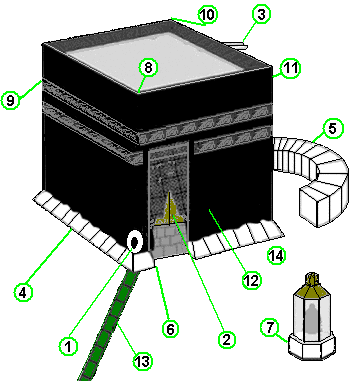
It is in the spirit of a gift that I offer Ms. Dowd this image:
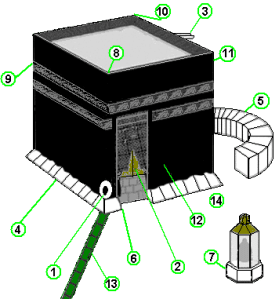
Labeled elements are as follows: 1 – The Black Stone; 2 – Door of the Kaaba; 3. Gutter to remove rainwater; 4 – Base of the Kaaba; 5 – Al-Hatim; 6 – Al-Multazam (the wall between the door of the Kaaba and black stone); 7 – The Station of Ibrahim; 8 – Angle of the Black Stone; 9 – Angle of Yemen; 10 – Angle of Syria; 11 – Angle of Iraq; 12 – Kiswa (veil covering the Kaaba); 13 – Band of marble marking the beginning and end of rounds; 14 – The Station of Gabriel.

Russell tribunal says sanction Israel

Russell Tribunal on Palestine concludes the EU should sanction Israel until violations stop.

On the real “Climategate”

If you saw Johann Hari’s widely-circulated indictment of corruption in the conservation movement in The Nation, you should watch his interview from Tuesday’s Democracy Now! With Christine MacDonald, he lays out the real outage in the environmental community — the collusion between several of the largest conservation groups and some of the world’s worst polluters. As he wrote last week:

Groups like Conservation International are among the most trusted “brands” in America, pledged to protect and defend nature. Yet as we confront the biggest ecological crisis in human history, many of the green organizations meant to be leading the fight are busy shoveling up hard cash from the world’s worst polluters–and burying science-based environmentalism in return. Sometimes the corruption is subtle; sometimes it is blatant. In the middle of a swirl of bogus climate scandals trumped up by deniers, here is the real Climategate, waiting to be exposed.

MacDonald, meanwhile, has authored Green, Inc. which similarly exposes the complacency of a number of organizations in the wake of alarming corruption and corporate influence.