The New York Times and the Israeli-Palestinian Conflict: The Bronner Affair

By Jerome Slater

The New York Times has now confirmed that the son of Ethan Bronner, for the past two years its chief correspondent in Israel, has enlisted in the Israeli army. On January 25, the website Electronic Intifada picked up on what was then still a rumor and pointed out that the internal policies of the Times state that journalists might have to be reassigned if the activities of family members create apparent conflicts of interest. The policy guidelines provide an example: “A brother or a daughter in a high-profile job on Wall Street might produce the appearance of conflict for a business reporter or editor….”

Electronic Intifada sent a message to Bronner asking if the rumor was true. Bronner did not respond but turned the message over to Susan Chira, the Times foreign editor, who did. With the usual brisk arrogance, evasiveness, or non-responsiveness of the Times whenever its coverage of the Israeli-Palestinian conflict is criticized, Chira dismissed the question of whether Bronner’s family ties (he is also married to an Israeli woman) constituted a conflict of interest: “Mr. Bronner’s son is a young adult who makes his own decisions. At the Times we have found Mr. Bronner’s coverage to be scrupulously fair and we are confident that will continue to be the case.”

No doubt the Times hoped that would dispose of the issue, but thanks to the internet, it was not to be.

Continue reading “The New York Times and the Israeli-Palestinian Conflict: The Bronner Affair”
USA and USSR: Accidental Parallels?

M. Shahid Alam

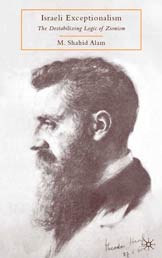
Cover Image GIFIs the question of parallels between the USA and the USSR idle, even mischievous? Perhaps, it is neither, but, on the contrary, deserves our serious consideration.

During the Cold War, the USA and USSR were arch rivals, each the antipodes of the other. For some four decades, they battled each other for ‘survival’ and global hegemony, staring down at each other with nuclear tipped missiles, ready at the push of a button to consummate mutually assured destruction. What parallels could there possibly exist between such irreconcilable antagonists?

Dismissively, the skeptic might retort that their similarities start and end with the first two letters in their names. The USA won and the USSR lost the Cold War. With all four of the letters in its name, the USSR is dead and gone. Its successor state, Russia, now ranks a distant second behind the USA in military power, a position it retains only by virtue of its nuclear arsenal. Measured in international dollars, the Russian economy ranked eighth in the world in 2009, trailing behind its former client, India.

On the other hand, the USA still believes it can ride roughshod over much of the world like a Colossus. It came close to doing this for a few years after the collapse of communism. In the years since its occupation of Iraq, that image has been deflated quite a bit. Haven’t the events of the last decade – the growing challenge to its hegemony in Latin America, the economic rise of India and China, and the recovery of Russia from its collapse of the previous decade – downsized the Colossus of the 1990s? Indeed, the near collapse of its economy in 2008 appears to have brought the Colossus down on its knees.

Continue reading “USA and USSR: Accidental Parallels?”

Sut Jhally on US Culture and Media

Sut Jhally

I have used several Media Education Foundation films in my classes and have found them to be an excellent resource for teaching. Jhally also has some perceptive comments on US media coverage of the Israel-Palestine conflict.

Sut Jhally is Professor of Communication at the University of Massachusetts at Amherst and Founder and Executive Director of the Media Education Foundation (MEF). He is one of the world’s leading scholars looking at the role played by advertising and popular culture in the processes of social control and identity construction. The author of numerous books and articles on media(including The Codes of Advertising and Enlightened Racism) he is also an award-winning teacher (a recipient of the Distinguished Teaching Award at the University of Massachusetts, where the student newspaper has also voted him “Best professor”). In addition, he has been awarded the Distinguished Outreach Award, and was selected to deliver a Distinguished Faculty Lecture in 2007.

The Coming Revolt of the Guards

Thoughts from Dane County Jail
 
by Joshua Brollier
 
Entering Fort McCoy

On entering the Dane County Jail, the first holding cell that Brian Terrell and I were placed in had only one other person. We previously saw this man outside the cell during our initial booking. He was a man with dark black skin and a full beard. I thought I heard one of the officers say he was from Gambia. When we entered the cell, the man was in mid-ritual in what appeared to be a Muslim’s midday prayer. A young white guard, who had the accent of a Midwesterner, looked disdainfully at the man and then somewhat positively at Brian and me. The guard said, “Just ignore that,” as if the man was insulting or threatening us by his peaceful act of prayer. To which I replied, “It’s fine with me.”

This experience was contrasted by the next encounter I had with another officer who made digital copies of my fingerprints and pictures. As this middle-aged man placed my hand on the machine, I made a remark that I was surprised that he did not already have my information handy. (This was the third time I was fingerprinted and pictured for this same charge.) He said, “Oh yeah? You arrested a lot? What are you in for?” I told him that I was arrested with a group who engaged in civil disobedience at Ft. McCoy. Getting the sense that this man may have previously been in the armed services, I explained that we were not against the men and women in the military personally, but that our goals were to enter the base to talk to the rank and file soldiers about ending the wars in Iraq and Afghanistan and to make certain the soldiers were aware of their right to refuse illegal and immoral orders.

Continue reading “The Coming Revolt of the Guards”

Myth-Making

We often project our current political concerns backwards in time in order to justify ourselves. I say ‘we’ because everyone does it. Nazi Germany invented a mythical blonde Aryan people who had always been kept down by lesser breeds. The Hindu nationalists in India imagine that Hinduism has always been a centralised doctrine rather than a conglomerate of texts and local traditions, and describe Muslim, Buddhist, Christian, Sikh, Jain and animist influences on Indian history as foreign intrusions. Black nationalists in the Americas depict ancient Africa as a continent not of hunter-gatherers and subsistence farmers but as a wonderland of kings and queens, gold and silk, science and monumental architecture. To our current cost, Zionists and the neo-cons have been able to reactivate old Orientalist myths in the West, myths in which the entirety of Arab and Islamic history has involved the slaughter and oppression of Christians, Jews, Hindus, women, gays, intellectuals .. and so on.

Such retrospective mythmaking frequently goes to the most absurd extremes in young nations conscious of their weakness or of a need for redefinition (America may be one of these). Probably for that reason it is particularly evident in the Middle East.

Many Muslims go beyond adherence to those concepts and taboos that are necessary for religious belief and idolise or demonise historical figures who have nothing to do with the divine revelation. For many Sunnis, the first caliphs were ‘rightly guided’ saints who could do no wrong. During their reign there was no crime, poverty or injustice in the realm of Islam. For many Shia, the same men (apart from Ali) were decadent criminals. These secular figures were not deities or prophets but human beings working in specific contexts, with all the good and bad and moral ambiguity that implies, but Muslims frequently hold religious positions on their worth. The same applies even to later worldly figures like Haroon ar-Rasheed (saint or criminal) and Salahuddeen al-Ayubbi (likewise; as well as Kurdish traitor and hero of Arabism).

Continue reading “Myth-Making”

Defamation: In Search of Antisemitism

From "Defamation"

Last month, PULSE published Yoav Shamir’s film, Defamation. I’ve finally gotten around to  watching it, and just couldn’t help writing as I watched. Aside from the comical Nancy Drew music, I found it at times very hard to watch. Looking in the mirror is never easy.

The Easy Part – The Adults
There’s something pathetic about a grown man living in unsubstantiated fear. Probably the most pathetic statement in the movie is made by the security guy at Crown Heights:

When a black guy sees two people walking down the street, a black person and a jewish person, his choice to attack someone will not be a black person. With a black person, you never know, does he carry a knife, does he carry a gun?..

Continue reading “Defamation: In Search of Antisemitism”

The Zanj Revolt

Working in intolerably humid conditions clearing the salt marshes of southern Mesopotamia, fed on a poor diet of dates and semolina, frequently racially abused, the ‘Zanj’ – east African slaves in 9th Century Iraq – rose in their hundreds of thousands in a revolt which lasted for 15 years. They conquered large parts of Iraq, Iran and Bahrain, held the city of Basra for a decade, established their own capital, and even minted their own currency.

As labour intensive activities such as mining and plantation agriculture had expanded in the Muslim empires, so the slave trade had developed, especially the commerce in African slaves. Simultaneously, cultural justifications for the enslavement of Africans multiplied, with many classical writers depicting blacks as slow-witted and bestial. One writer who did not rehearse the stereotype was Jahiz of Basra, himself perhaps of African origin, who wrote:

Everybody agrees that there is no people on earth in whom generosity is as universally well developed as the Zanj. These people have a natural talent for dancing to the rhythm of the tambourine, without needing to learn it. There are no better singers anywhere in the world, no people more polished and eloquent, and no people less given to insulting language. No other nation can surpass them in bodily strength and physical toughness. They are courageous, energetic, and generous, which are the virtues of nobility, and also good-tempered and with little propensity to evil. They are always cheerful, smiling, and devoid of malice, which is a sign of noble character.”

Continue reading “The Zanj Revolt”

America’s nightly news: Watching us watching you

When the journalist David Barsamian asked Indian writer and political activist Arundhati Roy about her travels in the United States, she admitted that she was amazed how insular a nation America really was. “When you live outside it, and you come here, it’s almost shocking how insular it is. And how puzzled people are — and how curious, now I realize, about what other people think, because its just been blocked out.”

Thus, Roy may not be surprised that when the Tyndall Report broke down the nightly newscasts of the three main networks in the US (ABC, NBC, and CBS), the top Indian story was the appearance of two uninvited guests at the White House dinner for Manmohan Singh.

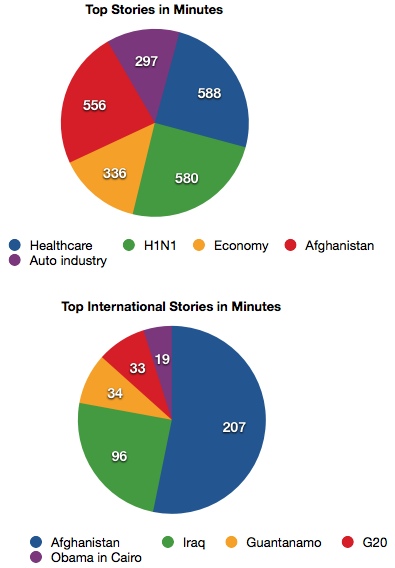
As the IPS noted this weekend, much can be learned about America’s news diet from the Tyndall Report’s review of 2009 which ranks the airtime given to various issues on the nation’s top three nightly half-hour news broadcasts.

So what were Americans watching? Health care reform and the H1N1 virus dominated the airwaves. Afghanistan received more coverage than Iraq for the first time since the invasion of Iraq (735 minutes to 169 minutes). The international focus was certainly on the Middle East as Israel and Palestine were given 132 minutes (102 of those during the siege of Gaza). Iran’s election and nuclear program was also a central international story with 194 minutes and Ethiopian piracy garnered a considerable amount of press with 112 minutes.
Continue reading “America’s nightly news: Watching us watching you”

Graphic History of the Honduran Coup, final part

Dan Archer, comics journalist and instructor at Stanford University, has the following to say about the final installment of his 3-part graphic history of the Honduran coup, which can be viewed below:

In the final part… I focus on piecing together the evidence of the repression that went mostly undocumented in the wake of the Nov 29th Honduran elections. Despite the media’s portrayal of a democratic transition to Porfirio Lobo’s inauguration as president a week ago, the de facto government’s use of violence and threats against resistance members should stand as an ominous augury, especially given its clear links to Lobo and his cabinet. Most troubling of all is the United States’ involvement under the banner of promoting ‘democracy,’ a term that is being increasingly used as a pretext for supporting a regime whose sympathies correspond to the American agenda (be it CAFTA or alarmist left-wing conspiracies), regardless of popular feeling or their worrying record of human rights abuses.”

Continue reading “Graphic History of the Honduran Coup, final part”

New York Times: No conflict of interest — with the conventional wisdom

by Robert Jensen

The New York Times’ public editor wrestled this week with conflict-of-interest charges sparked by the revelation that Jerusalem bureau chief Ethan Bronner’s son had joined the Israeli army.

The executive editor of the paper responded with a sensible defense of the paper’s decision to keep Bronner in that position.

Although it had the appearance of a spirited exchange, the “debate” was a tired old diversion that keeps us from facing more important questions, not just about the Israel/Palestine conflict but about U.S. journalists’ coverage of the world. As is typical in mainstream journalists’ discussions of journalistic neutrality and objectivity, the focus on an individual obscures more important questions about the institutions for which individuals work and the powerful forces that shape those institutions’ picture of the world.

The question posed by the Times officials is framed in the narrowest terms: Could Bronner maintain his neutrality and objectivity given those family circumstances, or was that indirect connection to one side of the war “still too close for comfort,” in public editor Clark Hoyt’s words. In his Sunday column, Hoyt described Bronner as a “superb reporter” but concluded that the paper should reassign him to avoid the appearance of a conflict of interest. Executive editor Bill Keller argued that such a policy would disqualify many reporters from assignments that draw on their specialized knowledge and diminish the quality of the reporting in the paper, and concluded there is no reason to reassign Bronner.

Continue reading “New York Times: No conflict of interest — with the conventional wisdom”