Colombia’s Wayuu: Still Holding on at the Top of the Continent

Wayuu children at Playa del Pilón de Azúcar, Cabo de la Vela, Colombia (Photo by Ken Kelley)

by Ken Kelley

Sitting for hours in the market of Uribia in the Colombian department of La Guajira, watching indigenous Wayuu women in long flowing dresses selling smuggled gasoline and other Venezuelan wares, I started to wonder if I would ever reach the tiny fishing village of Cabo de la Vela on the Guajira Peninsula.

I kept getting conflicting stories as to whether the truck for Cabo had already left and whether there would be another that day. I was almost ready to backtrack to the city of Riohacha when two more travelers appeared, followed by the truck, into which were then loaded all kinds of goods plus myself and the other passengers. We set off.

Located on the northernmost tip of South America, the arid Guajira Peninsula straddles the border of Venezuela and Colombia. Until recently, it was rarely visited by outsiders, due in part to its Wild West reputation as a hub for trafficking in humans, drugs, and other items, and as the home of the strong-willed Wayuu, who were never subjugated by the Spanish and who have lived on their own terms in the La Guajira desert for centuries.

Continue reading “Colombia’s Wayuu: Still Holding on at the Top of the Continent”

The Fight Continues

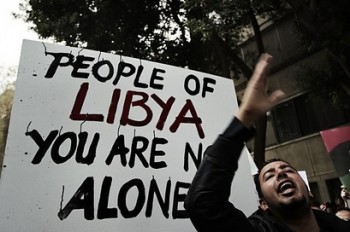
Xan Rice reports for the Guardian from besieged Misrata.

The resistance from the rebels – from all the people in Misrata – seems remarkable given their limited armoury and experience. That they have managed to keep Gaddafi’s forces to one side of the city seems a miracle, or at least a masterclass in guerrilla warfare.

At least a thousand have been killed in Misrata, 3000 are injured, and 300,000 huddle in a small section of the city away from the frontlines. Qaddafi’s forces are using sniper fire, heavy artillery and, Israel-style, illegal cluster bombs.

But there is some good news. This film shows the people of Misrata celebrating the recapture of a bank and insurance building. This film shows the people of revolutionary Nalut receiving news of the elimination of a Qaddafi commander. For those who tell us that Libya is split east-west, Nalut is in western Libya. According to the UN, 11,000 have fled Qaddafi’s attacks on Nalut for Tunisia in recent days. This film is from the western mountains. A revolutionary fighter announces the capture of ‘Libyan mercenaries’ – so-called because the regime bought them – and his plan to have them tried in Zawiya and Sabrata, the cities in which they committed their crimes, once freedom comes. Meanwhile, revolutionaries today captured the Wazin border crossing, forcing Qaddafi forces to surrender to Tunisian troops.

Tim Hetherington and Chris Hondros, R.I.P.

Two of the world’s best photojournalists, Tim Hetherington and Chris Hondros, were killed Wednesday in Misurata. They were part of a group of six photographers reporting on the Libyan conflict in a particularly dangerous part of the besieged city.

Rebel Workshop

The rebel army which John Pilger and other Western leftists tell us is a front for CIA.

Facing superior firepower on the battlefield, fighters seeking to overthrow Libyan leader Muammar Gaddafi are left renovating ageing, abandoned military hardware.

As the rebels refurbish old tanks and make launching systems from doorbells, they appeal for new weapons.

Al Jazeera’s Hoda Abdel-Hamid, reporting from Benghazi, has more from the rebels’ workshop.

Academic sanctions and global solidarity for Palestinian liberation: A view from South Africa

By Patrick Bond

Introduction

This panel is not only devoted to considering arguments about implementing the call for Boycott, Divestment and Sanctions (BDS) against Israel, but also about broader problems of progressive political positioning and backlash in the academy. Although I do not deal with the April 2 case of Richard Goldstone’s unprincipled U-turn on the findings of the United Commissions commission into Israel’s 2008-09 Gaza invasion, the incident suggests the extent to which South African commentary on the oppression of Palestinians has become acutely politicized. For if Goldstone’s return to his Zionist past – recalling, too, his past as a minor apartheid-era judge (hence as a human rights ally, his zig-zag unreliability, reliability and now unreliability) – serves any purpose aside from empowering Israeli militarists, it will be to compel us to use South Africa as a base from which critical inquiry into the condition of Palestine must now be intensified. Fortunately, just such an opportunity arises in the case of the University of Johannesburg faculty Senate’s decision on March 23 to support the Boycott, Divestment, Sanctions (BDS) struggle by breaking ties with Israel’s Ben Gurion University of the Negev.

Continue reading “Academic sanctions and global solidarity for Palestinian liberation: A view from South Africa”

Blankets, Dazzlement, Slander

This was published at Ceasefire Magazine.

The anti-imperialist left, in the West at least, is painfully divided over the NATO-led intervention in Libya. On the one hand, such commentators as Paul Woodward, Gilbert Achcar, Phil Weiss, and me, believe the intervention is the least worst option, that there was no better alternative. On the other hand, John Pilger, Mahmoud Mamdani and many others, are wary of a new Iraq and oppose Western intervention on blanket principle.

Both positions are legitimate. Although I disagree in this case, I’m very pleased that the general gut response – if we must work by gut responses – is against intervention. But unfortunately a number of lesser figures, emotional oppositionists of the sort who qualmlessly rearrange reality to fit their personal agendas, have wilfully ignored facts on the Libyan ground, and even stooped so low as to slander the revolutionary Libyan people.

Some say NATO is interfering in a civil war, that Libya is split between east and west, that Tripoli stands firm with Qaddafi. These people fail to understand the overwhelming unpopularity of Qaddafi’s capricious regime. In the first days of the revolution, the regime lost control of most areas in the west as well as the east, including suburbs of Tripoli. Protestors marching on Green Square (or Martyrs Square) were driven back by machine gun and artillery fire. Qaddafi is currently keeping the capital quiet by mass arrests, rooftop snipers, and roving jeeps of weapon-wielding thugs.

Some people describe the free Libyans are mere ‘so-called’ rebels. If they were real freedom-fighters, these people argue, they’d be able to take over the country without foreign help. Their acceptance of intervention proves them to be CIA stooges, agents of imperialism, traitors.

Continue reading “Blankets, Dazzlement, Slander”

Chase Madar: In defense of Bradley Manning

In this TomDispatch.com interview Civil rights attorney and PULSE contributor Chase Madar outlines the case against––and the defense on behalf of––the soldier who allegedly provided the documents for the latest WikiLeaks release as well as the now infamous “Collateral Murder” video, Private First Class Bradley Manning. Also, don’t miss Chase’s brilliant piece on Bradley Manning.

Three Cups of Hooey

UPDATE:Three Cups of Deceit‘, Jon Krakauer’s extensive expose of Mortenson is now available for download (but only for a brief time, so hurry). Also check out Nosheen Ali’s article from the Third World Quarterly on the Mortenson saga and the discourse of humanitarianism. (via Mike Barker)

Fellow PULSEr Chase Madar calls this Missionary Imperialism. Once a critic of Donald Rumsfeld, he notes, Greg Mortenson had taken to touring the US with Pentagon officials stumping for the Afghan effort, portraying it as a Peace Corps project that just happens to have 130k armed soldiers attached.

Continue reading “Three Cups of Hooey”

The US, Gulf Kings and Brutal Repression in Bahrain

The brutal repression of demonstrators by the US-backed monarchies continues.

Adam Hanieh: US policy in region based on Gulf Cooperation Council ability to suppress opposition