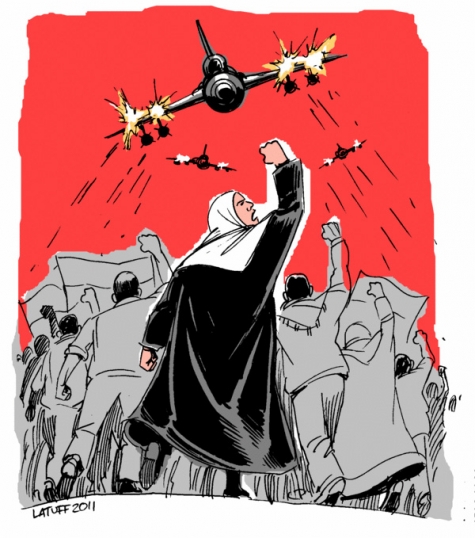
A Perfect Storm in the Arab World?

Middle East scholar Prof. Fawaz Gerges on the Arab revolt.

Regardless of the outcome of events in Egypt, for Arabs, psychologically and symbolically, this is their Berlin Wall moment. They are on the brink of a democratic wave similar to the one that swept through Eastern Europe more than 20 years ago, hastening the Soviet Union’s collapse. The Arab intifada has put to rest the claim that Islam and Muslims are incompatible with democracy. The democratic virus is mutating and will probably give birth to a new language – and a new era – of politics in the Arab world. Fawaz A. Gerges is a Professor of Middle Eastern Politics and International Relations at the London School of Economics and Political Science.

This event was recorded on 24 February 2011 in Sheikh Zayed Theatre, New Academic Building. It was chaired by Dr Maha Azzam.

Available as: mp3 (41 MB; approx 87 minutes)
Event Posting: A Perfect Storm in the Arab World?

Philip Weiss on the Arab Revolt

This is as good as talk radio gets. Our friend, the great Phil Weiss on Radio Open Source with Chris Lydon to discuss the implications of the Arab revolt and the changing discourse in the American Jewish community.

Information Wars

Information is power and in the age of the information revolution, cyber and satellite communication is transforming our lives, reinventing the relationship between people and power. New media, from WikiLeaks to Facebook, Twitter to YouTube, is persistently challenging the traditional flow of information, and cyber disobedience is exposing powerful governments. Websites are now being treated like hostile territories; whistleblowers and leakers as terrorists, and hackers as insurgents. Governments are scrambling to salvage their influence and take advantage of the new cyber and satellite media. From China to the Sudan, Egypt to Iran, despots and armies are tracking web activity and setting up Facebook accounts to spy on their citizens. So is this the century of free information and expression as the cyber utopians predicted, or new methods of electronic oppression as the cyber sceptics warned?

Pilger on Fascism and the Arab Revolt

Renowned journalist, author and filmmaker John Pilger writes today at Antiwar.com:

The revolt in the Arab world is not merely against a resident dictator but a worldwide economic tyranny designed by the US Treasury and imposed by the US Agency for International Development, the IMF and World Bank, which have ensured that rich countries like Egypt are reduced to vast sweatshops, with half the population earning less than $2 a day. The people’s triumph in Cairo was the first blow against what Benito Mussolini called corporatism, a word that appears in his definition of fascism.”

The article begins with Pilger’s 2003 interview with former elite CIA officer Ray McGovern. McGovern responds to Pilger’s question about Norman Mailer‘s assertion that America has entered a pre-fascist state:

Well … I hope he’s right, because there are others saying we are already in a fascist mode.”

Click to read the article in its entirety: “Behind the Arab Revolt is a Word We Dare Not Speak“.

The political power of literature

Can literature inspire revolutions? What role do artists and intellectuals play on the frontline of popular uprisings?

The Satan of Our History

Shahat city liberated. picture by Reuters

Latest from our freedom-loving friend in Tripoli:

I am in Tripoli, on the 24th February at 1pm. As I heard in the news this morning that Zawiya city is under attack, I called my friend in Zawiya to check. He confirmed to me that Zawiya city has been under ruthless and continuous attack since last night at around 2am. He also reported that around 8am there was very heavy gunfire and the sound of exploding bombs. He told me he was terrified because the gunfire didn’t stop the whole night. (An eye witness told al-Jazeera that at least 100 people have been killed in Zawiya this morning).

Minutes after my call with my friend, I received confirmed news that Misurata is under attack too by the so-called security forces, and a little girl along with many other injured people were brought to Misurata hospital.

Continue reading “The Satan of Our History”

Scandalously Done

picture by Carlos Latuff

Our witness in Tripoli writes:

At 2am I hear gunfire and screaming coming from far. Hours later, I heard that a woman was randomly shot by ‘security forces’ while she was standing by her window in an area called Zawiyat Adahmani, which is near the area of Ben Ashour, where I live.

Last night there were big celebrations around the streets and mainly in Green Square by the thug’s supporters (when 2 days ago almost 1000 martyrs were brutally killed). Following his threatening speech, anyone who walks in the streets of Tripoli by night will be cleared (killed) right away- exactly as he said. Right after the celebrations, non-Libyan mercenaries and some black Libyans (from the south) belonging to ‘kitaib khamis‘ (the Khamis Qaddafi Brigade) were spread all around Tripoli (there is a video taken proves mercenaries driving around the area of Fashloom- at least 8 open cars).

Continue reading “Scandalously Done”

This is an Arab 1848

by Tariq Ali

revolutionary murals in Cairo
Revolutionary murals on the walls of newly established toilet facilities for protesters in Cairo's Tahrir Square. Photograph: Ben Curtis/AP

The refusal of the people to kiss or ignore the rod that has chastised them for so many decades has opened a new chapter in the history of the Arab nation. The absurd, if much vaunted, neocon notion that Arabs or Muslims were hostile to democracy has disappeared like parchment in fire.

Those who promoted such ideas appear to the most unhappy: Israel and its lobbyists in Euro-America; the arms industry, hurriedly trying to sell as much while it can (the British prime minister acting as a merchant of death at the Abu Dhabi arms fair); and the beleaguered rulers of Saudi Arabia, wondering whether the disease will spread to their tyrannical kingdom. Until now they have provided refuge to many a despot, but when the time comes where will the royal family seek refuge? They must be aware that their patrons will dump them without ceremony and claim they always favoured democracy.

If there is a comparison to be made with Europe it is 1848, when the revolutionary upheavals left only Britain and Spain untouched – even though Queen Victoria, thinking of the Chartists, feared otherwise. Writing to her besieged nephew on the Belgian throne, she expressing sympathy but wondered whether “we will all be slain in our beds”. Uneasy lies the head that wears a crown or bejewelled headgear, and has billions stored in foreign banks.

Continue reading “This is an Arab 1848”

Voices

by Wislawa Szymborska

You scarcely move your foot when out of nowhere spring
the Aborigines, O Marcus Aemilius.

Your heel’s mired in the very midst of Rutulians.
In Sabines, and Latins you’re sinking up to your knees.
You’re up to your waist, your neck, your nostrils
in Aequians and Volscians, O Lucius Fabius.

These small peoples are thick as flies, to the point of irritation,
satiation and nausea, O Quintus Decius.

One town, another, the hundred seventieth.
The stubbornness of Fidenates. The ill-will of the Faliscans.
The blindness of Ecetrans. The vacillation of the
Antemnates.
The studied animosity of the Lavicanians, the Pelignians.
That’s what drives us benevolent men to harshness
beyond each new hill, o Gaius Cloelius.

If only they weren’t in our way, but they are,
the Auruncians, the Marsians, O Spurius Manlius.
The Tarquinians from here and there, the Etruscans from
everywhere.
The Volsinians besides. The Veientins to boot.
Beyond all reason the Aulercians. Ditto the Sapinians
beyond all human patience, O Sextus Oppius.

Small peoples have small understanding.
Stupidity surrounds us in an ever-widening circle.
Objectionable customs. Benighted laws.
Ineffectual gods, O Titus Vilius.

Mounds of Hernicians. Swarms of Marrucianians.
An insect-like multitude of Vestians, of Samnites.
The farther you go the more there are, O Servius Follius.

Deplorable are small peoples.
Their irresponsibility bears close watching
beyond each new river, O Aulus Junius.

I feel threatened by every new horizon.
That’s how I see the problem, O Hostius Melius.

To that I, Hostius Melius, reply to you,
O Appius Pappius: Forward. Somewhere out there the world
must have an end.

Wislawa Szymborska won the Nobel Prize for Literature for 1996. Poem courtesy of Andrew Bacevich.