Decency and Strength

by Kathy Kelly

A fire hazard mars natural beauty at Fort Carson

Here in Colorado Springs, student and community organizers recently invited me to try and help promote their campaign against a proposed “No Camping” ordinance, a law to ban the homeless from sleeping on sidewalks or public lands within the city limits.  The organizers insist it’s wrongful to criminalize the most desperate and endangered among us, that it instead seems quite criminal to persecute people already in need of far more care and compassion than we’ve been willing to offer, especially during these bitterly cold winter months.  But others in the area are intent on eliminating the tent encampments near the Monument Creek and Shooks Run trails, complaining that the encampments mar natural beauty, deter tourists, create fire hazards, and degrade the environment by strewing heaps of trash and debris near the creek and even in it.

It seems important for both sides of the argument to acknowledge other local encampments that Colorado Springs is home to: Fort Carson Army base, both Peterson and Schriever (formerly Falcon) Air Force Bases, Norad and Cheyenne Air Force Stations, and the U.S. Air Force Academy.  It’s not lost on opponents of the “No Camping” ordinance that stop-loss policies prevent many of the young men and women at these institutions from returning to their homes, where many of them long to be after repeated tours of military duty outside the United States.  For every soldier intent on strengthening his or her country’s military option, how many more are taking a last-ditch option, signing up for the famed “poverty draft,” to sustain themselves and their families through an economic crisis felt throughout the country and the world?   Many, though not all, of these young people have been driven by poverty into their encampments as surely as the Monument Creek campers have been driven into theirs.

Continue reading “Decency and Strength”

The Veil, Again

Yes, some women who cover their heads smile, too.

Some strands of feminism have a long history of serving as adjuncts of Western imperialism. Today they also enable domestic prejudice. Gore Vidal once mocked George Bush’s idea of democracy promotion as being synonymous with: ‘Be free! Or I’ll kill you’. In a similar vein, some feminists today want to ‘liberate’ Arab-Muslim women by constraining their freedoms. These women can’t possibly know what they really want, you see. The European feminists, like Bush, know what’s best for them. What could my sister — who studied at a co-ed university (in Peshawar!) but turned to wearing the hijab after moving to Canada — know about her interests? She must be told by the enlightened Westerner. She must be liberated.

Ignorance and racism combine in this potent form of messianism to sanction prejudice which increasingly targets Europe’s immigrant communities. Like the Orientalists of yore, this brand of feminism insists on seeing the brown or black woman in the subordinate role, wistfully awaiting a Westerner liberator. They are childlike, they must be protected in the same manner that a responsible parent protects an unruly nestling. They must be saved from the hijab, or — God forbid! — the veil. To protect their freedom of choice, their freedom to choose must be revoked.

Continue reading “The Veil, Again”

And they call this man eloquent…

‘The middle east is obviously an issue that has plagued… the region… for … centuries.’

It appears the word ‘occupation’ is not a part of this blathering milquetoast’s vocabulary. (Kudos to the courageous questioner, who, I am told, was Laila Abdelaziz of the University of South Florida.)

The person he reminded me most of was this:

Oprah’s Neoliberal Empire

Following on from last week’s discussion about the tyranny of positive thinking here is Janice Peck, author of the excellent The Age of Oprah: The Making of a Cultural Icon for the Neoliberal Era speaks about the place of Oprah Winfrey’s media enterprise in the last quarter century of U.S. culture and politics. The first interview was conducted by Bruce Dixon of Black Agenda Report, the latter by Bob McChesney of Media Matters. (Update: The first mp3 appears to have vanished from the internet. I have reproduced a transcript of Dixon’s interview with Peck below).

(Also don’t miss the excellent piece, ‘The selling of “Precious”‘ by Ishmael Reed.)

Janice Peck  Associate Professor at the University of Colorado, her research interests include critical theory, the relationship of media and society, the social meanings and political implications of mediated popular culture, communication history and theories of media and culture. She has also authored a book on the history and politics of religious television in the U.S.,The Gods of Televangelism: The Crisis of Meaning and the Appeal of Religious Television (1993).  She has published articles and book chapters on the theoretical and intellectual history of cultural studies, issues in media theory, the family and television, TV talk shows, Oprah’s Book Club and issues of literacy, religion and advertising, and representations of race in media.

Continue reading “Oprah’s Neoliberal Empire”

The Conquest of Cool II

Douglas Rushkoff was once an enthusiast of the revolutionary potential of cyberculture. During the ’90s the increasing conglomeration of the internet business led him to temper his enthusiasm. But I think his prophecies had more substance than he was given credit for. The internet truly came into its own with Web 2.0 technologies and from blogging to Twitter, its true democratizing potential is only now being recognized. It has already succeeded to a certain degree in holding MSM accountable, though it hasn’t quite levelled the playing field as some optimists like to imagine.

Like Neil Postman, however, an important aspect of Ruskhkoff’s work has been the effect of media and advertising on culture. Every other year I teach an undergraduate course in Globalization and Resistance in which I show students this excellent documentary which Rushkoff made for PBS’s Frontline. It illustrates the ersatz nature of alternative culture, the process of its manufacture, in a manner than leaves many of them flabbergasted. It also illustrates the feedback loop through which businesses steal from youth the fruits of their creativity, stamp it with their label, mass produce it, and then sell it to everyone else until it has lost its ‘cool’ — much as Thomas Frank argued in The Conquest of Cool. As the culture degenerates, the ideal female and male types are reduced to the ‘midriff’ and the ‘mook’. (According to the BBC, two-thirds of all teenage females in the UK aspire to be models). Youths, as Rushkoff shows in The Merchants of Cool, have become one of corporate America’s largest sources of revenue.

The Conquest of Cool I

When is dissent hip? This is the subject of the following discussion hosted by the excellent Your Call Radio. Participants include Douglas Haddow of Adbusters, whose article, ‘Hipster: The Dead End of Western Civilization‘, generated one of the longest running debates in the magazines history (the article presently records more than four thousand responses on the Adbusters website). Also participating are  Dan Sinker of Punk Planet, and journalist and hip-hop historian Davey D. They discuss: What is the relationship today between pop-culture, counterculture and dissent? What is the counterculture that sells media now? And can activists reclaim the counterculture that now permeates the mainstream?
The discussion is also joined later by Ishmael Reed and Thomas Frank, author of the splendid work The Conquest of Cool. In the book Frank (who also authored the classic What’s the Matter with Kansas? and edits The Baffler) shows that the advertising industry did not just co-opt the ’60s counterculture movement, in many respects it anticipated, indeed created, it. The instant-gratification individualism and the perpetual pursuit of uniqueness were the perfect compliments to capitalism’s manufacturing of needs to fuel the consumption on which it thrives. If capitalism had built planned obsolescence into its products,  the counterculture’s very idea of rebellion was premised on  ‘standing apart’. As soon as a new product was in the hands of more than one, it had lost its uniqueness, pushing the rebel to search for a new ticket to cool. Rebellion which seeks expression in merchandise manufactures its own needs, and the engines of capital obligingly hum along. Franks gives the example of the Volkswagen Beetle ads, which were all designed as a critique of mass culture. To own a Beetle, then, was to stand apart.  And the process continues as I’ll show in this series of three posts.

The Haitian Revolution

Even if you have been watching Democracy Now’s outstanding coverage of the Haitian tragedy, the despicable neglect with which the United States and other rich countries have treated the disaster-struck nation, you still can’t fathom the depth of outrage the Haitians feel unless you put it into the context of its tortured history. Here is an excellent overview from C. S. Soong’s Against the Grain.

It was a cataclysmic event, the first and only successful slave revolution in the Americas. In 1791 brutally exploited slaves on a small Caribbean island rose up and eventually won emancipation. Their story, a legacy that has inspired and instructed people and nations for centuries, is told in Laurent Dubois’s Avengers of the New World.

Worst decision since Dred Scott

The US Supreme Court has ruled that as a legal ‘person’ a corporation can spend unlimited amounts in an election campaign to elect its preferred candidates. The lax campaign financing rules already allowed lobby groups such as AIPAC to funnel massive amounts to candidates through individuals. Instead of reforming the system, as people like Ralph Nader have been demanding for years, the court further hacks away at democratic checks and balances. The ruling has been rightly compared to the Dred Scott case justifying slavery. Here is a clip of Robert Weissman summing up what consequences this might have for US democracy (to the extent that it exists) followed by a statement by Ralph Nader. (For Americans who want to save their democracy, here is a campaign they can join: http://www.movetoamend.org/. Also check out Public Citizen’s proposed action).

Continue reading “Worst decision since Dred Scott”

The Tyranny of Positivity

My friend’s childhood friend recently passed away after a painful bout with cancer. She was abandoned by her boyfriend because she was ‘too negative’ about her illness. A mutual friend of my friend’s also blamed the ailing woman for being too negative. If she couldn’t be positive about her disease, then she must in part have been responsible for her own decline. Or so the thinking goes.

If there is anything unique about this story, it is the nationality of the cast: they are Italian. In the United States, this is the norm. People who suffer from debilitating diseases are not only expected to endure the pain but also to put on a brave face. If they don’t, then friends can abandon them with a clear conscience. They just aren’t being positive, and hence are the architects of their own decline.

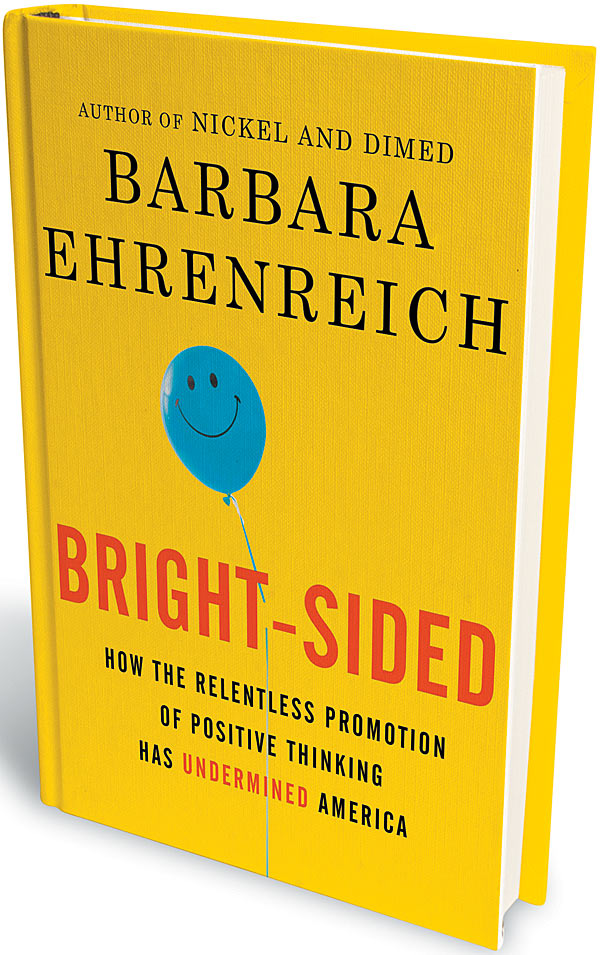
Positivity became the reigning attitudinal orthodoxy around the time of the ‘Reagan Revolution’, but it has its roots farther back in Calvinist theology. God rewards piety and hard work with success; failure, perforce, is evidence of sloth. Sidney Blumenthal once ironically summed up the mindset as ‘God takes most pleasure in people who are most pleased’. Reagan turned positivity into the central tenet of American civic religion. This also freed the New Right from the responsibility of caring for the destitute and vulnerable: if they aren’t doing well the fault must necessarily lie with them. It has come to a point, notes Barbara Ehrenreich in this excellent interview on Media Matters, that even people who lose their jobs are expected to be positive about it. Since a negative attitude will merely prove that their dismissal was justified.

As for illness, Tony Judt ends a recent essay about the torment of enduring nights while suffering from ALS thus: ‘Loss is loss, and nothing is gained by calling it by a nicer name. My nights are intriguing; but I could do without them.’


Continue reading “The Tyranny of Positivity”