From “Islamist Watch” to Islamic Mimbar: the Politics of Hypocrisy

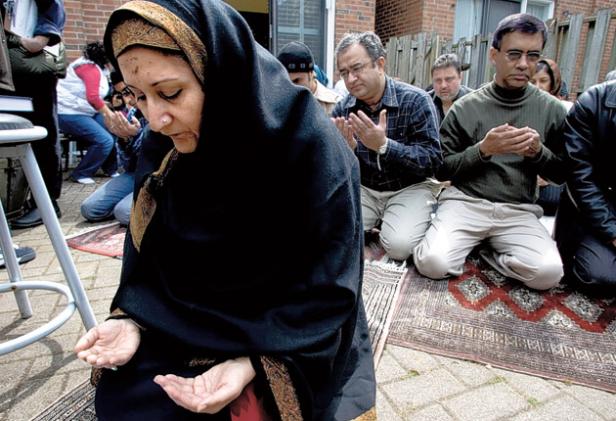
Raheel Raza leads a group of Muslims in prayer in Canada

By Huma Dar

On Thursday, June 10, 2010, Jerome Taylor, the Religious Affairs Correspondent of The Independent posted an article headlined, “First Woman to Lead Friday Prayers in UK.” Two-thirds of the way down this article, we find that:

“Ms Raza’s appearance in Oxford is a repeat of a similar prayer session in 2008 which was led by Amina Wadud, an American-born convert and Muslim feminist. But this is the first time a Muslim-born woman will lead a mixed prayer service in Britain.”

Continue reading “From “Islamist Watch” to Islamic Mimbar: the Politics of Hypocrisy”

US Drones and the Politics of Body Count

News organizations need to be careful about their sources. They appear to report as fact claims made by any entity that calls itself an ‘institute’ or a ‘foundation’. This otherwise commendable report from Russia Today on the murderous US drone attacks is no exception. Like many other media outlets (including, oddly, Democracy Now and Al Jazeera) it reports as fact a dubious report produced by the New America Foundation (NAF), a leading cheerleader for the wars in Afghanistan and Pakistan, which has transmuted the drones 98% failure rate into a 67% success rate. None of these media outlets it appears has taken a minute to study the report’s methodology or question the motivations of the organization behind it. The conflicts of interest are serious.

The NAF report is based exclusively on English language media reports, which rely solely on official claims. The officials, both American and Pakistani, for their reasons have an interest in inflating the success rate. Two studies produced by Paksitan’s The News and Dawn (the latter a supporter of the war) show that that the actual success rate is near 2 percent. This estimate has also been endorsed by David Kilcullen, the former senior advisor on counterinsurgency to Gen. David Petraeus. (In response NAF’s ‘Afpak Channel’ published this airy assessment by Christine Fair challenging Kilcullen which relies on yet another ‘institute’, the ‘Aryana Institute’, a sectarian paper organization which actually claims that Pakistanis are thrilled by drone attacks!)

NAF’s ‘Afpak Channel’, which produced the report, discredited itself long ago with its overly rosy assessment of the situation in Afghanistan and Pakistan. And while it has been featuring commentary which is frequently at odds with reality, it has been reluctant to publish anything that might undercut its sanguine support for the war. It sat on a grim assessment of developments in Afghanistan by IPS’s excellent investigative journalist Gareth Porter before informing him that it won’t be published. Its Twitter frequenlty features juvenile commentary, breathlessly sanguine about US successes in Afghanista and Pakistan. Over all, it is a highly questionable source. I’d urge journalists to show more caution.

UPDATE: Don’t miss this important interview with Kathy Kelly who has just returned from Pakistan and Afghanistan.

Continue reading “US Drones and the Politics of Body Count”

The world cup of economic and military warfare

By Kathy Kelly and Joshua Brollier

Bike Shop near Charikar, Afghanistan

June 2, 2010, Islamabad — “Our situation is like a football match. The superpower countries are the players, and we are just the ball to be kicked around.” This sentiment, expressed by a young man from North Waziristan, has been echoed throughout many of our conversations with ordinary people here in Pakistan and in Afghanistan. Most are baffled that the United States, with the largest and most modern military in the world, can’t put a stop to a few thousand militants hiding out in the border regions between Pakistan and Afghanistan.

Just about everyone we have spoken with, Pashtuns included, has little to no sympathy for the Taliban or their tactics. Many people have lost limbs, homes and loved ones to the brutal assaults of suicide bombers or the indiscriminate violence of IEDs. Yet, people expressed frustrated confusion over uncertainties regarding U.S. government goals in relation to the Taliban. Some believe that the United States might be working with the ISI (Pakistani Intelligence Services) or at least not working against them, to enable continued Taliban resistance. If there is no resistance, according to this view, a military presence in the region cannot be justified. Nor can a so-called humanitarian presence further flood the Pakistani and Afghan economies with millions of dollars in aid that most often lines the pockets of the politicians, elite bureaucrats, and United States corporations involved in construction and security.

Continue reading “The world cup of economic and military warfare”

Unarmed and Courageous: Emergency Workers in Afghanistan

by Kathy Kelly and Josh Brollier

June 1, 2010

Emergency crew goes to work in Panshjir

For six days in late May, 2010, Emergency, an Italian NGO providing surgery and basic health care in Afghanistan since 1999, welcomed us to visit facilities they operate in the capital city of Kabul and in Panjshir, a neighboring province. We lived with their hospital staff at both places and accompanied them in their weekly trips to various FAPs (First Aid Posts) which the hospitals maintain in small outlying villages.

One morning, accompanying a field officer from the Kabul hospital, we pulled off of the main road and traveled over unpaved lanes, then walked a short distance to a shady grove outside a small Afghan village. Villagers, eager to welcome Emergency’s staff and drivers, served ripe mulberries and a salty cucumber yogurt drink. We sat in a circle, shaded by the trees. When breezes stirred the branches, we’d enjoy a momentary rain of mulberries, much to the amusement of little children nearby.

Continue reading “Unarmed and Courageous: Emergency Workers in Afghanistan”

Suicide Bombers

The Riz Khan show asks what motivates a person to sacrifice their own life in order to kill others. There are sensible answers from the venerable Robert Pape, Director of the Chicago Project on Security and Terrorism and author of Dying to Win: The Strategic Logic of Suicide Terrorism, and much twaddle from Farhana Ali, a particularly clueless terrorologist. If this stupid woman is serving as a ‘senior instructor for the US Afpak team’, then God help America and God help the people of ‘Afpak’. (I suspect Pape was thinking the same. His laughter at the end of the interview was eloquent).

Atrocities in Afghanistan: A Troubling Timetable

by Kathy Kelly and Dan Pearson

Photo: Paula Bronstein/Getty Images

Peace activists can hasten an end to the U.S. war in Afghanistan by demanding a timetable for U.S. military withdrawal. [A bill in the U.S. Congress] introduced by Representatives McGovern and Jones, requires such a timetable. In the Senate, a similar bill has been introduced by Senator Feingold. Arguments in favor of a timetable for withdrawal of U.S. forces from Afghanistan should include readiness to examine disturbing patterns of misinformation regarding U.S./NATO attacks against Afghan civilians.

It is worth noting that even General McChrystal acknowledges that U.S. forces have killed civilians who meant them no harm. During a biweekly videoconference with US soldiers in Afghanistan, he was quite candid. “We’ve shot an amazing number of people and killed a number and, to my knowledge, none has proven to have been a real threat to the force,” said General McChrystal. “To my knowledge, in the nine-plus months I’ve been here, not a single case where we have engaged in an escalation of force incident and hurt someone has it turned out that the vehicle had a suicide bomb or weapons in it and, in many cases, had families in it.”

Those families and individuals that General McChrystal refers to should be our primary concern. We should try to imagine the sorrow and horror afflicting each individual whose tragic story is told in the “timetable” of atrocities committed against innocent people. How can we compensate people who have endured three decades of warfare, whose land has been so ravaged that, according to noted researcher Alfred McCoy, it would cost $34 billion dollars to restore their agricultural infrastructure. We should notify our elected representatives that the $33 billion dollar supplemental funding bill sought by the Obama administration to pay for U.S. wars in Afghanistan and Iraq could be directed toward helping Afghanistan replant its orchards, replenish its flocks, and rebuild its irrigation systems. We should insist on an end to atrocities like those which follow.

Continue reading “Atrocities in Afghanistan: A Troubling Timetable”

Pakistan: A new wave of attacks?

This is a video of my appearance on Al Jazeera’s Inside Story. For context, I’d encourage viewers to read my articles in Political Insight and Le Monde Diplomatique.

The Pakistani Taliban have claimed responsibility for an attack on the US consulate in Peshawar on Monday. Is Pakistan paying the price for battles waged by the United States in the region?

From the Front Line: Insurgent Pakistan

This article appeared in the Political Studies Association‘s excellent new publication Political Insight.

by Muhammad Idrees Ahmad

No nation has ever made a frank avowal of its real imperial motives. It always claims to be primarily concerned with the peace and prosperity of the people whom it subjugates. — Reinhold Niebuhr

The ironies of US President Barack Obama’s Nobel acceptance speech in Oslo were widely noted. Not since Theodore Roosevelt had a Nobel laureate used the acceptance ceremony to make a case for war. Both men appealed to St Augustine’s authority to support the justness of their cause. However, when Roosevelt spoke he had already concluded the peace for which he was honoured; Obama’s lies distant in the purgatory of  ‘hope’. In the present he remains at war — as Henry Kissinger was, when he picked up his prize — having recently ordered the second major escalation of his brief presidency. Kissinger’s war simmered on for two more years; Obama’s will likely last longer.

Afghanistan may well become Obama’s Vietnam, but his diversion is not Cambodia, or Laos, it is nuclear-armed Pakistan. History sometimes repeats itself both as tragedy and farce.

Weeks before Obama described al-Qaeda as a threat on a par with Nazi Germany, national security adviser, General James Jones, told CNN that the organisation had fewer than a hundred men in Afghanistan. Driven by institutional inertia and vulnerable to the charge of weakness, Obama appears unable to disengage. Instead he has borrowed Bush’s rhetoric of good and evil and joined the fear factory. He has subsumed al-Qaeda and the Taliban into a singular threat of global proportions whose defeat he pronounced ‘fundamental to the defense of our people’. Afghanistan, he argued,will not be pacified until the Taliban’s allies in Pakistan are vanquished. Precipitate withdrawal will restore the Taliban to power, and create a safe haven for al-Qaeda to plan more terrorist attacks on the west.

Continue reading “From the Front Line: Insurgent Pakistan”

Pacified

by Kathy Kelly

If the U.S. public looked long and hard into a mirror reflecting the civilian atrocities that have occurred in Afghanistan, over the past ten months, we would see ourselves as people who have collaborated with and paid for war crimes committed against innocent civilians who meant us no harm.

Two reporters, Jerome Starkey (the Times UK), and David Lindorff, (Counterpunch), have persistently drawn attention to U.S. war crimes committed in Afghanistan. Makers of the film “Rethinking Afghanistan” have steadily provided updates about the suffering endured by Afghan civilians. Here is a short list of atrocities that have occurred in the months since General McChrystal assumed his post in Afghanistan.

December 26th, 2009: US-led forces, (whether soldiers or “security contractors” (mercenaries) is still uncertain), raided a home in Kunar Province and pulled eight young men out of their beds, handcuffed them, and gunned them down execution-style. The Pentagon initially reported that the victims had been running a bomb factory, although distraught villagers were willing to swear that the victims, youngsters, aged 11 – 18, were just seven normal schoolboys and one shepherd boy. Following courageous reporting by Jerome Starkey, the U.S. military carried out its own investigation and on February 24th, 2010, issued an apology, attesting to the boys’ innocence.

Continue reading “Pacified”
The genius of an oeuvre is measured by the breadth of its message – Avatar as not “just another war movie”

by Kim Bizzarri

Following last night’s choice of the Oscars’ jury to award Katherine Bigelow’s The Hurt Locker with the Best Picture prize, the debate has since then moved to the pubs and the ether. It appears to be primarily concerned with whether Bigelow’s portrait of “the” war does justice to the genre and whether, with time, Avatar will come to be recognised as more deserving of the aspired title. The debate however is having the effect of reducing Cameron’s gargantuan critique of modernity to “just another war movie”, adding to the already popular dismissal of the film, by the intellectual left, as a western guilt-fantasy. 

Lets start by considering the assumption that Avatar is “just another war movie”.  

If indeed we accept that Cameron’s intention was to provide us with a science-fictional portrait of war, then we must also conclude that von Trier’s Dogville is nothing more than an aesthetically minimalist representation of the Great Depression. Just as von Trier exploits the Great Depression as a historical backdrop against which he develops a provocative portrayal of human nature, so does Cameron in the use he makes of military intervention in Avatar.  

Continue reading “The genius of an oeuvre is measured by the breadth of its message – Avatar as not “just another war movie””