The Passion of Bradley Manning

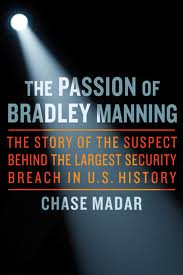
Essayist, lawyer, and PULSE contributor Chase Madar’s much-awaited book The Passion of Bradley Manning: The Story of the Suspect behind the Largest Security Breach in U.S. History is out this month from O/R Books.

The following is an excerpt from Kelly B. Vlahos’ recent review of the book at Antiwar.com:

It might be too easy to invoke Manning as martyr two days after Palm Sunday, when Christians observe the betrayal, humiliation and crucifixion of Jesus Christ two thousand years ago. While it is not our intention to compare Manning to the Christian Son of God, who according to Gospel, rose from the dead, humanity’s sins forgiven, on Easter Sunday, author Chase Madar lays out a deft argument that Manning has indeed sacrificed everything for his country’s sins in his aptly entitled new book, The Passion of Bradley Manning.

“I wanted to write a full-out defense of his alleged deeds — a political and moral defense,” Madar told Antiwar.com in a recent interview. And he has. As Madar points out, there are “many people in history who have died and sacrificed for their cause.” The Passion makes an industrious case that Manning did what he did for a cause: to give the people the information they need and deserve about what their government is doing in their name. Transparency — Robin Hood style.

“What I find remarkable and praiseworthy is, he was not — despite having this terrible time getting bullied and messed with constantly — leaking these things to get revenge,” Madar said. “He was a true believer in patriotic duty and military service, I think. If you look at the chat logs, he was very clear about his motives for leaking, that this was what the public should know, so that we as a country could make better decisions.”

Continue reading “The Passion of Bradley Manning”

#trashthestache: an unabashedly—but deservedly—fawning review of The Imperial Messenger

by Steve Marlowe

This is an excerpt from a review, published at Chapati Mystery, of The Imperial Messenger: Thomas Friedman at Work. Click here to read the review at CM.

More sophisticated readers of the New York Times’ editorial pages have, for years, fumed at Thomas Friedman’s inane musings. Even less sophisticated readers, some of which write book reviews and essays for online magazines named after mysterious flatbreads, have bristled at Friedman’s claims, prose and weak reasoning.

There are times, in fact, that one might suspect the Times’ Editorial Board is putting Friedman over on the public as some sort of Onion-style goof, a la Jackie Harvey.

Some readers have an automatic, visceral dislike of his face, alone: the suburban-mall Glamour-Shots photograph accompanying his crimes against logic calls for snarky comment; in it, he appears smug, self-satisfied and eager to be taken as the thinker of deep thoughts that, in The Imperial Messenger: Thomas Friedman at Work, Belen Fernandez proves he is not.

Continue reading “#trashthestache: an unabashedly—but deservedly—fawning review of The Imperial Messenger”

Verso competition: Win the Counterblasts series and more

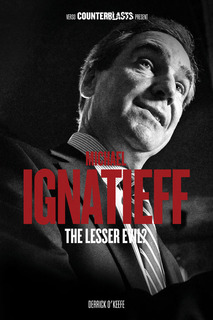
Visit the Verso website today to participate in a contest to win the Counterblasts series (consisting of The Imperial Messenger: Thomas Friedman at Work by Belén Fernández, The Impostor: BHL in Wonderland by Jade Lindgaard and Xavier de la Porte, and Michael Ignatieff: The Lesser Evil? by Derrick O’Keefe), plus Britain’s Empire: Resistance, Repression and Revolt by Richard Gott and Liberalism: A Counter-History by Domenico Losurdo.

The contest consists of three questions, the first one being:

Which of these is a genuine Friedmanism?

A. “Syria has come to a fork in the road to Damascus. Whichever road it takes, let’s hope it’s not the road not taken.”

B. “In China today, Bill Gates is Britney Spears. In America today, Britney Spears is Britney Spears-and that is our problem.”

C. “Looking for dignity in all the wrong places, Egypt takes step backward after shooting itself in both feet.”

Arab Writers at the Book Cafe

I was on BBC Radio Scotland’s Book Cafe talking about writing from the Arab world at this revolutionary time. Here it is:

I mention novelist Manhal al-Sarraj’s immediate response to the repression in Syria, ‘Syrian Scenarios’, which can be read here.

Adam of Lost Eden

by Najeeb Mubarki

(This article first appeared in The Economic Times, May 19, 2007, while the Palestinian poet, Mahmoud Darwish, was still alive.  Darwish was born exactly seventy-one years ago in the Western Galilee village of al-Birwa on March 13, 1941.)

Mahmoud Darwish (13 March 1941 – 9 August 2008)

In his 2004 film Notre Musique [Our Music], a journalese-philosophical meditation on war and reconciliation, Jean-Luc Godard gave pride of place to Palestinian poet Mahmoud Darwish. In the film, repeating what he had once told an Israeli journalist, Darwish inverts the relationship with the ‘other’: “Do you know why we Palestinians are famous? Because you are our enemy. The interest is in you, not in me…” By saying that he was important because Israel is important Darwish wasn’t just referring to the erasure of identity and history the Palestinians have had to struggle against, but perhaps more to the continuum of suffering, of that erasure, that has been passed down, as it were, to the Palestinians by the Jews. Not that Darwish now needs to affirm his self as an inversion of his ‘enemy’, or that he needed a Godard to affirm his being. In fact, it is quite the other way round, he was in the film because one cannot make a film on reconciliation without him, and his is a poetry of love, loss, of memory and exile that is more a challenge to the occupier than slogans and bombs ever can be.

Continue reading “Adam of Lost Eden”

Reading Sebald

by Manash  Bhattacharjee

G. W. Sebald  (1944-2001)
G. W. Sebald (1944-2001)

World, take a backseat.
Do not disturb.
I am reading Sebald.
Hush.

Trees with eyes flit by
My blind face.
I hurriedly drink
Evanescence.

Continue reading “Reading Sebald”

Book excerpt–Michael Ignatieff: The Lesser Evil?

The following excerpt is from Derrick O’Keefe’s Michael Ignatieff: The Lesser Evil?, recently released by Verso as part of its Counterblasts series. The book has been described as a “forensic critique of the influential liberal [and] his opposition to fundamental human rights, the extension of democracy and the pursuit of economic equality”.

The excerpt deals with Ignatieff’s initial cheerleading for the war on terror.

Click here to read a new interview with O’Keefe at the New Left Project.

It would be wrong to treat Ignatieff’s judgment on Iraq merely as “a mistake.” In fact, it flowed inexorably from his near-total identification with U.S. military power. In Empire Lite (2003), Ignatieff takes up an old family business — propagandizing for imperialism. Lamentably, the good old days of his great grandfathers Nicholas Ignatieff and George Monro Grant were long gone, but the great-grandson still came out swinging: “Imperialism used to be the white man’s burden. This gave it a bad reputation. But imperialism doesn’t stop being necessary just because it becomes politically incorrect.”

Empire Lite is heavy on these sorts of pithy, in-your-face, politically incorrect phrases. No effete, overly intellectual constructions from this teller of hard truths. Ignatieff sought to rouse the complacent American liberal conscience to its historical duty.

America’s entire war on terror is an exercise in imperialism. This may come as a shock to Americans, who don’t like to think of their country as an empire. But what else can you call America’s legions of soldiers, spooks and Special Forces straddling the globe? These garrisons are by no means temporary. Terror can’t be controlled unless order is built in the anarchic zones where terrorists find shelter.

There were plenty of new battles to be fought — weak-kneed fools be damned. And the new rationales for military intervention that Ignatieff and others had been road-testing in the 1990s were more sought-after commodities than ever before. Newly ensconced at Harvard, Ignatieff was well positioned to be in the frontline of the battle of ideas over the war on terror.

In the early days after 9/11, Ignatieff was quick to stake out a hawkish position, writing in the Guardian that the terror attacks on the United States were an act of “apocalyptic nihilism,” outside the realm of politics. Those who believed that “the terrorists’ hatreds must be understood, and that what they hate must be changed so that they will hate no more” were dismissed as naïve and foolhardy. “Since the politics of reason cannot defeat apocalyptic nihilism, we must fight,” he thundered.

Continue reading “Book excerpt–Michael Ignatieff: The Lesser Evil?”

Out Of It

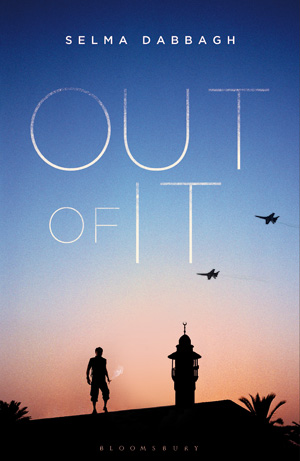
This review appeared in the Guardian.

The Mujaheds, if somewhat more privileged than their neighbours, are a typically itinerant Palestinian family who have learnt to attach sentimental value “only to the small things, the ones that could be thrown into suitcases and scurried away with.” Originally from Jaffa, now returned from Tunis, Beirut and Scandinavia, the novel’s opening finds them living in Gaza in the early years of the second intifada.

One of the many strengths of Selma Dabbagh’s writing is its unerringly precise sense of place. Gaza, imagined from inside with the mental aid of satellite images, is “like dried-out coral, ridged, chambered and sandy.” It contrasts with Israel, “the other side, that side, the place they came from, that had been theirs,” which, studded by solar panels, swimming pools and irrigated fields, looks from above like “an elaborate blanket of modernist design.”

Life in the Mujahed apartment, between the noise of nearby families and the louder noise of warplanes and helicopters, may be like “camping under a flyover”, but it’s better than living in tents as the neighbours – refugees from house demolitions – are forced to do.

The details of dispossession and siege are relentlessly accumulated: the rotting flowers and fruit blocked off from the market by the ‘closure’, the targetted killings, incursions and arbitrary arrests, as well as the increasingly violent internal competition between the religious parties and the corrupt Palestinian Authority whose luminaries are “yearning for cheap suits and desks with name plaques.”

Continue reading “Out Of It”

Re-Membering Toba Tek Singh: Looking for Manto

Between works censored for “obscenity” and those pirated and then censored for nationalism, which censorship is more obscene?

by Huma Dar

Sa'adat Hasan Manto
Sa’adat Hasan Manto

In today’s edition of Dawn.com, Jan 1, 2012, the renowned feminist poet, Fahmida Riaz has an article, “Understanding Manto,” about Urdu literature’s enfant terrible, Sa’adat Hasan Manto.  This year will mark Manto’s birth centenary.  Thank you, Fahmida Apa, for writing this moving tribute!  Sad indeed is the day when Pakistan cannot or does not publish Manto’s work, uncensored, unedited.  Despite justified indignation, knowing our “guardians of morality and piety,” it aches my heart to confess, I am not surprised.

Ironically, the “Indian pirated edition”—even if we overlook the immense ethical difficulties with the issue of piracy, and the direly-needed resources that were (and are) thus withheld from Manto and his family—is still no guarantee of accessing the “original, uncensored text.”  Christine Everaert in her book, Tracing the Boundaries between Hindi and Urdu: Lost and Added in Translation (Brill, 2009) painstakingly records many elisions, omissions, and additions in just a few of Manto’s stories as they’re carried from their original Urdu to the [pirated] Hindi versions.  Some of these transformations are, of course, to ease the transmission of the literary register in Urdu to Hindi; others to simply make things more palatable for Indian nationalism.  (Please especially see the Chapter II of this book for many examples…)

Sarmada

A slightly shorter version of this review appeared in The Independent.

Places have moods, this novel reminds us. Sometimes Sarmada, a mountain village rising from the Hauran plain of southern Syria, is all “oblivion, dust and tedium”; at other times it’s a shimmering delight, each rock, tree, spring, cliff and cave owning rich meanings and histories. Sarmada is also “a Sheherazade”, a generator of tales, so many tales we can’t possibly hear them all. “I thought about telling her the joke about the overweight fortune-teller,” Azzam writes, “but..”

Like the Arabian Nights, “Sarmada” contains stories within a frame story. The frame and trigger is a meeting with Azza Tawfiq, an expert in chaos theory at the Sorbonne who (following the Druze tenet of transmigration) believes she lived in Sarmada in a past life as a murdered girl called Hela Mansour. Bemused, disbelieving, the narrator returns from “chasing dreams in Paris and delusions in Dubai” to excavate the village’s memories, at first on Azza’s behalf.

Continue reading “Sarmada”