A Passport Of The Country Without A Post Office

The genocide in Kashmir is not over yet, but the land fertilized by the blood of innumerable, amaranthine martyrs is blossoming bouquets of tulips and roses in quick succession. New possibilities of spring, of poetry, of Azadi, of freedom, of peace are here, and they are unstanchable. I wish you were here, Shahid: Beloved, Witness, and perhaps with the slip of tongue, even Shahd, or Honey.

by Huma Dar

Passport to The Country Without A Post Office

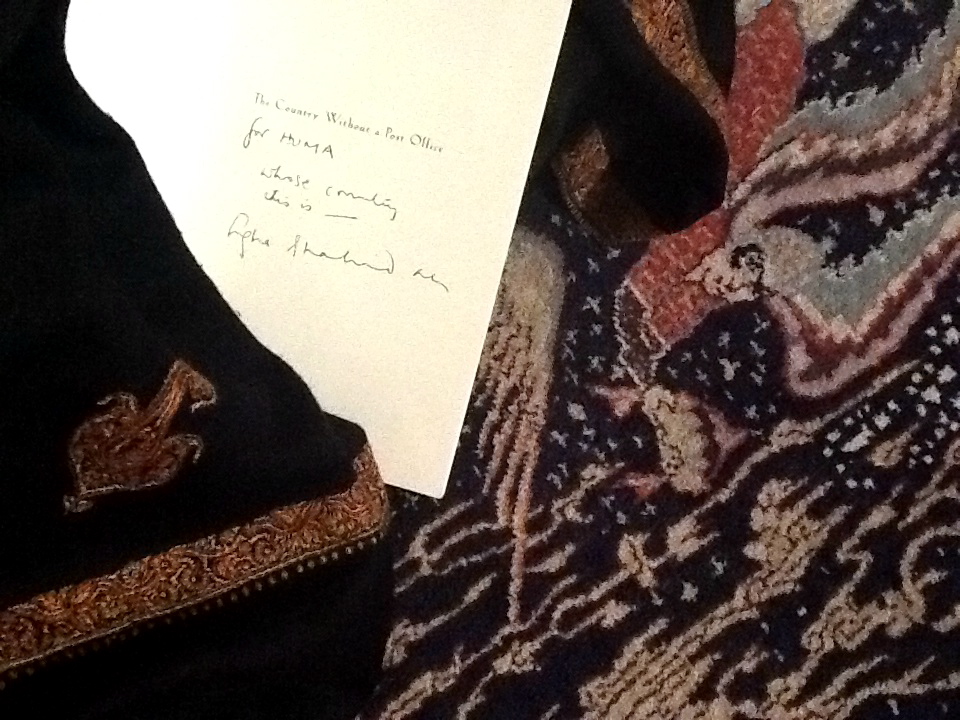
I met Shahid between noon and one pm, in the Lipman Room of Barrows Hall, almost exactly thirteen years ago, on December 3, 1998.  He’d come to recite from The Country Without A Post Office (1997) for the Lunch Poems Reading Series at UC Berkeley.  His jokes, tinged with a very particular Kashmiri black humor — irreverent, risqué, ridiculous — mirrored my family’s wacky one.  All that heartache about Kashmir, finding not many kindred souls around, found solace in Shahid’s scriptured lament, “After the August Wedding in Lahore, Pakistan.”

A brigadier says, The boys of Kashmir
break so quickly, we make their bodies sing,
on the rack, till no song is left to sing.
“Butterflies pause / On their passage Cashmere –”
And happiness: must it only bring pain?
The century is ending.  It is pain
from which love departs into all new pain:
Freedom’s terrible thirst, flooding Kashmir,
is bringing love to its tormented glass.
Stranger, who will inherit the last night
of the past?  Of what shall I not sing, and sing?

Continue reading “A Passport Of The Country Without A Post Office”

Aftermath

The first issue of Critical Muslim, a quarterly magazine in book form co-edited by Ziauddin Sardar and me, will be in the shops in January. More on that at a later date. Today I’m finishing off a long essay on Syria, Iraq and sectarian hatred for Critical Muslim’s third issue. Amongst the books I review in the essay are Fanar Haddad’s indispensable “Sectarianism in Iraq” and Nir Rosen’s “Aftermath: Following the Bloodshed of America’s Wars in the Muslim World,” which is also indispensable, in a different way. As a taster, here’s the section on “Aftermath.”

For a mix of contextual analysis and gripping reportage, the reader will find no better book than Nir Rosen’s magisterial “Aftermath: Following the Bloodshed of America’s wars in the Muslim World”.

Most Western correspondents were flown into Iraq unable to speak Arabic, largely ignorant of the context, to pass their time attending coalition press briefings or embedded with the US military. Their reports were heavy with simplistic labels (‘the Sunni triangle’, for instance) and ignored non-sectarian nationalism and class issues. Rosen’s writing on Iraq is the polar opposite of such parachute journalism. He speaks Arabic for a start, and blends in physically as a result of the “melanin advantage” bequeathed by his Iranian father. More to the point, he is courageous and energetic, going where few outsiders would dare, whatever their skin tone. He’s a reporter of the best kind, capable of locating pattern behind the copious detail. So he doesn’t merely report the mosque sermons he attended, or his encounters with militiamen and their victims, but accurately interprets and reads between the lines. His descriptions of time, place and personality are vivid, with not an ounce of orientalism added. His lack of sentimentality combined with his obvious sympathy for the people of the region make him the perfect candidate to voyage into the sectarian heart of darkness.

Continue reading “Aftermath”

Stranger Magic

This review appeared in the Guardian.

The Arabian Nights (or the Thousand and One Nights, or the Arabian Nights Entertainments – there are so many versions) constitute, in Marina Warner’s words, “a polyvocal anthology of world myths, fables and fairytales.” The antecedents of these Arab-Islamic texts are Quranic, Biblical, Indian, Persian, Mesopotamian, Greek, Turkish and Egyptian. In them, oral and written traditions, poetry and prose, demotic folk tales and courtly high culture mutate and interpenetrate. In their long lifetime the Nights have influenced, amongst many others, Flaubert, Wilde, Marquez, Mahfouz, Elias Khoury, Douglas Fairbanks and the Ballets Russes.

The frame story, in which Shahrazad saves her life by telling King Shahryar tall tales, is only one such ransom. More than simple entertainment, then: throughout these stories within stories, and stories about stories, and stories metamorphosing like viruses, endlessly generative, narrative even claims for itself the power to defer death.

Continue reading “Stranger Magic”

Blue Nights: a conversation with Joan Didion

Christopher Lydon of the excellent Radio Open Source speaks to Joan Didion, one of the greatest non-fiction writers and prose stylists of the past half century, about her latest book Blue Nights. The book is a follow-up to her acclaimed The Year of Magical Thinking; both are meditations on death inspired by the death of her husband, the author John Gregory Dunne, closely followed by the death of her adopted daughter Quintana.

Joan Didion is reading from her second smashing meditation on death, Blue Nights. And I’m her interlocutor and foil again onstage in Cambridge. With a woman of the considered written word, not the spontaneous spoken word, it’s a tricky job. And it didn’t solve for me the puzzle of Didion’s power. But how could I not share it, or you not respond?

Joan Didion’s a writers’ writer gone suddenly, in her seventies, rock star and phenomenon, meeting a hungry market for introspections on death both sudden, as in the case of her husband John Gregory Dunne and Didion’s 2005 best-seller, The Year of Magical Thinking; or slow and almost unfathomable death, which came to Didion’s adopted daughter Quintana Roo, at 39, and prompted Blue Nights. Six hundred readers bought books and tickets to hear Didion and pack the First Church in Harvard Square last night.

Continue reading “Blue Nights: a conversation with Joan Didion”

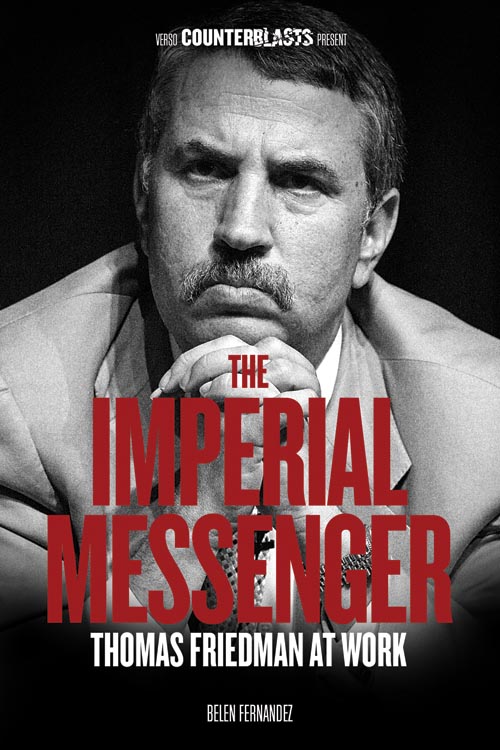
Jadaliyya interview with Belén Fernández

Jadaliyya recently interviewed PULSE co-editor Belén Fernández about her book The Imperial Messenger: Thomas Friedman at Work, to be released by Verso Nov. 7. The interview appears in Jadaliyya’s New Texts Out Now (NEWTON) section and includes an excerpt from the book. The following is the start of the interview:

Jadaliyya: Why did you write this book?

Belén Fernández: I asked myself this question several thousand times, particularly during my third rereading of every Friedman column published since 1995.

The idea for the book came about in a far less climactic fashion than Friedman’s ideas tend to occur—i.e. it did not involve “Quarter-Pounder[ing] my way around the world,” being struck by a “bolt out of the blue that must have hit somewhere between the McDonald’s in Tiananmen Square in Beijing, the McDonald’s in Tahrir Square in Cairo and the McDonald’s off Zion Square in Jerusalem,” and unfurling the Golden Arches Theory of Conflict Prevention, according to which American fast food is the key to world peace.

Rather, in May of 2009, following a four-month hitchhiking trip through Colombia, Ecuador, and Venezuela, I returned to Buenos Aires, where my parents were living at the time. Though up to that point I had been blessedly sheltered from the phenomenon that is Thomas Friedman and had only read a smattering of his dispatches over the years, he happened to publish a spate of articles that summer which caught my attention.

Topics ranged from how Iraqis should appreciate the US military legacy of “a million acts of kindness and a profound example of how much people of different backgrounds can accomplish when they work together” in their country, to how Barack Obama had defeated Mahmoud Ahmadinejad in the Lebanese elections, which somehow indicated a triumph of Lebanese sovereignty. Also reported by Friedman that summer was the encouraging fact that the more than 50,000 Facebook fans of Iranian opposition leader Mir Hossein Mousavi far exceeded the capacity of a mosque, thus reiterating the positive role technology can play in the hands of proper Muslims, as opposed to those concerned with conducting “J.O.L.” (Jihad Online).

Continue reading “Jadaliyya interview with Belén Fernández”

British Muslim Fictions

By Claire Chambers

What does it mean to be a writer of Muslim heritage in the UK today? Is there such a thing as ‘Muslim fiction’? If so, is it cultural background or belief that makes writing (or identity) Muslim?

My book, British Muslim Fictions: Interviews with Contemporary Writers (Basingstoke: Palgrave Macmillan, 2011), is the first in a two-part book project, which seeks answers to these complex questions. It is a collection of conversations with writers who live or work in Britain and have an intimate relationship with Islam, whether they are religious, cultural, or even – paradoxically – atheist Muslims, and whether South Asian, Arab, African, or European.

Over thirteen interviews, I talked to Anglophone writers including Aamer Hussein, Fadia Faqir, Hanif Kureishi, Leila Aboulela, Abdulrazak Gurnah, and PULSE’s own Robin Yassin-Kassab. This is a group of writers who are highly diverse but, like a loosely connected and often discordant family, they have much in common, through their connections both to Islam and the United Kingdom. As well as discussing their literary techniques and the impact that their Muslim heritage has had on them, I became increasingly persuaded that this body of writing shares certain preoccupations (relating to gender, class, the war on terror, al-Andalus, the Rushdie Affair, and a cosmopolitan outlook), and is some of the most important and politically engaged fiction of recent years.

As you can tell from my name, I am not from a Muslim background myself, although I was fortunate enough to grow up in Leeds in West Yorkshire, surrounded by many South Asian Muslim friends. As clichéd as it may sound, my worldview has also been crucially shaped by my gap year, 1993-94, which I spent teaching English in Peshawar, Pakistan, at the age of eighteen. I went on to specialize in South Asian literature in English as a postgraduate student, and continue to fuel my interest by return visits to the Indian subcontinent and by working with diasporic communities.

Continue reading “British Muslim Fictions”

Our Lady of Alice Bhatti

This review was written for the Guardian.

“These Muslas,” says Joseph Bhatti, father of Alice, “will make you clean their shit and then complain that you stink.” This is pretty close to the mark. Pakistan won’t forget the low-caste origins of most of its Christians, or ‘Choohras’, who constitute an ‘untouchable’ sweeper and maid class. In recent decades, with the rise of increasingly intolerant forms of Islam, the Choohra plight has worsened. Christians are victims of obscene ‘blasphemy’ laws and frequent sectarian violence. The outside world is often ignorant of the minority’s very existence.

How refreshing, therefore, that Mohammed Hanif, Booker-listed author of ‘A Case of Exploding Mangoes’ and perhaps Pakistan’s brightest English-language voice, has chosen to view his country through the eyes of a (lapsed) Christian – the eponymous Alice Bhatti, a hard-nosed, warm-hearted nurse, too beautiful for her own good, also nifty with a razor blade.

Her lover and foil is the ‘Musla’ Teddy Butt, a thigh-waxing, body-building, Mauser-packing lowlife. Teddy works unofficially for the Gentlemen’s Squad, a police unit somewhat darker than the Keystone Cops staffed by partially reformed rapists, torturers and sharpshooters.

Continue reading “Our Lady of Alice Bhatti”

The Unmaking of Israel’s Soul and the Making of Israel’s Dead Soul

I wrote the following piece about my new book Israel’s Dead Soul at the request of Temple University Press for its blog.

I am, of course, often asked about the title. I cannot complain about the inquiries, though. When one chooses to title a book Israel’s Dead Soul, he or she can’t rightly expect polite nodding or painfully feigned interest when that title is uttered.

It is good to give a book a title that provokes reaction, though in this case the reaction has a decent probability of being negative. But I relish the opportunity to discuss Israel’s dead soul, which is why I named my book Israel’s Dead Soul. There needs to be discussion, much more discussion, of the role a mythologized Israel plays in American political and intellectual life.
The best way to understand what I mean by the title is to read the book, but I offer some thoughts on it here. There is no false advertising in the title: I have no affinity for Israel or Zionism, and I wanted to make that clear for anybody picking up the book, no matter his or her politics. The adjective “dead” intimates finality and thus my belief that Zionist settler colonization is unsustainable. The title also illuminates a profound skepticism I have about the propensity of people to imagine nation-states as anthropomorphic entities.

This happens in lots of ways: by referring to nation-states by the pronoun “she,” by conceptualizing their bureaucracies and policing mechanisms as living organisms, and by endowing those nation-states with souls. Nation-states, however, do not exist to do humane things; they are invented replicas of elite societies that steadfastly facilitate their enrichment. I don’t believe that Israel is unique among nation-states in being soulless. All of them share this distinction.

I do believe Israel is unique in the level of anguish its citizens and supporters express about its soul. My book quotes a wide variety of writers and politicians who wring their hands about Israel’s declining soul or the potential Israel has, if its behavior doesn’t improve, to lose its soul altogether. The point is that Israel once stood for something noble and compassionate and that its foolishness or arrogance or shortsightedness has separated it from its better self.

I find this type of reasoning unappealing and unconvincing. It belongs to the same rhetorical tradition we see in the United States, where commentators and politicians lament actions such as torture or extrajudicial killing and implore our leaders to restore the true spirit of America. The founding of the United States, of course, was accompanied by chattel slavery and the dispossession of indigenous peoples. Israel likewise has no noble or compassionate origin: it was founded on the displacement of 700,000 Palestinians and immediately consecrated juridical racism that would exclude Palestinians from the full rights of nationality.

By acknowledging the violence central to the founding of Israel (and other nation-states) we can question the moral commonplaces of jingoism that usually accompany nationalistic celebration. If Israel has a corrupted soul, then it can presumably vanquish corruption and restore its endemic purity. This would be possible, however, only if Israel ceased to exist as an ethnocentric nation-state. Such is the irony of any desire to restore the nation-state to honor. The only way to vanquish the impurities of the nation-state is to vanquish the nation-state.

I reject, in all their manifestations, the ideological vocabularies of exclusionary belonging so fundamental to discourses of Zionism. To mourn Israel’s dilapidated soul is essentially to accommodate the logic of ethnonationalism. In any case, as long as that dilapidated soul belongs to Israel it has no chance of resurrection.

For more information about Israel’s Dead Soul, please click here
The Social Democratic Manifesto

Tony Judt’s Ill Fares The Land: A Treatise On Our Present Discontents is an elegantly crafted elegy for the postwar consensus and a concise and erudite statement by a towering public intellectual of political wisdom accumulated over a lifetime of achivement. Its intended audience is ‘youths on both sides of Atlantic,’ who are too leery of civic engagement because of their disillusionment with politics and suspicion of government. Judt aims to invigorate their interest with challenging ideas and a practical project for political transformation. He offers no utopia, but an alternative that is ‘better than anything else to hand.’ He makes a case for social democracy, a form of government that can play an enhanced role without threatening liberties.

Judt begins with a diagnosis of the present malaise, a condition JK Galbraith described as ‘private wealth and public squalor.’ Judt finds something ‘profoundly wrong’ with an age which has made ‘a virtue out of the pursuit of material self-interest.’ Like Oscar Wilde’s cynics, he laments, ‘we know what things cost but have no idea of what they are worth.’ With ‘growth’ as the only index of progress, politicians have been able to claim success even as inequality has reached grotesque proportions. The decline began with Reagan and Thatcher’s assault on the welfare state, but has proceeded apace both in Britain and the US under successive Democratic and Labour governments. The result is a society marked by extreme inequality and broken communities. Judt draws on the work of Richard Wilkinson and Kate Pickett, authors of The Spirit Level, to show a correlation between the extreme inequality of the American and British society and its adverse consequences on health, crime, and social mobility.

Continue reading “The Social Democratic Manifesto”

Lyrics Alley

This review of Leila Aboulela’s novel was published in the excellent Wasafiri magazine.

It’s the mid twentieth century, as British control over north east Africa fails. Sudanese cotton tycoon Mahmoud Abuzeid, awarded the title Bey by Egypt’s King Farouk, is pulled between his two wives.

“They belonged to different sides of the saraya, to different sides of him. He was the only one to negotiate between these two worlds, to glide between them, to come back and forth at will.”

The two wives share a compound. Sudanese Waheeba in her hoash – a traditional living space half open to the air – represents “decay and ignorance…the stagnant past” to gregarious, multi-lingual Mahmoud. Egyptian Nabilah, much younger, better educated, attempts to recreate Cairo in her Italian-furnished modern salon. She represents “the glitter of the future..sophistication.” But events question such easy distinctions.

Continue reading “Lyrics Alley”