The Wikileaks confirm what we already know about Af-Pak. Pakistan is a US satrapy: its military and political leaders constitute a venal elite happy to kill and maim its people at the behest of a foreign power. The US proconsul in Islamabad, Anne Patterson, emerges as a shrewd diplomat, repeatedly warning her country of the consequences in Pakistan if they carry on as before. Amusing but hardly a surprise is Zardari reassuring the US that if he were assassinated his sister, Faryal Talpur, would replace him and all would continue as before. Always nice to know that the country is regarded by its ruler as a personal fiefdom.
It has been over six weeks since heavy rains caused devastating floods across Pakistan and the UN has launched an unprecedented disaster appeal for $2bn. Pakistan has already received more than $1bn in emergency donations but some opposition politicians accuse the government of playing politics with international aid money. Al Jazeera’s Kamal Hyder asked the politicians representing both the opposition and the government if the flood victims are receiving aid regardless of their political affinity.
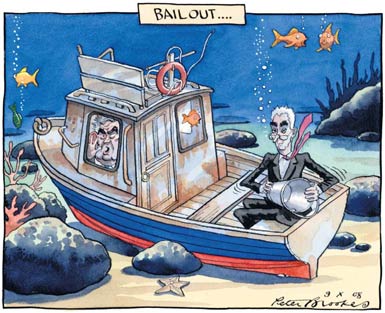
As if everyday life in Pakistan weren’t dispiriting enough, last month the swift and turbulent Indus burst its banks and swathes of the country disappeared under water. Divine punishment, the poor said, but they were the ones who suffered. Allah rarely targets the rich. As the floods came and the country panicked, its president fled the bunker and went on a tour of inspection to France and Britain.
The floodwaters have now receded in many parts of the country, leaving 20 million people homeless. The province of Sindh, however, is still under threat and 800,000 people are marooned without food. Aid agencies estimate the bail-out costs for the country at between seven and ten billion dollars, but only $800 million has been pledged by foreign donors, in total contrast to the support given after the devastating earthquake of 2005. The rebuilt towns and villages are proof that not all the money was stolen that time. But despite this, little help has been forthcoming from abroad, the result of a combination of Islamophobia and distrust of the Zardari government on financial matters.
Did the rulers of Pakistan treat the worst natural disaster to hit their country as an emergency, and pull out all the stops without thinking of themselves or drooling at the prospects of foreign aid pouring in? Like hell they did. For the whole of August the plutocracy floundered hopelessly as the catastrophe grew. The army did its best, but was hindered by the war on terror. As nearly a million people came under threat from the floodwater in Jacobabad, the local authorities were informed that the nearby Shahbaz airbase could not be used for rescue operations. In response to a parliamentary question from the opposition, the health secretary, Khushnood Lashari, explained: ‘Health relief operations are not possible in the flood-affected areas of Jacobabad because the airbase is controlled by the United States.’ It was not necessary to add that those on the base were busy arming and dispatching drones to hit villages in northern Pakistan. In Swat, closer to the AfPak war zones, a detachment of marines was made available to airlift tribal elders to safety, in an attempt presumably to win hearts and minds. Some hope.
While Zardari was inspecting his French chateau...
A disaster of biblical scope: the floods triggered by heavy monsoon rains a month ago have affected more than 17.2 million people and killed over 1,500, according to Pakistan’s disaster management body. August is the monsoon season in Pakistan. This year a hard rain keeps falling, which is why the floodwaters are not abating. Nearly two thousand deaths and over 20 million people are homeless. The man-made disasters – war in Afghanistan, its spillage into Pakistan – are bad enough. Now the country faces its worst ever natural disaster. Most governments would find it difficult to cope, but the current regime is virtually paralyzed.
Over the last sixty years, the ruling elite in the country has never been able to construct a social infrastructure for its people. This is a structural defect that goes deep and affects the bulk of the population adversely. Today the country’s rulers eagerly follow the neoliberal dictates of the IMF, to keep the loans flowing. Not helpful at the best of times they are useless when the country is undergoing its worst humanitarian crisis of recent decades.
IDF Economics: Keynote Speaker Chief of the IDF General Staff, Lt. Gen. Gabi Ashkenazi addressing the audience at the Friends of the IDF 2010 National NY Gala Dinner, where 20 million dollars was raised
About a month ago I wrote an article about a bill proposition to heavily fine initiators and encouragers of a boycott directed at the state of Israel. On Wednesday, I joined a “Non Violence Short Course”. Today a friend posted an article on my Facebook wall [translation of important parts below] about the inflated “security budget”. I’m an activist in Israel, so naturally the boycott, nonviolence and the IDF budget all fall within my interest span. But this morning, as I read this very not-new news article about wining and dining generals, the assumptions tickling at last month’s article were driven home like a punch in the gut: Class war.
If you saw Johann Hari’s widely-circulated indictment of corruption in the conservation movement in The Nation, you should watch his interview from Tuesday’s Democracy Now! With Christine MacDonald, he lays out the real outage in the environmental community — the collusion between several of the largest conservation groups and some of the world’s worst polluters. As he wrote last week:
Groups like Conservation International are among the most trusted “brands” in America, pledged to protect and defend nature. Yet as we confront the biggest ecological crisis in human history, many of the green organizations meant to be leading the fight are busy shoveling up hard cash from the world’s worst polluters–and burying science-based environmentalism in return. Sometimes the corruption is subtle; sometimes it is blatant. In the middle of a swirl of bogus climate scandals trumped up by deniers, here is the real Climategate, waiting to be exposed.
MacDonald, meanwhile, has authored Green, Inc. which similarly exposes the complacency of a number of organizations in the wake of alarming corruption and corporate influence.
After hearing that the Palestine Liberation Organization has decided to abandon a resolution requesting the Human Rights Council to forward Goldstone’s report to the UN Security Council, the thought flashed through my head that if I was Palestinian, I’d vote Hamas. What could have possibly possessed them, but a sheer disconnect from their people? One must ask, is their money that good?
Fatah Vs. Hamas
On many occasions, we that are born free (all is relative) find it hard to understand Palestinian mentality. Just this week, I’ve had exhausting debates about the safety of children, during the Bil’in weekly protest. Though I can’t defend or agree with allowing your children to be near the fence, when the army is 101% likely to fire gas grenades, I firmly believe that mindsets under occupation are something we don’t fully understand. Maybe when I’m a mother to a child that’s been snatched from his bed at night, arrested, beaten and interrogated, I’ll have a different perspective on danger.
By the same token, I believe it may be extraordinarily hard to make that fateful choice, when you’re at the voting booth. Although Hamas has been cynical towards its people during the Gaza massacre (claiming to have “won the war” and other flamboyant rhetoric), as if militaristic ego was a top priority; If I were Palestinian this latest in a long line of PLO sell-outs would seem much more cynical, to me.
Is this where Obama's financial policies are made?
Robert Hormats, Vice Chairman of Goldman Sachs, is to be installed as Under Secretary of Economics, Business, and Agricultural Affairs. This comes as one more, probably unnecessary reminder of the total control exercised by Wall Street over the Obama administration’s economic and financial policy. True, Hormats is “a talker rather than a decider” according to one former White House official, but he will find plenty of old friends used to making decisions, almost all of them uniformly disastrous for the U.S. and global economy.
In an excellent, thorough investigation of the financial crisis in the last issue of the London Review of Books, John Lanchester had presented the scrapping of pensions in the public sector as a worst case scenario. Looks like it has already started to happen in the private sector with Barclays scrapping the pensions of its 17,000 employees. This does not, of course, affect the President Bob Diamond who last year raked in £21 m, nor does it affect the rest of the the 1,500 best paid employees. Here is Lanchester (however, let me warn that this piece is more than 14,000 words long, so you better have a good strong copy of coffee and plenty of free time before diving in; also, I’ve appended a reader’s letter correcting an accounting error made by the author):
It’s a moment of confusion and loathing that most of us have experienced. You’re in a shop. It’s time to pay. You reach for your purse or wallet and take out your last note. Something about it doesn’t feel quite right. It’s the wrong shape or the wrong colour and the design is odd too and the note just doesn’t seem right and . . . By now you’ve realised: oh shit! It’s the dreaded Scottish banknote! Tentatively, shyly – or briskly, brazenly, according to character – you proffer the note. One of three things then happens. If you’re lucky, the tradesperson takes the note without demur. Unusual, but it does sometimes happen. If you’re less lucky, he or she takes the note with all the good grace of someone accepting delivery of a four-week-dead haddock. If you’re less lucky still, he or she will flatly refuse your money. And here’s the really annoying part: he or she would be well within his or her rights, because Scottish banknotes are not legal tender. ‘Legal tender’ is defined as any financial instrument which cannot be refused in settlement of a debt. Bank of England notes are legal tender in England and Wales, and Bank of England coins are legal tender throughout the UK, but no paper currency is. The bizarre fact of the matter is that Scottish banknotes are promissory notes, with the same legal status as cheques and debit cards.
These feared and despised instruments, whose history has long been of interest to economists, come in three varieties from three issuing banks: the Bank of Scotland, the Royal Bank of Scotland and the Clydesdale Bank. Small countries with big ambitions but few natural resources need ingenious banking systems. The history of the Netherlands, Venice, Florence and Scotland show this – and so does the tragic recent story of Iceland. ‘In the 17th century, when English and European commerce was expanding by leaps and bounds,’ James Buchan wrote in Frozen Desire, ‘the best Scots minds felt acutely the shortage of . . . what we’d now call working capital; and Scots promoters were at the forefront of banking schemes in both London and Edinburgh, culminating in the foundation of the Bank of England in 1694 and the Bank of Scotland in 1695.’ The powers down south, however, came to think – or pretended to think – that the Bank of Scotland was too close to the Jacobites, and so in 1727 friends of prime minister Walpole set up the Royal Bank of Scotland.
There’s something very odd going on with the British political system when the Chancellor of the Exchequer can lose his job over less than £700 whilst billions are squandered on illegal wars, nuclear missiles, corporate subsidies and bailouts. George Monbiot’s latest piece on Znet uncovers the massive corruption behind the M25 project. It is but one of many examples of the way the political system is designed to ensure the socialisation of risk and privatisation of profit.
It’s a thousand times bigger than the one we’re talking about, so why doesn’t it ignite public anger?
For a moment, my heart leapt. The headline on the front of yesterday’s Daily Mail contained the words travel, scandal, extortionate and £6.2. I imagined, until I read it properly, that it referred to the £6.2bn contract to expand the M25 motorway, which has just been signed. Some hope. “The £6.2m bill: Scandal of how MPs are taking taxpayers for a ride with extortionate travel expenses” referred to a rip-off precisely 1000th of the size of the travel expenses scandal that interests me.
I understand the public anger and fascination about MPs’ expenses, and the burning question of whether you can obtain capital gains tax exemption on your second duck house. But it is microscopic by comparison to the corruption that has been bubbling along merrily for 15 years in the UK, unmolested by the tabloid press.
 The Wikileaks confirm what we already know about Af-Pak. Pakistan is a US satrapy: its military and political leaders constitute a venal elite happy to kill and maim its people at the behest of a foreign power. The US proconsul in Islamabad, Anne Patterson, emerges as a shrewd diplomat, repeatedly warning her country of the consequences in Pakistan if they carry on as before. Amusing but hardly a surprise is Zardari reassuring the US that if he were assassinated his sister, Faryal Talpur, would replace him and all would continue as before. Always nice to know that the country is regarded by its ruler as a personal fiefdom.
 As if everyday life in Pakistan weren’t dispiriting enough, last month the swift and turbulent Indus burst its banks and swathes of the country disappeared under water. Divine punishment, the poor said, but they were the ones who suffered. Allah rarely targets the rich. As the floods came and the country panicked, its president fled the bunker and went on a tour of inspection to France and Britain.


 After hearing that the Palestine Liberation Organization has decided to abandon a resolution requesting the Human Rights Council to forward Goldstone’s report to the UN Security Council, the thought flashed through my head that if I was Palestinian, I’d vote Hamas. What could have possibly possessed them, but a sheer disconnect from their people? One must ask, is their money that good?

 P U L S E